
Mark Schmidt
June 2025
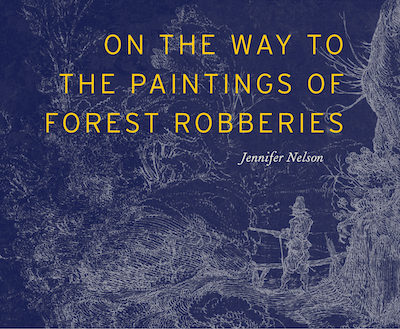
Jennifer Nelson
On the Way to the Paintings of Forest Robberies
Fence Books, 2025
The gap between visual art and literature is either illusory or fictional, depending on which side your allegiance lies. Jennifer Nelson’s On the Way to the Paintings of Forest Robberies (2025) is an ekphrastic triptych which attempts, however non-systematically, to bridge that gap. The balance found in the book’s overarching form (three “panels,” or sections of poetry) and content (increasingly more ekphrastic poetry toward the middle) is undercut by the individual poems themselves, which often humorously defy expectations; in a refreshing twist, the humor is far from the usual dismissive irony of millennial nihilism, instead offering something closer to the relief of catharsis.
This doesn’t mean Nelson’s work is unbothered by mortality or omnicide, far from it. The first of three sections, “Tenure Dossier,” is deeply concerned with nature, especially bodies and what it means to lack one. Ghosts regularly float through the poems, haunting every page with what might have been but will never be. The traumatic repetition of missed chances seems like an accurate description of our failure to respond to environmental crises, a trauma which we’re all guilty of using art to escape. Though nature is omnipresent in these early poems, it’s pushed to the background, resulting in a fragmentary, window-framed experience. Like looking out a window at night with the house lights on, we see more of our own reflection than the nature right outside.
The longer we travel through the forest of this first section, the more idioms come to mind; “missing the forest for the trees” feels the most apropos, given that that’s how most nature poetry feels: poets tend to use nature as a convenient raw material for either divinization or for trivialization. Nelson’s poetry does neither, instead resting amidst the tension we feel toward nature. This tension is tempered by understated humor like including formal academic documents as titles for poems, e.g. “Statement of Future Research Plans” and “Optional Statement on ‘Engaging with Diverse Communities.’” Despite these titles, the poems are much more poetic and ultimately of much more import than the bureaucratic minutia they’re named after. The humor, rather than undercutting the seriousness of the poems, instead forces us readers to ask ourselves whether we must laugh at oblivion despite feeling like endlings.
The longest poem of the first section is also the first major ekphrastic poem, based upon the Boxer Codex. Written during the 1590s but rediscovered during the 1950s, this early colonial book telescopes the distance between the two time periods (its composition and its rediscovery), challenging how much has really changed in the 400 or so years between them. The (re)discovery of the text itself also parallels the (re)discovery of the “new world,” lands which certainly felt “old” to the original inhabitants. Nelson focuses not only on the art from this codex, but also its sparse captions, among which are terms like ladrones (“thieves”), and other names for the indigenous peoples described therein. As Derrida points out, language and its effects persist in the radical absence of the sender, and this codex is certainly no exception.
Following the triptych layout of the collection, the second section is in some ways the main focus, having the most references to artworks. Certain ekphrastic poems more explicitly treat their subject, while others are only barely relate to the art in the title. Those which do treat the artwork more straightforwardly tend toward poetic summary rather than taking inspiration from the work (e.g. “The Last Supper, Designed by Bernaert van Orley, at the Met”). Some of the poems address art more generally (“Fontispiece”), while others continue the environmental anxiety from the previous section, especially “Don’t Kill Yourself.” Possibly the tensest poem of the collection, it shows us how the only thing separating “horror” from “humor” is a few pixels. The poem delicately balances between the hope of “I swore I would always see beauty in the garbage” and the despair of “I / will kill myself, rather than touch the world / and feel my constant harm on it” (51). The ethical question Nelson seems to be wrestling with is how to justify losing yourself in fine art while the world burns. One possible justification is that both poetry and art history require a keen eye for details, and it’s only by close observation that one can see what needs to be seen, not just what is obvious.
It was precisely in those quietest and most minute moments when Nelson’s poetry felt strongest. For example, the lines “hard to see / whether the break in the clouds is just / expensive paper” (63) bring into consciousness the sorts of questions non-experts would never even think to think. Though Nelson clearly enjoys early modern art, her enjoyment isn’t merely straightforward and approving, especially when it comes to its religious aspect. The text which follows the above quote lays out some sense of the tension she must feel: “How many people on the shore / want to be misled, want a strong / voice to take strong teeth and wrap a wet mouth over them? Not // Christ. It’s mainly the painter who believes…in the power of transmission: but / without exception in time / iconography turns into grief, recognition into desire / to decipher.” Earlier in the second section she writes, “Scholars misinterpret / images for a living, call them / worlds, a synechdoche / based on faith in the moment / of creation” (48). These poems repeatedly link faith and artistic creation; both must simultaneously coexist for the splotches and shadows to magically transform into what we call art; or, put another way, anticipation precedes recognition.
The final section, “Primordial Tide Pool,” is the most explicitly humorous, as one might guess from the title. The second poem in particular, “Self Portrait in a Primordial Tide Pool,” comes across as surrealistic and even at times uses meme language (“I’M A SHIP OF THESEUS / STAN,” 69). This threatens to undermine the otherwise delicate balance between humor and horror that the rest of the collection had carefully curated, but ultimately its tone returns to the tone of the first section, once again concerned with ghosts, empire, and technology. In fact, the ghosts seem to summarize the many anxieties of the rest of the book, including the danger of attempts at universal truth, the power of institutions, and the long-lasting ramifications of colonization.
The titular poem pushes back against this anxiety, however, using the lesson learned from art about “belief,” broadly understood: “Believing we can listen / can be the closest thing / to listening, and change / life” (86). In the second, most ekphrastic section, Nelson subverts the notion of belief in a traditional sense, aiming a broadside simultaneously at the audience and at the painting of Christ she’s responding to: “since if you channel God / no one will be happy, / since you aren’t God, but a person, / and persons require freight” (54). Instead of an orthodox or even heterodox understanding of the concept, her appeal to belief acknowledges the gap which must be bridged between the self and the other, between the art and the viewer, and even between the art and the artist. These gaps, rather than being the problem, might just be the solution, if we would simply let them.
For more info on Jennifer Nelson’s On the Way to the Paintings of Forest Robberies →
◊
Mark Schmidt is an Adjunct Instructor of English at the University of South Dakota, where he graduated from in May 2024 with a Master’s in English. He has critical and creative work published or forthcoming in the Journal of the Midwest Modern Language Association, Middle West Review, Ecokritike, i19: The Incredible Nineteenth Century, Mantis, Red Coyote, and elsewhere.