
Arielle Burgdorf
August 2025
trying to sneak one form into another
An Interview with traducciones trepidantes
In the pages of a zine, visual artist and educator Luisa Martínez translates “traducciones trepidantes” as: trembling translations. More commonly in Spanish, trepidante means breakneck, thrilling, fast-paced. But trembling is a good fit in this case—trembling in the sense of fear, sure, but also trembling like earthquakes, like tremors hinting at seismic shifts just below the surface. It’s an appropriate name for a group concerned with shaking up the landscape of translation.
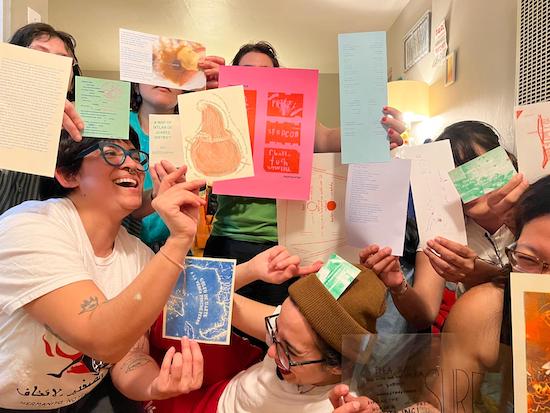
I first discovered the collective traducciones trepidantes on Instagram. Their page features colorful photos of young people working on a fanzine of many languages together, each page or section a complete world unto itself, order made fully mutable through the act of removing the binder clip holding the whole thing together. In the hot pink centerfold of the zine, they write:
The objects offered in this zine were birthed from a collaboration between writers and
artists living in san diego and tijuana, engaging in a series of looping translation
exercises in which we trans(lated)formed each other’s work. The emerging creations push
against the divisions between borders, languages, forms, the theoretical division of the
original and translation.
At a crooked angle on the same page they offer a second definition: Una desilustracion funcional y alucinante de la traducción. This reminded me of something I heard recently in a recording of the Irish critic and writer Maria Fusco, talking about the Catholic concept of transubstantiation as, “a very deeply-embodied, belly-holding sense of metaphor…where one thing may be the other.” Through the power of language, movement, and magical transformation, one thing may be the other. This, to me, is one definition of translation.
The zine left me curious to know more about the group, their translation practice, and who they are. I was grateful when traducciones trepidantes agreed to speak to me about their work, which, as you will see, is ever-evolving and influenced by the cumulative interests and abilities of its members. The members spoke to the importance of getting to know one another, sharing food and ideas, and making art without a preconceived goal in mind. They share a visionary and capacious view of translation that includes embodied action, play, and art. They understand translation as a collective experience that can drastically restructure how we think of boundaries, relationships, and language. There is something incredibly exciting to me about the openings traducciones trepidantes create by thinking about “translation as creative transformation” as translator Barbara Godard once wrote.
Of course, the idea of a translation collective is not new. As long as there has been a need for translation, translators have banded together in solidarity. A few of the more well-known ones include the now-defunct Antena Aire, “a flexible vehicle for work at the intersection of language justice and language experimentation,” the Third Coast Translator’s collective, “an international community of literary translators,” as well as Colaboratorio Ávila, “Taller transatlántico de traductoras venezolanas y venezolanistas.” There are also micro-collaborations such as the translation duo, cocoruto, made up of Jess Oliveira and bruna “mercúrio” barros. They write: “Our critical-creative practice of translating (oral and written texts, within the African Diaspora) is a kind of dance, known so well by Black people navigating this world.” Like these groups, traducciones trepidantes are imagining their own definitions of translation specific to the needs of their members and their presence on both sides of the border wall separating California and Mexico.
The collective began as a series of workshops / talleres starting on January 19th, 2025. So far, there have been five workshops, alternating between San Diego and Tijuana, rotating host spaces like “Burn All Books” and the “Ediciones Caradura Cafeteøría”, utilizing both in-person and online participation. These workshops are free, multilingual, and open to anyone. Most of the workshops are centered on different forms of art such as dance, painting, or music. While the workshops and fanzine are significant achievements in their own right, it’s clear that they are just getting started.
What follows is a condensed conversation between myself and some members of traducciones trepidantes who include: Julia Kott (jk), Yasmin Rojas (yr), Karlox Kalimax (kk), Valente Herrera (vh), and Nilufar Karimi (nk). In a society where literary translation projects often collapse due to lack of funding, copyright restrictions, or a perceived lack of interest, traducciones trepidantes are doing it anyway, without permission from any superiors. Translators, students, teachers, artists,writers, publishers, readers—all of us stand to learn a lot from the way they see the world.
How did the collective begin?
jk: It was about starting the kind of workshops we wanted to take, and approaching friends about structuring a series of workshops.
nk: The bad workshops I’d been to talked about translation as isolated, extractive, separate from friendship. Translation theory can be outdated and doesn’t take relationships into consideration, it considers the political as a person.
kk: [la inspiración] fueron las palabras, los dibujos, buscamos cómo decir sentimientos, convertir en multi lenguaje las personas, las ideas.
nb: Karlox further explains that the “palabras dibujos” borrows from the Spanish translation of the 2014 book Speculative Drawing [Dibujo especulativo] by the Austrian philosopher, Armen Avanessian, and the German illustrator Andreas Töpfer.
yr: When I first joined I was really happy, I didn’t feel the pressure [of academia]. Everyone was helping each other and it was interesting to see all the experimentation, everyone has their own style. I still need to brush off some of the academy stuff, but I’m learning a lot with this group.
vh: Fue maravilloso encontrar este espacio de traducción, una gran sorpresa practicar un método artístico sin un objetivo final, compartir nuestros imaginarios.
Tell us about some of your workshops.
jk: Ana Villalpando and Luisa Martínez planned the art workshop held at a gallery in San Ysidro [just over the US border from Mexico]. Everyone had to walk around and pick an artwork from the gallery to recreate. It was about a deeper way of understanding art, translation as a mode of engaging, or seeing closely an object or text you’re translating. [At the end of the workshop] you understand a piece really differently than when you first see it.
nk: We are thinking about the body in a lot of workshops, [creating] activities related to the body, where participants are physically moving north or south on a page that has text on it. [Then (in a different workshop, also led by Ana and Luisa) participants] came up with a word that your body was communicating and cut the word up, so that you were working with another word, and combining your word with someone else’s word, and then making a cyanotype of the two words—so there was no original.
jk: Karlox had an idea for our movement workshop where we would trace a particular body part of a person as they moved to create a kind of constellation of their movements, and it was something that we started practicing in our workshop with Tania Rentería.
kk: Constelaciones exótericas que son diseñadas por nuestros cuerpos en movimiento y en contacto con otros cuerpos. nodos-estrellas que al señalar noslos (por ejemplo, en el centro de nuestro palma de la mano) nos sugieran trayectos como las estrellas. Así formando unas nuevas-otras constelaciones hechas con nuestro cuerpo y así generar reflexiones y proponiendo otras cartas astrales con otras características tal vez más propias de nosotrxs mismxs.
What is the philosophy behind traducciones trepidantes?
kk: No hay una filosofía, el colectivo está naciendo. Es demasiado temprano, y todos todavía están decidiendo lo que quieren que sea, es un laboratorio, un aula.
vh: Traducirnos estilos, colores, lenguajes. Descubrir otrosros mundos descobarnos. Resistir para lenguaje.
jk: Translation as not just a movement across the border in one direction from english to spanish, but recursive, contra la idea de un original. Translation can be a gift, a comment, a response that the work can react to.
nk: Translation as blurriness, something that can’t be captured in a legible way, constantly moving, trying to sneak one form into another.
yr: Refugio, amistad, y amor.
living translations that are still in motion. some are oozing, cursing, edible, in invisible ink, some half geographical mapping and time itself, some can hold water in addition to words, others invite you to complete/continue them
translating was a way of learning and moving and taking care, not a transfer of information or a “bridge” that isolates one language from another, one thought from another, but a threading.
Can you talk about the experience of operating a translation collective at the border?
kk: A lot of people don’t know what is going on at the border. La frontera es horrible.
vh: La frontera es tan presente, it’s very difficult for everyone with the racism and discrimination. But when everyone’s voices are united, not individuals, but as a collective, it’s a form of protection.
jk: Part of what we do involves giving rides to members so that people spend time and have the experience of the border crossing together. [But] not everyone in the collective is able to cross, so we also hold workshops online.
yr: Writing is borderless; our words are traveling even if members can’t. We are going around the border by taking poems and literature to other places.
What lies ahead for traducciones trepidantes?
everyone: We have lots of ideas of projects but for now nothing super concretely planned, these include: we want to publish another zine, work more formally with writers in the region and translate longer texts together, continue to host workshops, and we’ve also thought about getting more involved in translation / interpretation volunteer work. We have hopes also of working on cinepoemas, of having a beading workshop, continuing to experiment with cyanotype and language.
Sections in italics are taken from the traducciones trepidantes fanzine and Instagram.
traducciones trepidantes on Instagram →
Arielle Burgdorf is a writer and literary translator from French. They are the author of the novel Prétend (End of the Line Press, 2024) and the UK edition Jeanne (Moist Books, 2025). Their writing and translations have been published in Lambda Literary, Electric Literature, Worms, Amsterdam Review, Full Stop, and elsewhere.