
Sally Jane Brown
November 2025
Immersing myself in Sharon Lopez Mooney’s poetry collection, CANTATA for a desert poet, Arteidolia Press, I found myself pondering a timeless adage. Jon Kabat-Zinn’s seminal work, “Wherever You Go, There You Are,” posits that happiness resides within oneself, independent of external circumstances. However, through the poignant verses dedicated to Mohamed Abdulsalam Khalili “Salam,” Mooney challenges this notion, offering a profound exploration of the human experience.
As a Palestinian journalist, painter, poet, and peace activist, Khalili’s life was marked by adversity. Imprisoned, tortured, and ultimately exiled to California for daring to expose the truth behind the Six-Day War, Khalili grappled with the relentless ache of displacement and yearning for home. Mooney’s evocative prose captures his anguish, prompting a profound contemplation: was Khalili’s unhappiness rooted in his physical displacement, or did it stem from the unyielding unrest of his homeland? Perhaps, it was both—a haunting duality that pervaded his existence.
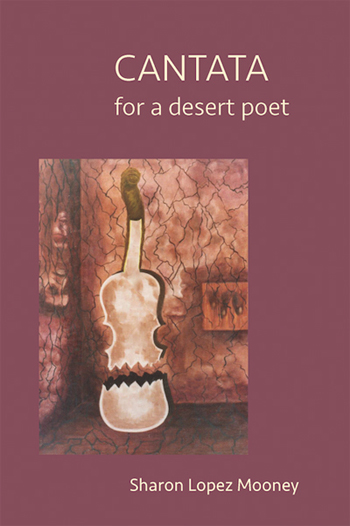
Despite the destruction of much of Khalili’s creative output, Mooney artfully preserves his legacy using his poignant painting for the cover—an arresting depiction of a broken guitar against a backdrop of cracked walls, symbolic of his fractured reality. Intertwining Khalili’s verses throughout the narrative, Mooney paints a vivid portrait of a man torn between past and present, longing and loss.
Structured in three sections, Mooney guides us through Khalili’s journey cleverly, blending moments of profound sorrow with glimpses of fleeting joy. Each poem, each line, pulsates with raw emotion, inviting readers to immerse themselves in Khalili’s world of contradictions and complexities.
In CANTATA, Mooney does more than recount Khalili’s tale; she invites us to bear witness to his unyielding spirit, his unwavering devotion to his homeland, and his relentless pursuit of peace. Through her eloquent prose, Mooney bridges the chasm between distant lands, infusing Khalili’s story with universal resonance and timeless relevance.
As I reluctantly closed the final pages of CANTATA, readers will feel profoundly moved by Khalili’s journey. Though he may have departed this world a broken-hearted exile, Mooney ensures that his legacy endures—a testament to the enduring power of art to transcend borders, unite hearts, and illuminate even the darkest of paths.
For more info on Sharon Lopez Mooney’s Cantata for a desert poet →
◊ ◊ ◊
Sally Brown is an artist, curator and writer currently based in Morgantown, West Virginia. Her artwork—including drawing, painting, and performance—explores womanhood, motherhood, and the body. Sally has exhibited her work in spaces nationally and in the United Kingdom. She has won two awards for illustration for Intimates and Fools and Leaves of Absence, both with poetry by Laura Madeline Wiseman. She also illustrated What We Do in the Hollows, with poetry by Renée K. Nicholson. Her writing has been published in Hyperallergic, Women’s Art Journal, and Artslant, among others. Visit Sally Brown’s website:sallyjanebrown.com