
Pria Louka
November 2025
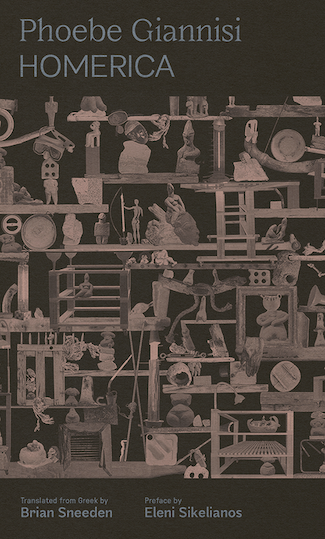
Phoebe Giannisi’s Homerica
Translated from Greek by
Brian Sneeden
World Poetry Books, 2025
Episodic, fragmentary, yet entirely cohesive — steeped in Homeric epic yet rooted in the present — Phoebe Giannisi’s Homerica offers a shattering of canonical epic, symbolically grounded in myth-history yet ultimately drifting beyond time itself. A pliable, atmospheric re-envisioning — a light, loosely fitted, transparent yet palpable gauze of Homer that “covers it all” — Iliad, Odyssey — yet shimmers beyond, rendered simply and evocatively in the present, in a language of today.
Originally published in Greek in 2009 and first rendered into English in 2017 by the pioneering World Poetry Books, Brian Sneeden’s luminous translation now returns in a forthcoming second edition (Fall 2025), complete with a new translator’s note and a preface by poet Eleni Sikelianos.
Homeric voices — from women to gods, to goddesses, to the anonymous: Penelope, Aphrodite, Hermes, Patroclus, “The Ravenous,” the Lotus-Eaters — interweave as invocations that speak personally yet collectively, dazedly resurrected. Penelope — the devoted wife of Odysseus, who waits twenty years for his return to Ithaca — swims laps in the pool:
up and down
the same circuit again and again
Neglecting the laundry, she wears her children’s outgrown, dirty clothes to hold onto their bodily odors — their presences — as they outgrow her too:
perhaps she’s trying to save money on the laundry
or does the charm work
only if
it retains from the body
the strongest
traces
of our secreted smells?
“What I love dearly about Giannisi’s poetry,” Sneeden writes, “is how the body vessels history and myth, and when the senses return us to the present moment, we recognize its depths. It is here that is speaking.”
Scents and aromas — thyme, angelica flowers, sea tamarisk — waft from poem to poem, grounding us in a here, then, and there, all at once. Sensory and emotional registers trigger one another, oscillating from the exotic immediacy of the “here and now” to an aching pull toward “over there,” toward home (nostos). Yearning and presence alternate throughout the collection: the heart, lured by the sheer magnitude of the sea, aches for home in awareness of that insurpassable expanse:
the seagull takes the measurement of your wings
the sea calls you
but you do not want it
you ache at its magnitude
Another visceral ache is rendered through the pained voice of a naïve, modern-day Nausicaa: a deceptively uttered “I love you” — spoken by a lover past, repeated endlessly within her — which she clings to still, her ultimate lifeline in solitude:
I should have left behind only
my smell on the things and words
on the sound of the Earth spinning
night and day
night and day
on the axis of its solitary column
“I love you — forever — yours.”
Sneeden’s translator’s note illuminates the fascinating challenges of translation while tracing etymologies and unpacking startling images and metaphors. One striking example: Giannisi’s simile likening the dynamic motion of a wave to the way Greek fishers kill octopuses — by turning their heads inside out — which Sneeden reveals as imbued with “texture of intelligence and pain.”
Giannisi’s original is, in a way, a loose (or free) translation of Homer (encoded in the -ica of Homerica) — a dance around a core (Homer), pulled by the invisible tug of deep roots and pushed beyond by the lure of new skies. Sneeden performs this devotional dance of translation with acute musical awareness, ease, and grace, capturing the cascading cadences of the originals and transmuting their resonance into sonic zigzags across the text, rendering each piece in English a bright, echoing chamber.
a spider weaving its web
before it finishes after it starts over again
and again the motions together with secretions
We find ourselves Penelope or Patroclus, reminded that we are eternal lovers and heroes of the moment — worthy of inclusion in an ageless epic, simply because of what we feel, and the dimensions of that feeling, “between silence and silence.” What is deeply human now was just as present in the Homeric past — three thousand years ago, and even before then — and will continue to be.
World Poetry’s Homerica is a deep pleasure to hold and read: a tangible yet ethereal, lithe keepsake of Greece’s atmosphere, a poetic experience seeping naturally into the eternal — beyond Greece and beyond the boundaries of the word itself:
here the bend of the eternal recurrence submission
there in the calm the dolphin swimming
and listening to the last voice
of a cicada up a tree
For more info on Phoebe Giannisi’s Homerica from World Poetry Books →
Pria Louka is a poet and translator. Her recent translation of Greek Modernist poet George Sarantaris, Abyss and Song, was published by World Poetry Books (2023). Her work has been featured in Asymptote, Caesura, Circumference, and Mantis, as well as in several Greek literary journals. A recipient of a Fulbright Fellowship and a recent Ertegun Scholar at the University of Oxford, she currently lives in Athens, Greece.