
Arteidolia
January 2026
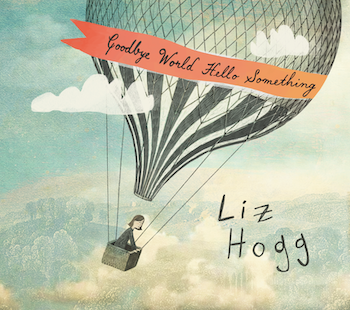
Goodbye World Hello Something
Liz Hogg
Aagoo Records, 2025
Arteidolia: In listening to Goodbye World Hello Something, your 2nd solo album, I can hear a unique spark in all your songs. I checked out the video you did for Irreversible, and the dynamics between the words, visuals & sound are really striking. I see that you worked with Bas Mantel on this. Can you tell us about how it all came together and your ideas behind it?
Liz: Bas Mantel is a friend of Alec Dartley, the owner of Aagoo Records. I asked Alec if he had any ideas for the video and so he contacted Bas. Here are Bas’ words on it: “It’s a journey of love through space, where the universe unfolds and time and space are irreversible.The stop-motion technique, cut and paste, layering, and movement often intertwine with the music.” I really let him do whatever he wanted to do, and didn’t play a collaborative role in the video. I did give him my OK when it was almost done and helped contribute ideas regarding the credits, but it was really Bas’ vision.
Arteidolia: I read that, from an archive of almost 300 song “kernels”, you chose the song ideas for Goodbye World Hello Something and each was completed in two sessions to ensure that “a purer message was transmitted.” I know that every composer/singer-songwriter has their own creative process, so I’m interested to hear about yours.
Liz: Since around the age of 14, I’ve been recording little musical ideas to turn into songs. I’ve used a handful of those ideas for songs on Beach Arabs’ Under The Whale (2010) & Wild Movement (2012), as well as my first S/T solo album (2018). But it wasn’t until 2023 that I organized them all into one folder of audio files. Previously, they were scattered on different cassette tapes, some CDs, videos on my phone, logic or GarageBand files, etc. Once I had them all in one place and audio format, I listened to each and categorized each file (what I call kernels) based on instrumentation and recording method. I also did not include the 10 or so previously recorded kernels that had already been turned into songs on the 3 earlier albums mentioned. This led to a total of 7 folders containing 283 kernels total. My long term plan is to develop each kernel into songs. For this album, I started off with the first folder, Acoustic Digital, and the 1st 10 in that folder were the kernels that created the 10 songs on the album.
I chose the 2 day songwriting process mostly inspired by how quickly the Beatles wrote all their songs, especially the early ones. Considering they’re the greatest band ever, I said I had to try to find a way to take a cue from that method. So I tried it and like doing it that way. I would spend the first session pinning down the song form and the drums, as well as at least 2 guitar parts and the underlying harmony for 2 of the main sections. I then worked on vocal parts.
The second session was devoted to finalizing the lyrics and vocals as well as the bass, keyboards, if any, and adding all details such as little changes to make the 2nd verse different than the 1st, etc.
Once a demo was done, I’d e-mail it to Carlos Truly (producer/bass player) & Daniel Siles (drums). We only had one band practice and that was only when the first 3 songs had been demoed, so I made sure the demos were as precise as possible, and since they are both total professionals, Daniel executed all the drum parts in one 8 hour session, and Carlos was able to do his parts at home, from demos, or sometimes just written descriptions I’d give him because for some of the songs, I wanted to hear the finalized version without bass to decide exactly what the bass would do. Once Carlos finished recording bass, all the mixing, and the editing, all of which (aside from one final in-person mixing session) was done remotely, I sent it to Amar Lal for mastering and he had a quick turnaround.
Arteidolia: Putting together a recording can definitely be a challenging adventure, but you seem to really have the process down. Liz, I see that you’ve done a lot of touring, 26 countries across four continents. What were some of your favorite spots, audiences and performances?
Liz: Performing at Casa da Música in Porto, Portugal when I was 20 in 2014 was really fun. It was my first time traveling across the ocean by myself and my longest time away from home (about 2 months) up to that point. It was a large and friendly crowd and a great way to start off that tour. It was also exciting to finally play SXSW in Austin, TX back in 2023.
Another highlight was a gig from my first time in Asia in 2019, where I did a Japan tour. In Hiroshima, the venue was accessible only via boat and it was just this 1 guy who didn’t speak a word of English and his little wooden boat I met on a pier. I couldn’t speak any Japanese and had to trust that he was taking me to the right place and safely; any kind of communication was futile. The venue itself was also very interesting architecturally and for its programming history. And it was a good show.
A few early shows I hosted and played in my childhood home’s basement as a teenager were also somewhat legendary, including pool parties and bands that became pretty well known.
Other than that, it’s always nice to play big, famous and iconic venues, so highlights in that category are Carnegie Hall & Lincoln Center.
Arteidiolia: Performing. Touring. Local & worldwide. Sounds like you’ve had some very cool experiences. I know you play both classical and indie-rock music. Totally different directions. How did you get involved with each?
I was born in Brooklyn in the 90s, with no musicians or artists to speak of in my family. So I was drawn to whatever music I had around me, which was stoop party music Dominican neighbors had on my block until it got very gentrified, Z100 played on car rides to and from school and at my summer day camp bus rides, and, before I started collecting my own CDs from the age of 8, the CDs my parents already owned, a quick list which includes: the Beatles, Beach Boys, Burl Ives, my mom a ton of jazz, and stuff like that. Classical music was heard more around the holiday season, and while I loved the annual Nutcracker my parents usually took me to at Lincoln Center, and was lucky to go to a lot of ballet, modern dance, NY Phil, etc. which employed classical music. I really didn’t get into it until late high school/early college as a listener.
I took piano lessons from age 9-13 and got as far as Clementi sonatinas and Bach inventions and enjoyed that, but at age 13, around the time I decided I wanted to be a musician full-time, I was still just enmeshed with rock/pop music, and my goal was to start writing songs and perform them with a band as soon as possible. I did that throughout high school, playing in various bands, and when it was time to go to college, I was undecided for a while on whether to study music, but in the end, decided to go that route. I chose classical guitar because I’m not big on jazz guitar or jazz in general (with notable exceptions). I’ve also always liked music theory and took as much as I could of that in high school. Once I started, I went in all the way and am just as committed as ever.
Arteidolia: Yes, I can hear your dedication, love, and creative energy in what you do. Goodbye World Hello Something. Great title. What’s the story behind it?
Liz: The story stems from my, maybe typical, teenage goal to never have a job. By that, I mean a “real job.” I just wanted to be a musician, on my own terms. Which has basically nothing to do with money. And turning 18, feeling the walls close in, bills and reality starting to seep into my internal world that up to then could run mostly on fantasies and god knows, was hard for me. But once I decided it was indeed necessary to enter the real world, I went all in and worked very hard until I was almost 30. At which point I had saved and hustled enough to step back, take a look at everything, and decide, based on what I really wanted, how to proceed. This is when I was finally able to say “Goodbye World” again. That’s the original meaning of the title.
Calling it Goodbye World however sounded emo or even suicidal to some people. Which I could see. So I was quickly convinced to change it. That’s when I thought a little more and compromised with the understanding that, saying goodbye to anything, as long as you are still alive, is inevitably saying hello to something else. Because there’s always something.
Lastly, it also relates to heartbreak because love can take over one’s entire world, so when you say goodbye to that, the only thing that can fill it at first is something completely foreign, that is “something” because you don’t even know what it is. For a while I really didn’t want it to be “Something.” I wanted to decide on a real noun but couldn’t find a satisfactory noun, so I settled on Something and grew to like it.
You can listen to Goodbye World Hello Something on Soundcloud →