
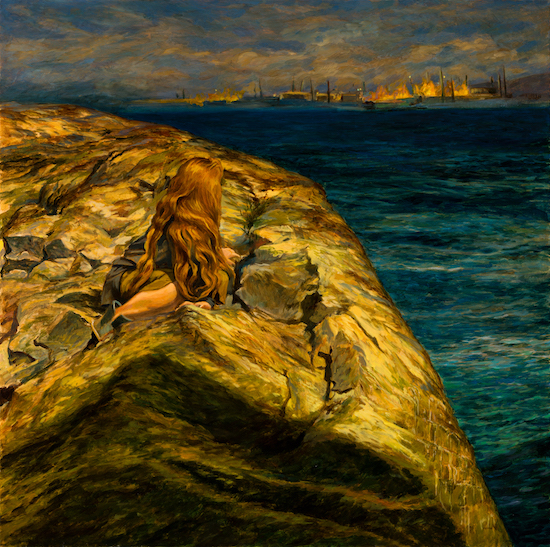
 Untitled from “The Edges” series, oil on canvas, 100 x 100 cm, 2025
Amirhossein Bayani in conversation with Ayda Roozbayani, October 15, 2025
Amirhossein Bayani: In nearly all of the bodies of work I’ve seen from you in recent years, there seems to be a recurring reference to a boundary or an edge. At times, this boundary relates to the outskirts of the city, or to the border between two entities; and in your most recent series, which was exhibited at Saray Gallery, you explicitly addressed the notion of the boundary/edge itself.
Ayda Roozbayani: The concept of the edge or boundary is one of the fundamental notions in philosophy and has been examined repeatedly across various fields such as ontology, politics, and art. One of the most compelling and influential articulations of this concept I encountered in the writings of Hegel, where he states that a boundary is not fixed, but that every boundary simultaneously contains within itself the possibility of crossing beyond itself. This Hegelian understanding of the boundary has had a profound impact on me.
Amirhossein Bayani: In recent years, particularly in light of the political events currently unfolding around the world, we have repeatedly experienced this lived reality of the boundary. What is especially interesting is that this concept has always presented its own specific challenges within the form of painting itself, to the extent that one could say there is almost no artist engaged in the process of image making who does not, in some way, confront the question of the edge.
Ayda Roozbayani: For a long time, I searched for the concept of the edge in the works of painters throughout art history. When you examine artworks from this perspective, you realize that each painter has a distinct visual signature in the way they employ the edge. One of the most precise and inspiring examples for me is Rembrandt, an artist who, with extraordinary intelligence, carries out complex and at times astonishing engagements with the concept of the edge.
Amirhossein Bayani: I have seen almost all of the bodies of work you have created up close, from the piece that won first place at the 2016 23th Youth Visual Arts Festival to the solo and group exhibitions you have held over the years. What has struck me as interesting is that in the early years, your approach to the image was much more action-driven and accompanied by a higher degree of expressivity. However, as time has passed, this intensity has lessened and the shift in tone has gradually become more noticeable, to the point that in your recent series, the spaces feel calmer and the treatments appear more precise and detailed. I know that the art community has responded positively to this change and that you have achieved strong sales in recent years, but my question is whether this evolution in your work has developed naturally and gradually, or if it has been a conscious move with consideration of the art market.
Ayda Roozbayani: As you mentioned, fortunately my works have been well received, bringing significant achievements both economically and professionally. This path has enabled me to participate in international events, including art fairs. Alongside the proposals and collaborations I have had in Iran, I have also received offers from one or two galleries in the Europe. I am currently in discussions with them, and both sides are interested in establishing a serious and long-term collaboration. Part of this development reflects the gradual change in my perspective on the world. Previously, I liked to construct a landscape with large and fragmented strokes, but over time what gives me a better feeling in the painting process is creating a form out of a multitude of strokes and marks. Up close, these strokes resemble forms that intertwine, but when viewed from a certain distance, they achieve a unity, and their collective effect forms a cohesive overall shape. This shift in tone is even more evident in my sketchbooks and colored pencil works, yet generally, this evolution has developed gradually in my work, and one can trace its formation across a series of pieces over the years. In fact, this change was never entirely deliberate or pre-planned, as even the works you mentioned, including the 2016 festival piece and similar examples, achieved strong sales at the time.
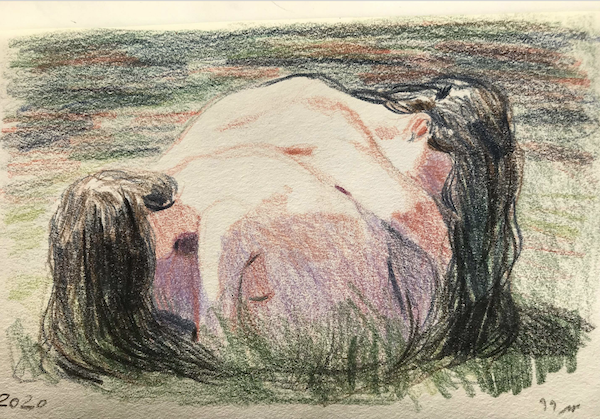 Untitled, 15×20 cm, colored pencil on paper, 2020
Amirhossein Bayani: In your remarks, you referred to the colored pencil series and sketchbooks. A significant portion of your work is dedicated to these sketchbooks. I believe that at one of your exhibitions in previous years, I saw and flipped through one of these sketchbooks up close. The predominant technique in these works is usually colored pencil, and as I reviewed them, I realized that a large part of these pieces traces back to family photographs and portraits.
Ayda Roozbayani: Yes, the sketchbooks were exhibited in all three episodes of the “In the Middle” series. My sketchbook is almost always with me and whenever I have the opportunity I start drawing. Some of these portraits are of my friends while others are of people I have drawn in the city metro. In fact, under the pretext of drawing I would constantly travel along the metro lines. Another portion of these works comes from a period when I visited a nursing home and while listening to the life stories of the residents I would draw them. This experience was both very enjoyable for me and in a way felt like a social responsibility. The family photographs were mostly selected from old family and acquaintances albums. When I go through these photos I feel a strange sensation from the lifestyle of people at that time to the common poses they used for photography which are sometimes unintentionally infused with humor. All of this connects me to that period in my family’s life and serves as a kind of reflection for me suggesting that the roots of many of the issues I deal with today can be found hidden within these images. As you mentioned the predominant technique in these works is colored pencil a material I am very fond of. The interplay of colors in colored pencil creates a distinct sensation. Sometimes these drawings tempt me to continue a piece on canvas with oil paint but I usually refrain from doing so. I prefer the colored pencils to follow their own path.
Amirhossein Bayani: It is interesting that you mentioned this because I also feel that the nature of what is expressed in the colored pencil works is somewhat different from what is explored in the “Edges” series. For example, in the “Edges” series, people are usually seen with indistinct faces; they are either turned away from the viewer or a shadow covers their face. In fact, the focus is removed from the face and is directed more toward the figures as a whole, figures that appear to be wandering in a landscape or engaged in an unspecified activity. In this sense, the figure functions more as a relational element interacting with other elements of the image. In contrast, in the colored pencil works, the faces and figures themselves, with their distinct characteristics, become the main element of the piece.
Ayda Roozbayani: Exactly. In the colored pencil works I delve into the details of the characters’ and individuals’ lives, but in the “Edges” series I point to a broader, more general issue.
Amirhossein Bayani: In your paintings, we sometimes see that alongside the landscape and figures, industrial elements also appear in the distance.
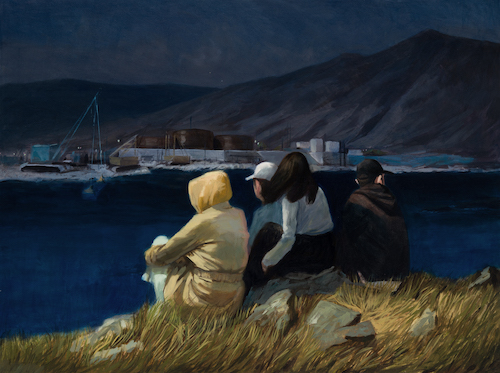 The Suburb from “Suburb” series, 60×80 cm, 2022
Ayda Roozbayani: I spent my childhood in the south, in neighborhoods that were considered the outskirts of the city. Around our home there were coast and sea where we used to play. Beyond these plains, industrial and oil factories could be seen, and because of their cylindrical and spherical forms they fascinated me and remained in my memory. Later, we moved to the city, but this habit stayed with us. My sisters, my friends, and I often went to the city outskirts for recreation and walks. Sometimes I would sit on a hill for hours, looking at those factories and drawing them. But beyond the nostalgic aspect, I later realized the important role these elements play in the lives of the people in the south. As you know, many of these factories and refineries are related to the oil industry, and today we understand that oil is no longer merely a fossil fuel but functions as a political material in regional relations, a reality whose impact I think we have all experienced in some way in our lives.
Amirhossein Bayani: Yes, you also exhibited the “Suburb” series in the south, correct?
Ayda Roozbayani: Yes. One of the branches of Sarai Gallery is located in Mahshahr, Iran, and I held that exhibition there with great enthusiasm. I think it is a very important and appealing idea for professional galleries to be active in other cities and provinces of Iran as well. I have always welcomed events held in other cities, and I believe that we painters should strive to create a kind of community across different parts of Iran, because it is from these gatherings that significant momentum in culture and art can emerge.
◊ ◊ ◊
Ayda Roozbayani (b. 1995, Iran) is a figurative painter based in Tehran. She holds a BA in Painting from Alzahra University and has exhibited her work in multiple solo and group exhibitions, receiving several awards throughout her career. In 2022, her work was featured in the KHOR Artists Group exhibition, and in 2024 she made her international debut at Untitled Art Miami Beach, marking a significant milestone in her artistic trajectory. Roozbayani’s work merges classical and contemporary styles through techniques such as oil, acrylic, watercolor, pencil, and collage. Her work often explores the relationship between humans and nature and the emotional effects of industrialization on human emotions and psychological states in contemporary life. Water appears as a recurring element in her paintings، serving as a symbol of mysteries, the unknown, a metaphor for introspection, and the boundary separating the figures from the rest of the world. Through her imagery, she conveys collective sense of confusion, solitude, and quiet anticipation in the contemporary human experience. https://www.instagram.com/ayda_roozbayani
Amirhossein Bayani (b. 1977, Tehran, Iran) is a painter, visual artist, and curator. He received a B.A. in painting from Tehran University School of Art in 2004, and an M.F.A. in Art Research from Tehran Azad University in 2008. He is a member of the Iranian Painters Society (IPS) and the founder and director of MERXOUT Projects. Bayani’s work explores critical politics, sociology, and philosophy as related to human existence and experience. His work, in particular, focuses on the colonization of his subjects by the politics of power, where acts of violence, sabotage, and tyranny are underhand deals, too artful to be covered by the mainstream and prestigious information channels. Bayani’s work has been exhibited extensively in solo and group shows around the world. Bayani resides in London.England. https://www.amirhosseinbayani.com/