
Daniel Barbiero
June 2026
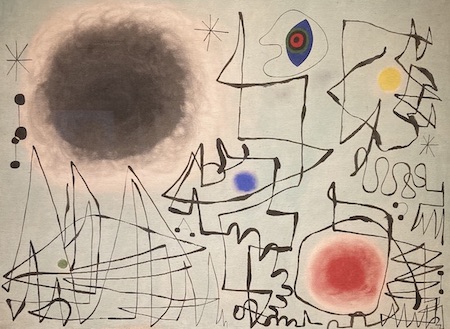 The Diamond Smiles at Twilight (1947)
Miró and the United States
The Phillips Collection, Washington DC, March 21 – July 5, 2026
The emergence in America of a mature, gestural abstract painting out of European Surrealism was a transformative event in the postwar development of art. One of the key catalysts for that emergence was American artists’ personal contacts with the European Surrealists in wartime exile in America, Roberto Matta primary among them. A second catalyst was the work of Catalan artist Joan Miró (1893-1983). The meeting and exchange of inspiration between Miró and his American counterparts is the subject of Miró and the United States, a valuable exhibition at the Phillips Collection in Washington.
Unlike Europeans such as Matta, Max Ernst, and Yves Tanguy, who fled to the United States following the German invasion of France, Miró spent the war years in Europe. Having left France as the Germans were approaching Paris in May 1940, he resettled in Palma de Mallorca in Spain, where he spent the remainder of his life. His first visit to the United States didn’t take place until 1947, when he came over to execute a commission for a mural for the Terrace Plaza Hotel in Cincinnati, a small-scale facsimile of which is included in the exhibition. During that first visit, which was followed by six others during the next two decades, he met and collaborated with artists in New York, a number of whose works the show puts in dialogue with Miró’s. The juxtaposition of his paintings and sculpture with their paintings and sculpture not only shows how Miró inspired two generations of artists on the other side of the Atlantic, but also provides a vivid survey of the diverse approaches to abstract and abstract-adjacent art that flourished during the 1940s, ‘50s, and ‘60s.
Although Miró wasn’t physically present in America until after the war, his work had had substantial exposure here since 1926, when two of his paintings appeared in the Brooklyn Museum of Art’s International Exhibition of Modern Art. Fifteen works of his were included in the widely attended landmark show of Fantastic Art: Dada and Surrealism at the Museum of Modern Art in 1936, and his 1941 retrospective there was seen by a number of young American artists, including Jackson Pollock and Lee Krasner. He was unable to send new work to American during the war, but the Pierre Matisse Gallery, which represented him in New York, nevertheless exhibited work of his from its inventory every year.
Miró’s influence on American abstraction derived from his being the leading exemplar of the automatist tendency in Surrealist visual art. (The other major tendency consisted in the realistic depiction of dreamlike scenes, at the time most famously associated with Dalí.) His paintings, the general look of which was remarkably consistent throughout his career, featured a dynamic interplay of line and color composed in a way that suggests the rapid and spontaneous execution of automatic drawing. The pictures, whose rhythms are lyrical and sinuous, often read as having improvised themselves in a fit of conscious forgetfulness. In fact in a 1933 statement he claimed that “[r]ather than setting out to paint something, I begin painting, and as I paint, the picture begins to assert itself, or suggest itself under my brush.” The affinity of this approach with the gesturalism being explored in America in the 1940s and 1950s is obvious. A work like The Diamond Smiles at Twilight (1947), with its interlaced lines and squiggles, sits on the boundary between automatic drawing and abstract painting. His Constellation series of twenty-two paintings, originally shown at the Matisse gallery in 1945 and a complete set of prints of which fills one room at the Phillips, is credited with helping inspire the “all-over” abstraction of Pollock, Krasner, Grace Hartigan, Janet Sobel, and others. Although his work wasn’t representational in any conventional sense, Miró always denied that he was an abstractionist, and indeed he often included eyes, outlines of figures, hints of hair and body parts, and other vaguely biomorphic shapes in his compositions. His Still Life with Old Shoe of 1937, inspired by Picasso, features recognizable objects depicted with a distorted realism that oddly recalls some of Dalí’s work from the same period.
The work of the thirty or so other artists shown alongside Miró includes first-rate pieces by such well-known figures as Pollock, Krasner, Hartigan, William Baziotes, Sam Francis, Arshile Gorky, Adolph Gottlieb, Franz Kline, Joan Mitchell, Robert Motherwell, Louise Nevelson, and Mark Rothko. But it also contains accomplished work by the lesser-known Perle Fine, Herbert Ferber, Alice Trumbull Mason, Alfonse Ossorio, Sonja Sekula, and others. This inclusion is illuminating for showing the depth and variety of the pool of work being created in the hothouse of postwar artistic experimentation, much of it in direct or indirect response to Miró.
These responses manifest themselves in various ways. The most basic parallel between Miró and the Americans lies in their acceptance of a conception of the picture plane as flat rather than the site of three-dimensional illusion. The notion of the flatness of the painting goes back to Cubism, but Miró introduced a fluidity into the flatness that Cubism lacked. For Gorky, who immersed himself in Miró’s work after a previous immersion in the work of Picasso, this fluidity allowed him to break out and renounce Cubism’s right angles in favor of curvilinear biomorphic shapes, which can be seen in his 1943 Garden in Sochi. For some artists, the implication of flatness was that a painting could be a quasi-graphic work. De Kooning’s Zurich (1947) and Norman Lewis’ Blending (1951), for example, both black-and-white paintings, seem to take their point of departure from the predominance of the black line in Miró’s work. By contrast, Krasner’s untitled painting of 1947-1948, like Pollock’s drip paintings, takes flatness as the prerequisite for a dense texture of tightly interwoven, thickly painted shapes and colors. The vocabulary of quasi-hieroglyphic figures of eyes and geometric shapes in Gottlieb’s Vigil (1948), a large painting from his pictograph series, recalls Miró’s own iconography, which he once acknowledged to interviewer Eduardo Roditti was “ideographic.” Rufino Tamayo’s 1946 Heavenly Bodies refers directly to Miró’s constellations series as it outlines star shapes in a night sky observed by a head in profile.
Just as Miró helped midwife the birth of American abstraction out of Surrealist automatism, American abstraction helped Miró find new possibilities in his own work. For, as the exhibition demonstrates, the lines of influence between Miró and the Americans weren’t one-way: they moved in both directions. Miró’s time in New York in 1947 lasted eight months and his contacts with the artists there, many of whom he met through Stanley William Hayter’s Atelier 17 printmaking workshop, inevitably had an effect on his own work. His Red Sun (1948), for example, is a wash of colors that wouldn’t be out of place next to a Rothko from the same period, and seems to foreshadow the burst paintings that Gottlieb was to create soon after. His The First Spark of Day II, from 1966, approaches pure abstraction and displays the kind of painterly brushwork that brings him close to the textures of the American abstractionists.
During his 1947 visit Miró was asked whether America would influence him; he answered “yes, very much so.” By the end of his life he asserted that “It was really American painting that inspired me.”
◊ ◊ ◊
Daniel Barbiero is a writer, double bassist, and composer in the Washington DC area. He writes about the art, music, and literature of the classic avant-gardes of the 20th century as well as on contemporary work; his essays and reviews have appeared in Arteidolia, The Amsterdam Review, Heavy Feather Review, periodicities, Word for/Word, Otoliths, Offcourse, Utriculi, London Grip, and elsewhere. He is the author of As Within, So Without, a collection of essays published by Arteidolia Press; his score Boundary Conditions III appears in A Year of Deep Listening (Terra Nova Press).
Link to Daniel Barbiero’s, As Within, so Without →