
Sally Jane Brown
July 2026
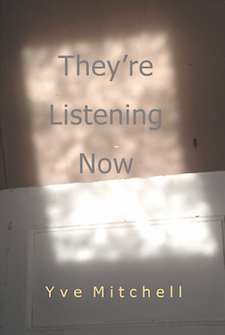
They’re Listening Now
Yve Mitchell
Arteidolia Press
Sally Jane Brown interviews Yve Mitchell
Yve Mitchell’s debut collection, They’re Listening Now, is haunted by memory, lineage, and the enduring echoes of racial and familial history. In this interview, we discuss poetry as a body print, the architecture of protection and release, and the radical power of remaining partially unknowable.
SB: Is this your first book? Tell me a bit about your background and what compelled you to write this collection.
YM: This is my first book, though the stories here are decades old. I remember reading (and loving) Sian Hughes’s novel, Pearl, and I reveled in her noting that it took, “her entire adult life” to write it. I started this collection when I was a very young child via observation. It was a reliable source of intimacy, and it snowballed into a creative path.
I was raised in the west by an interracial couple who could never navigate the racial tension between them. I lived with extreme violence. My father escaped Tennessee via the army, and settled in California in the 70s as part of the last wave of Black migration. I was obsessed with watching how his life unfolded so differently than my white mother’s. I used all of my senses to imprint the way that people looked at him, feared him, and othered him. I wanted to document his grief; the shock was too heavy to bear alone.
SB: They’re Listening Now is published by Arteidolia Press, which is led by Randee Silv. As a curator and an artist, I’m interested in how independent cultural spaces, small presses, and matriarchal networks champion voices that defy commercial norms.
What was it like navigating the vulnerable process of editing and shaping this deeply personal collection with a (female) editor and publisher? How did that shared container influence how safe you felt exposing the “volume of blues” within these pages?
YM: I loved working with a female publisher, but I had an unfair expectation that my collection would be held differently, perhaps with some extra tenderness. I expected a bit of mothering that was part fantasy. Working with Randee forced me to be clear and direct in a way that would have been dangerous in my childhood. I thought I needed cooing, but what I really needed was much more rational and balanced. Writers spend a lot of time alone, so I had to practice a professional interplay that still honored the magic in having created this collection at all.
SB: In your poem “Shibari,” you write:
“Knead me, flower king. / Bind me / against a down bundle / against a hardback chair / for the glue / for the glassing…”
In my own visual art practice, I use body printing and mixed media to create a literal, tactile index of the female form, mapping womanhood, maternal labor, and trauma directly onto a surface. Your poems feel similarly visceral, constantly depicting a body that is frozen, bound, or holding “long memory” in the small of its back.
How do you view the relationship between the physical body and the page? Do you see your poetry as its own form of “body print”, a somatic marking that indexically captures what the body endured?
YM: Poetry can serve as a map of the body, especially demarcating all of the places where it hurts. Rachel McKibbons did this so well in Blud. Ocean Vuong did it so well in Night Sky With Exit Wounds. Our bodies store trauma almost as if we’re waiting for an anatomist’s gaze, and I use syntax, rhythm, and (especially enjambment) to draw attention there over and over again. Steering this kind of hyperfocus is a great achievement of poetry and its tools. It’s the best way to feel inside another person and, ultimately, try to do less harm.
SB: The collection is deeply haunted by the inherited architecture of Jim Crow and white supremacy. In “My Daughter Discovers the Klan,” you write: “Leave a volume of blues / untouched for a decoy…” and in “Workshop,” you reference being “less than beguiling / with children of Jim Crow who mute their faces.”
As a white woman looking at your work through the lenses of feminist theory, history, and curation, I am deeply aware of my own positionality as a witness to these narratives. Your exploration of trauma as an internalized, physiological inheritance, something trapped in the joints, the marrow, or a facial expression, really forces me to think about the ethics of the gaze.
How do you approach writing about intergenerational trauma without letting it become a spectacle for an outside, white gaze? How do you protect the private, interior sovereignty of your lineage while still exposing the violence they weathered?
YM: I asked for the white gaze in this collection. I think we’re in a particular historical moment where there’s an incredible amount of pressure to deny the ongoing repercussions of enslavement and the failure of Reconstruction. My father wanted to be a photographer for National Geographic but was taught that he couldn’t roam. It was a whole ethos etched onto him, and it absolutely altered his course here. I wanted an audience keen on hearing more. At the same time, my work is full of dream-like images that save the worst experiences from clear deciphering. It was very important for me as a black author to claim this space, too. There’s something radical about being puzzled over.
SB: There is a brilliant dialogue throughout the book concerning domestic spaces and the inevitable release of children. “Mae” captures the ultimate limit of maternal protection:
“When what happened then and what is now rises in the dark, / I cannot protect you… Home is not what you’ve imagined.”
As a mother and an artist currently exploring the “Empty Nest” through drawing, I am struck by how frequently your collection addresses the boundaries of parental protection. How has witnessing the growth, detachment, and autonomy of your own children influenced the physical architecture of containment and release in these poems? How does a mother build an “esteemed barrier” while preparing her children to break rank?
YM: What’s so interesting about Mae is that she’s a dissociated part of the speaker (me but not me) that must be brought through to maturity. One of the ways to do that is through honesty. When my daughter comes to find me because she is terrified by some glimpse of our history, I try not to present myself as a god. I let on about my limits and wish the best for her out there. It won’t be easy. Working with my own dissociated parts helped with this necessary distance. I’ve had to parent them along, too. Seek out the poems “Mae”, “T”, and “Look to Nature” for the best examples of this.
SB: Lineage in your collection functions as both a profound weight and an act of resistance. In “Bargaining,” you write, “in a chain of resistance / there are no young,” which pairs terribly and beautifully with “Elegy #2”:
“You were kept from me before I was born — / the opposite of an heirloom— / just the way your mama was kept from you…”
As someone who views art and literature as a continuous matrilineal conversation, I see an incredible tension here between stolen connections and indestructible bonds. When historical violence breaks the natural transmission of heirlooms and stories, how does the poem step in to recover that lost connection? How do you use language to retroactively offer rest or sanctuary to the ancestors who were kept from you?
YM: I felt intricately connected to my lineage through writing this collection. I suffered from chronic tension that was unrelenting, and I found that I couldn’t work in manageable chunks. I was living Mark Wolynn’s It Didn’t Start With You, and I almost gave it all up. Through some miracle, I found a new approach to my labor. I began to rely on my long experience as a reader to re-learn that poetry begs returning, it pleads titration. You must approach in this way to avoid taking in too much at once. I found sanctuary in the genre itself, and I learned to rest “in the heat of the afternoon”. The bodies in my body found rest, too, even if only temporarily. This is how I loved them.
SB: Luke Hankins notes that your poems are “not about experience so much as it is an experience,” drawing parallels to poets who reject linear narrative in favor of an atmospheric reality. This perfectly mirrors the philosophy of “slow art” and “active looking” that I practice as a curator, forcing a viewer to slow down, sit uncomfortably within “not-knowing,” and experience the work over time.
In an era that demands immediate, easily consumable legibility, how do you cultivate the artistic patience required to let a poem remain a cryptic, visionary scene? How do you navigate the tension D.W. Winnicott identified: the intense human pull between the desire to communicate and the urgent desire to hide?
YM: Hiding is a non-negotiable for me; it’s sustaining. It’s how my father coped, and it’s how I cope best. I took four years to write this collection, and so much of that was spent waiting for the next image, the next starting point. I’m not sure where I found the courage to give myself this freedom, but I’ll never give it up. As the world speeds up, I slow down. I always think about a friend who left a note on her front door so that delivery drivers knew not to ring the bell when she was nursing her baby. Writing deserves time (changes in light), and society will take refuge in this last, slow thing when all else feels like it’s spinning out of control. It’s not hiding so much as an extreme form of self-care, self-preservation.
SB: In “Article (after Nick Cave),” you construct an invisible structural space:
“Yours is an invisible big top tent / I suffuse with sight. / Where you wish to survey, / I motion the ties.”
As a curator, I am constantly preoccupied with how walls, lighting, and partitions dictate visibility, power dynamics, and who is allowed to see. Your collection is heavily populated by structural barriers: trick windows, blinkered partitions, and sunglasses used to make a face unfamiliar.
Can you speak to the act of curating the gaze within your writing? How do you balance light and shadow across the page, deciding exactly what the reader is permitted to look at with absolute clarity, and what must remain protected behind a partition?
YM: I lost it when I saw Nick Cave’s Soundsuit for the first time. Everyone should see it. He created this protective barrier, this cape, out of flowers. There was something so vulnerable and heartbreaking in the need for such a device. Yet our ancestors did need it; they absolutely did. We need it now. I took his ideas around protection and created a safe space for my father. This tent that could billow and fall among “new shepherds”. And I thought that through my writing I could provide such a haven. “Where you land/ every house speaks/ a language that fortifies/ your bones.”
I use light and shadow throughout the collection to create tension or pull it away. It’s (again) a form of titration. So much happens behind closed doors and behind closed faces. I wanted to highlight that particular confusion and betrayal.
To buy a copy of They’re Listening Now →
For more info about Yve Mitchell’s They’re Listening Now →
Yve Mitchell is a writer and certified yoga teacher residing in Asheville, NC, with her husband and daughter. She’s an award-winning graduate of the literature department at the University of North Carolina Asheville.
Sally Jane Brown is a multidisciplinary artist, curator, and writer whose work explores womanhood, motherhood, and the body. Her artwork has been exhibited nationally and internationally, and her writing has appeared in The Conversation and Women’s Art Journal. She is the Curator for West Virginia University Libraries.