
Daniel Barbiero
July 2026
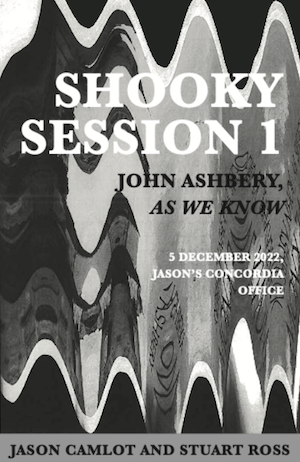
Shooky Session 1 John Ashbery, As We Know
5 December 2022, Jason’s Concordia Office
Jason Camlot and Stuart Ross
Above Ground Press, 2026
There’s a model of intertextuality that holds that every text has its double; in back of every text is another text, largely hidden but partly visible through the cracks in the first text, which in turn came into being as a response to the text secreted behind it. In many instances this second text goes unacknowledged, whether through absent-mindedness, anxious repression, or misdirection. Not so with Jason Camlot and Stuart Ross’s new chapbook Shooky Session 1: John Ashbery, As We Know 5 December 2022, Jason’s Concordia Office, a collectively authored poetic sequence whose authors cheerfully acknowledge the text to which their own text responds.
To write their sequence, Camlot and Ross first chose a book from the library at the Montreal university where Camlot teaches, and then settled in at his office to write. The book they chose was John Ashbery’s As We Know. Next, they alternated between reading and writing: one would read aloud from the book to the other, who’d write while listening, and then they’d switch roles. What and how much to take from As We Know to incorporate into his own poem was up to the writer to decide.
Camlot and Ross selected a book by Ashbery as their point of departure on the strength of Ashbery’s style and the inscrutability of his meaning. Ashbery is a poet of indirection, rapidly changing topics, plain diction, and labyrinthine syntax; negotiating his particular brand of ambiguity by ear is liable to open up a broad field of meaning full of possibilities that can inspire a range of imaginative responses. And the collection’s longest poem, “Litany,” itself is structured as an interplay of two texts. It’s written in facing columns that mimic the counterpoint of two independent voices heard at once, which makes it a fitting forerunner of Camlot and Ross’s own variety of verbal counterpoint.
The chapbook is divided into two parts. Part I consists of a single, quasi-narrative poem, while Part II is made up of discrete sections that can be read as independent poems. (Each part presumably was written by one or the other of the two poets.)
Part I’s discontinuous through-line recalls something of Ashbery’s own constant jumbling and rearranging of subjects, but without his systematic evasion of reference. While the forward motion of the long poem is propelled by a sequence of events that make sense on a local level but refuse totalization into a cohesive account, the things and actions they include often come plainly into view, albeit in contexts that are themselves enigmatic. For example,
We blush before elaborately broken entablatures
of bird-dropped simultaneities,
while smoke lingers,
looms above some simple ornaments
symbolic of beginnings,
of lonesomenesses,
of roundnesses, and of slants,
of thinnesses and generalities,
privatenesses and all things,
of preludes, and of farness,
of wonderfulness and asphalt.
The setting is a smoke-enfolded, presumably classical architectural ruin, which apparently causes embarrassment to the speaker. (But why? We don’t know.). The building’s ornaments are “simple,” but once their meaning is unpacked they turn out to stand for a mounting inventory of airy abstractions that then comes thudding to an incongruous and sudden end on a hard, paved surface. We’re jolted from the realm of the Ideal to something very close to the literally concrete.
This quick-cut shift in register, which pulls the rug out from under the tentative footfalls of common sense, is supplemented by elaborate metaphors and similes whose meanings are the product of their very incongruity:
Artifice is a twist
gaping at a citadelic tree,
a thing lumbering into
the invisible garment huddling
in a bus shelter on the icy
edge of the globe, a kind of
togetherness that injures illusion.[…] All we know is
existence is waiting for a cab, like a
woman with a baby carriage filled with
fever-stricken mechanisms
I shall never see
The poetry in Part II tends more toward the lyrical and reflective, as in this self-contained section:
Some very pretty views are ascertained.
At dusk, amidst fitful cedars,
an iota of remorse
reverberates against the nightingales.So, I wander through each dirty street,
as fools rush into my interstices,
and as my holes dream impetuously,
Solemnly, of rich adhesions.O Sun, I want to enjoy
your work, your shining,
and setting, and rising,
and turning everything around.
There’s a play of ambiguity here that keeps the tone evocative but undecidable. The light is dim and there’s a passing moment of regret, but there’s a suggestion of hope as well: the sun the poet wants to enjoy may just as easily be rising as setting, since “dusk” can describe either dawn or sundown, and nightingales can be heard at both times.
Sometimes Ashbery’s voice seems to come through on its own, as in this passage from Part II:
Did you ever stop to think
about that other blackened memory,
and whether it was omitted
from the agenda deliberatelyor out of innocent oversight,
or perhaps because it was pre-ordained
to be omitted from the
minutes, and so hadalso to be omitted from
the agenda, even though
that other blackened memory
was included, for whatever reason.And that these memories bear little resemblance
to anything but blackened star-shaped flowers?
The subject here—the “blackened memory”–is elusive and defined only in terms of another memory that presumably came up earlier in a conversation we’re only coming to in medias res. What it is we don’t know, and how or why it would be on anyone’s agenda (and anyway, what kind of an agenda would include a blackened memory as a discussion item?) also is a mystery. And meanwhile the syntax takes several serpentine turns as the question, rhetorical or in earnest, unspools. It’s the kind of thing we’d expect to find in Ashbery.
To be sure, in reading Shooky Session 1 it might make for an amusing game to try to draw a direct line between Ashbery’s poetry and Camlot and Ross’s by looking for coincidences of imagery or diction. For example, Part I’s
You can find knowledge like that
flowin’ round the flowers.
In this poem, flowers
stand in for something else.
Flowers are code names
for wishes of different kinds.
may have jumped off from the titular image of Ashbery’s “Flowering Death,” while the “interstices” from Part II may be an echo of “the interstices of my desirings” from Ashbery’s right-hand voice in “Litany.” But such an exercise would be beside the point. In the end, Camlot and Ross’s intertextual relationship to As We Know doesn’t rest on simple appropriation or direct commentary, but rather on the less predictable, and more inventive, ground of inspiration. What they’ve written stands on its own, and provides pleasures of its own besides.
For more info and to order a copy →
◊ ◊ ◊
Daniel Barbiero is a writer, double bassist, and composer in the Washington DC area. He writes about the art, music, and literature of the classic avant-gardes of the 20th century as well as on contemporary work; his essays and reviews have appeared in Arteidolia, The Amsterdam Review, Heavy Feather Review, periodicities, Word for/Word, Otoliths, Offcourse, Utriculi, London Grip, and elsewhere. He is the author of As Within, So Without, a collection of essays published by Arteidolia Press; his score Boundary Conditions III appears in A Year of Deep Listening (Terra Nova Press).
For more info on Daniel Barbiero’s As Within, so Without →
Read other essays & reviews by Daniel Barbiero on Arteidolia’s Archive page →