
Colette Copeland
August 2026
Colette Copeland interviews Julie Harrison
I met Julie this past March 2026 at Chokechaka Artist Residency in the Sacred Valley of the Incas where we both lived and worked together, inspired by the majestic landscape, culture and history of Peru. She is a New York-based visual artist whose work blurs the line between organic and invented forms. Julie has exhibited widely, both nationally and internationally, including solo shows at the Southern Vermont Arts Center, Delaware Valley Arts Alliance, and Wekalet Behna in Egypt, as well as museum group exhibitions at the Museum of Modern Art (MoMA), the New Museum, and the Staatliche Museum in Germany. Harrison is the recipient of numerous awards and fellowships, including recognition from the National Endowment for the Arts, the New York State Council on the Arts, and the New York Foundation for the Arts, alongside artist residencies at the Cold Spring Harbor Laboratory and Nordisk Kunstnarsenter Dale in Norway. For eighteen years, she was a professor of art at Stevens Institute of Technology, where she founded the Art & Technology B.A. program.
Colette Copeland: Although your work is rooted in abstraction, there is a strong environmental component present. In Peru, you were working on drawings inspired by the mountains and rivers there. How does that series fit into your larger oeuvre of conceptual and visual language?
Julie Harrison: I have always been driven by curiosity and adventure, and my career has been a process of investigating different materials and media in search of the new. This has shaped the evolution of my work, as I’ve moved from early video art and dance into drawing. Visually, I am a formalist, thinking in light, shape, texture, repetition, movement and color, but conceptually, I fold in the social, political, and environmental. This is what drew me to Peru with no fixed plan, only a desire to be guided by place.
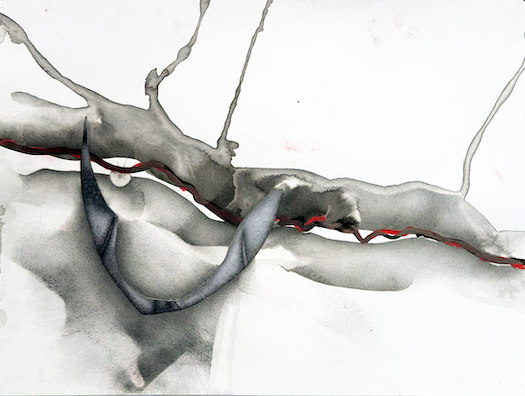
Apu Pitusiray Series, (1 of 14), 2026, graphite, India ink, oil pastel,
inkjet prints and paper on paper, 9 x 12 inches.
There, I found myself looking at Apu Pitusiray, a sacred mountain central to the traditional beliefs of the region. I learned that “apus” (mountains) are protectors; they mediate between the spiritual and human realms, manifesting the living energy of the natural world. So, I made fourteen small drawings of Apu Pitusiray’s crest. The drawings are largely abstract; I’m interested in how we perceive and interact with life beyond the visible spectrum, and how art might act as a conduit between observation, experience, and poetic interpretation. To this end, my perception is shaped not just by thought but by the body. I imbue all my work with sensory experience, so the finished works are only partially recognizable, like traces of memories half-erased.
CC: For your solo exhibition Rising Tide at Garrison Art Center, (GAC) you are showing twelve works made over the past four years from Brain Series, Landform Series and Coastal Series. You’ve stated that the works “reflect the fluidity of biology and the entanglement of nature, imagination and human intervention.” Please share more about your inspirations and thematic inquiries in these three projects.
JH: After years working digitally, I began drawing with graphite in 2017. My drawings combine repurposed microscopic imagery with hand-drawn elements to construct fragments of an imagined biology, mapping life forms and the energy passing between them. Rather than depicting specific organisms, my drawings capture the essence behind them. These ideas are rooted in reality, but not quite of it. Then again, isn’t that true of all art? That’s where imagination comes in. I work intuitively to determine the shape of the work, and my own understanding of it is often delayed. Even years before I made these drawings, my source material included bodies and images of cellular entities.
The Brain Series explores the in-between space of science and art. These works consider invisible living organisms and aestheticize my understanding of what is real and what is physically behind thought in living entities. It’s been a natural progression for me to move from drawings based on neurons in the brain to the exterior landscapes of rising tides.
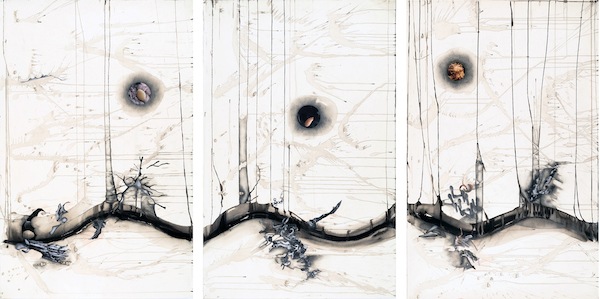
The Landform Series was a transition from the inside to the outside. It harkens back to some of my early work from the late 1980s, when I made a series of oil pastels based on the Möbius strip. Coastlines, like the Möbius strip, don’t really separate land from sea so much as fold one into the other. There is no inside or outside.
The Coastal Series emphasizes coastal environments as dynamic, transitional zones. I’m drawn to maps of coastal regions, sites increasingly vulnerable to ecological and climatic pressures. I interpret them through layered imagery that evokes both physical reality and speculative possibility, using technological imagery (what I find on the internet) not for scientific accuracy but as a basis for visual abstraction and conceptual exploration.
All the works echo the tension between the visible and the invisible, the real and the abstract.
Ghost Coast: A Hurricane Sandy Periplus of Lower Manhattan, Julie Harrison & E.J. McAdams, 2026 cloth-covered clamshell box with oxblood cloth lining, 96-inch accordion-fold book printed digitally in cloth over boards and stamped with bronze foil, 12 x 9 inches, published by Granary Books, NY.
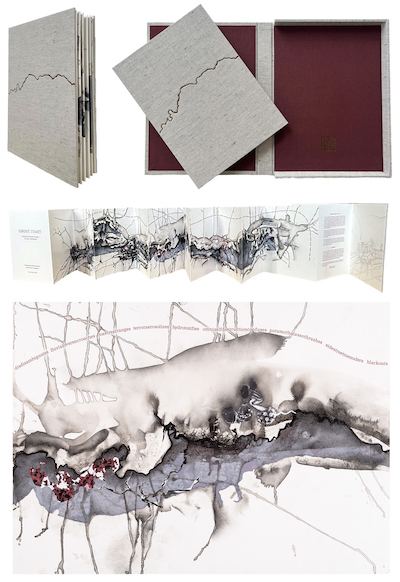
CC: Your collaborative artists’ book Ghost Coast: A Hurricane Sandy Periplus of Lower Manhattan will also be on display at GAC. This book serves as a creative eulogy to what has been lost, but also as a dire warning of the impact of climate change. How did the collaboration with poet E.J. McAdams and the publisher Granary Books come about? How did the collaboration impact your working process?
JH: Granary Books has facilitated dozens of image and text collaborations over the years. I’ve been fortunate to have two other books published by Granary, one called If It Rained Here with poet Joe Elliot in 1997 and one called Debtor’s Prison with poet Lewis Warsh in 2001. The directors, Steve Clay and M.C. Kinniburgh, were drawn to my current transfigurative, eco-based drawings and I thought E.J. would be the perfect collaborator, with his commitment to the urban environment and his spare aesthetics. He created a meandering line of concrete poetry composed entirely of verbs (some of them invented) describing water movement. The words flow through the work like the vibrancy explicit in the drawings.
I usually work alone and don’t necessarily know how my work will be shown in the end. But in this case, Ghost Coast had a definite container, a book. My coastal drawings have been horizontally oriented so I knew I wanted to make the book in an accordion style, a foldout that would emphasize the length of the coastline.
As you know, collaboration is always a give and take, like any relationship. Working with E.J. was easy because he’s a writer and I’m a visual artist, and we respected the autonomy of our professional experience. But once the size and format were established, E.J. had to adjust the text and pare his words down a bit.
The other important collaborator was Granary Books, specifically M.C. Kinniburgh, who made numerous physical and conceptual contributions to the final book. An important decision by M.C. was to have the book produced as ecologically as possible: the cover is made of recycled denim, the font was selected because it uses less ink, and the paper is lighter weight. She also donated a percentage of the sales to the Lower East Side Ecology Center, an organization that was instrumental in helping local communities recover after the flooding from Hurricane Sandy.
CC: I am always thinking about the ability of art to activate change and questioning whether art is an effective tool for communicating advocacy and care. I do believe in the ability of art to create dialogue and reflection, but true change? I’m not sure. Given that your artistic language is abstraction, how might abstraction function in ways that other more referential visual languages cannot, specifically with regards to awareness about environmental issues and climate change?
JH: I think the operative concept here is “communicating advocacy and care.” I see these as two different ideas. As an artist who came of age in the 1970s, I was an advocate of the dematerialization of art, and the politics of the ’60s and ’70s were often inseparable from culture. I spent decades advocating for political change through video and performance. That said, I don’t think my art was necessarily an effective means for that. I think political posters, trade books and films are much more potent. I have such admiration for artists who have been able to bridge that gap.
Communicating care, however, is a priori in making art. I have a spiritual understanding of what that means to me. Buddhism says “you reap what you sow,” that’s karma. I’ve long been interested in the concept that individual harmony is a pathway to global tranquility. Ultimately, it’s a matter of action and reaction, in a universe governed by cause and effect. So, I believe that when I make art, it’s a protest of sorts, and the act of creativity floods the world. I also think about this in more material terms, with a Marxist reading, that of controlling the means of production, being the boss of my own production. Unfortunately, artists are always subject to market forces, so that can be a dilemma.
I don’t think of my work as abstract, exactly, more abstractist. There are usually some elements of reality in my drawings. They may read as abstract at first but become less so upon closer looking. There is a tradition in visual art where abstraction falls into a more decorative register. The basic elements of design are often what abstraction is about; that’s its content, if you will. I’m a formalist in that sense. But I think my work also brings in the content of life itself, bodies and organisms.
This is where I think abstraction has something to offer that referential imagery doesn’t. Referential images tend to appeal to recognition, but abstraction works more slowly, through the body and the senses rather than through instant recognition. That kind of attention, the sustained looking, might change how someone relates to the natural world more than a single explicit image would. It’s less about delivering information and more about offering a different perception.
Landform Series (3 of 5), 2023, graphite, India ink,
inkjet prints and paper on paper, each 40 x 26 inches.
UPCOMING SOLO EXHIBITION
Rising Tide: Drawings by Julie Harrison
August 15 – September 6, 2026
curated by Kate Cahill and Charles Burleigh
Garrison Art Center, Garrison, New York
Colette Copeland is an interdisciplinary visual artist and cultural critic/writer whose work examines prescient socio-political and cultural issues. Sourcing personal narratives, historical research and contemporary culture, she utilizes video, sound, photography, printmaking, performance and sculptural installation to bring awareness and engage in critical discourse. Her work has been exhibited in 34 solo exhibitions and 156 group exhibitions/festivals spanning 36 countries. She received her BFA from Pratt Institute in New York and her MFA from Syracuse University. She writes for Glasstire, and Arteidolia online publications. She was awarded a Fulbright Scholar Research Award for 2023/2024 to write about female contemporary artists in India who work with socially engaged issues, as well as an experimental sound project amplifying female, non-binary and queer voices.