
Larissa Shmailo
June 2026
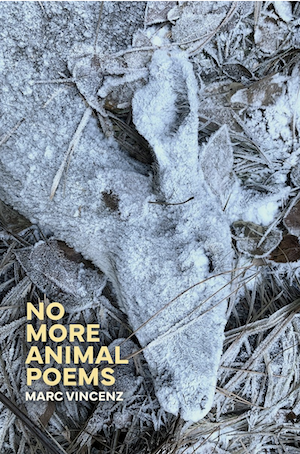
No More Animal Poems
Marc Vincenz
White Pine Press
Cosmic Cli-Po, Animal Necrology, and Quantum Entanglement
A Review of No More Animal Poems by Marc Vincenz
In this “moon locked moon pocked climate baggage” of an Earth, there are few poets of the like of Marc Vincenz, whose luxuriation in the magic of language across cultures and continents has been viewed in his many collections, including Leaning into the Infinite and The Syndicate of Water & Light. No More Animal Poems is perhaps the most ambitious of his works to date, a culmination of purpose, imagination, and innovation in eco-lit never seen before. A multi-genre extravaganza that offers a metaphorical feast in seven sections (amuse-bouche, hors d’oeuvres, dégustation, plat principal / entrées, vegetarian offering, vegan offering, petits fours), there is wonderful humor as well as pathos in this gastronomical, astronomical, ecological manuscript.
Dedicated to Ham, the first primate to engage in space travel, we see the poignant photo of this sub-orbital pioneer and note his reward: “a shiny red apple.” Like many of the poems in No More Animal Poems, “Planet of the Apes” about Ham melds popular culture with mythopoetic allusion (the notes to this poem tell us that it was written for the three monkeys of Japanese mythology who hear no evil, see no evil, and speak no evil after the novel by Pierre Boulle). Certainly Ham, almost electroshocked, traveling in a capsule of dubious design, experiences no evil, and is merely “grateful that these kind apes / had a vision of the future” (which included incinerating myriad animals in their space race). Pop culture meets Lao-Tsu in this collection as it makes reference to Sylvia Plath, Shakespeare, Jean Cocteau. the Tao te Ching, Carl Sagan, Rachel Carson, and David Bowie.
“Kokokola bears and caffeine caterpillars,” squirrels, wasps, scorpions, bees, cats, sponges, electric eels, walruses, rhinoceroses, spiders, voles, beetles, crickets, kestrels, snakes, and even cockroaches and parasites have a place in Vincenz’s ecology:
. .. the flat-footed foxes and their offspring excitedly exploring the crags and
her limpets; the golden-crowned grebe dragging the kelp from the lapping
surf; the nine-eyed newts on lookout squealing their borders, boundaries,
and defenses; and the wigwags hovering between bulrushes and the shallow
pools and surfaces…—From “A Think-Tank on Permafrost. . .”
Vincenz approaches the environmental crisis and the extinction of species (a comprehensive listing of lost animals is provided, including the presumed reason for their extinction, often habitat loss, overhunting, and other human-driven causes) on many levels, lyrical mourning for the Earth among them:
A Few Syllables on Greenhouse Gasses:
I espouse a mouthful of wisely chosen condolences
in the name of Mother Earth, Mother Cosmos,
unconditional Mother Universe . . .. . .
all those faded watercolors of waterfalls and birds,
the salmon spawning, the bears gulping salmon
as they ride the upsurge, upstaging the hovering buzzards;
at night, the crickets singing ancient love songs.—From “A TED Talk on Chlorofluorocarbons”
In “Master of Chocolate,” Vincenz takes on that sweet treat beloved by millions and examines the impact of the cocoa industry, entangled as it was in the slave trade of previous centuries and in the slave labor of millions of children today. Monsieur de La Fontaine, a self-professed “elocutionator” and representative of that industry, “embalms” a mic in funerary style with rapacious “chocolaty jowls.” He has blood on his hands and lips and may come from a “chocolaty hole” (hell?) “Let us quarry up,” he says, “let us pour forth our banks … I mean, thanks” speaking to the profits made through chocolate consumption. That “criminal sweetness” is then linked to ADHD and high cholesterol. Chocolate, says Monsieur de la Fontaine, “is at the heart of all dark matter.” And the matter is indeed as cosmic as it is dark as cocoa plantations displace wildlife and cause massive deforestation, all for, as Vincenz notes, “cavities and cravings.”
Then there is “World Turtle, Cosmic Elephant, Mother Goose: Where We Commence. Our planet, geophysically, indeed “wobbles,” as the poet has it, on its axis in a subtle, cyclical motion known as the Chandler wobble, causing the geographic poles to shift by about nine meters over a period of roughly fourteen months. Changes in water mass, such as melting ice sheets or shifts in Eurasian water storage, can push the spin axis eastward or westward. Here Vincenz, as is his wont, combines cosmology with ancient myth and eco-lit as he invokes the world turtle’s earth-bearing “hard-won carapace” and the eight cosmic elephants, “guardians of the edges of tomorrow” that syncretically raise it up. With Mother Goose-like whimsy in these tercets, our elephants, struggling in the wild, have a penchant for sweets. They lift up the turtle so that the Earth, may gaze upon another aspect of the universe. And our wobbling, beleaguered Earth, with its endangered species and environmental emergency, has, in a “brief elephantine whisper,” another turn. We commence from archetype to astronomy and back again.
Reminiscent of Nietzche’s eternal recurrence, Vincenz speaks of “the jolt of pure radiant energy that streams across the universe, then vibrates all your cells to remind you to which cosmic cloud, in the end, you shall return.” (From “Cosmic Background Radiation”).
Vincenz ends his collection with a homage to theoretical physics in fable form as animals discuss the ontology of our universe. “Quantum Entanglement” purports, as Vincenz explains, that there are atoms across the other side of the universe who oscillate in synch with each other. There is no space between us and the other, as the philosophers say; deep inside, we are all fuzzy and undefined, and despite our differences, could be mirrors of one another. Cause and effect, space time, the existence of the universe — all probabilities “descend in a raincloud.”
With a dusty love for living and a maelstrom of possible outcomes, No More Animal Poems is a signal, multifaceted and unique contribution to language, the understanding of our Earth, the environmental crisis, and our shared cosmic womb. With Vincenz, we pray “that we might return to the very beginning and find the ever after in the grass and in the soil.”
For more info & to order a copy of No More Animal Poems published by White Pine Press →
◊ ◊ ◊
Larissa Shmailo is a poet, novelist, translator, editor, and critic. Shmailo’s novels include Sly Bang published by (Spuyten Duyvil); and Patient Women (BlazeVOX). Her poetry collections are Dora/Lora (Unlikely Books), Medusa’s Country (MadHat), #specialcharacters (Unlikely Books), In Paran (BlazeVOX), the chapbook A Cure for Suicide (Červená Barva Press), and the e-book Fib Sequence (Argotist EBooks). Her work has appeared in more than thirty anthologies. For more than six years, Larissa has been teaching The Writing Resilience Workshop, a practice-based workshop designed for writers who want to develop steadiness, discipline, and continuity in their work.