
Daniel Barbiero
October 2026
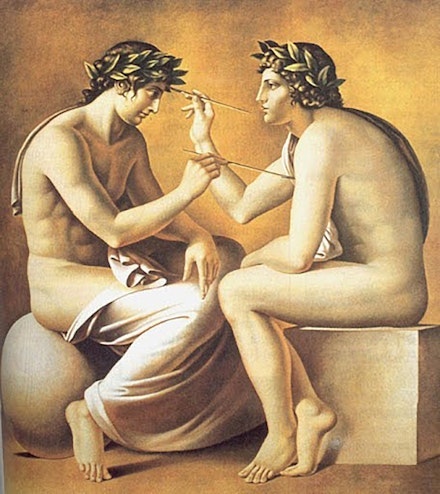 Carlo Maria Mariani, La mano ubbidisce all’intelletto
(The Hand Submits to the Intellect), 1983
The Anti Anti-Aesthetic of The Hand Submits to the Intellect
Enigmatic figures from an imaginary classical past depicted in mysterious situations: this describes the paintings Roman artist Carlo Maria Mariani (1931-2021) was producing in the 1980s. These paintings, apparently symbolic in intent, seemed at the time to contain encrypted messages whose meaning would have to be deduced from whatever visual clues they gave out. Mariani’s choice of a deliberately anachronistic style was something of a provocation that simply deepened the air of mystery surrounding them; like Pierre Reverdy’s poetic image, he seemed to be bringing together two more or less distant realities: the artificial reality of neoclassicism and the equally artificial reality of art in a late modern, or better yet postmodern, world. His quasi-mythological figures were obviously emblematic of something – what else would they be doing in the late 20th century if not acting in an allegorical capacity? – and that something, simply by virtue of its appearance at a time when aesthetic values were undergoing one of their periodic transvaluations, clearly seemed intended to speak to the concerns of the contemporary artworld, even if in an ostensibly dead language.
La Mano ubbidisce all’intelletto (1982-1983) – known in English as The Hand Submits to the Intellect – is one of Mariani’s major paintings of the decade. It consists of a side view of two laurel-crowned male figures facing each other in close proximity, the one on the left seated on a sphere, and the one on the right seated on a cube. Each holds a slender, long-handled paintbrush in his right hand. The figure on the left touches his brush to the chest of the figure on the right, who touches his brush to the forehead of the figure on the left. The painting is tightly focused and symmetrical in composition; its imagery is sparing – there are only the two crowned figures and the objects they sit on, nothing else. Every element shown – the figures, the crowns, the brushes, the sphere, and the cube – contributes to the picture’s meaning. Nothing is wasted.
The Dialectic of Desire and Intellect
To begin with the sphere and the cube. At the time The Hand Submits to the Intellect was painted – the early 1980s — these objects carried an important symbolic meaning for Mariani. As he told interviewer Danny Berger, the sphere and cube “are a reference to the Altar of Fortune of Goethe. The cube with the sphere above” (Berger, p. 84). The Altar of Fortune, or Altar of Agathe Tyche (1777), is an uncannily modern looking sculpture of a sphere resting on top of a cube that Goethe designed with his drawing teacher Adam Friedrich. The sculpture was created for Goethe’s garden in Weimar, where it still is sited. The sculpture stands as a monument to a particular moral vision; art historian Hugh Honour describes it as depicting “the sphere of restless desires immobile on the cubic block of virtue” (Honour, p. 130). It is a kind of metaphor in three dimensions for the taming of desire when virtue serves as its stabilizing foundation. In Mariani’s interpretation, “the sphere is a symbol of inquietude, of moto perpetuo – man’s thoughts that are always in an unrestful state. The cube is solidity, stability” (Berger, p. 84). There is on the one hand the volatility of desire and the passions of yearning and disquiet that accompany it; on the other, the stability of the unchanging and eternal – the Ideal.
The sphere and the cube appear in other paintings Mariani created at the time of The Hand Submits to the Intellect. In And the Prodigal One Came these two elements are separated and put on the ground; the sphere appears by itself in The Left-Handed Painter, where Mariani depicted it as the seat on which the painter of the title is situated.* It’s likely that these three works were related. In his conversation with Berger, Mariani stated that And the Prodigal One Came was one of a series of paintings “about ‘the artist,’” an admittedly vague description, but one that fits all three.
In The Hand Submits to the Intellect as in And the Prodigal One Came, Mariani has taken Goethe’s statue apart, separating its constituent elements and setting them side-by-side on the ground. In effect, he has severed desire from the foundation Goethe wished it to have in virtue, and recognized it as a domain of its own. Placed on the same level as the cube, the sphere is made its equal, suggesting that both the volatility of the passions and the stability of the Ideal coexist in a relationship of parity within the psyche, a parity based on a certain equilibrium held in place through a dialectical, and thus reciprocal, tension. The mutability of passion and the stability of the dispassionate intellect are like two bodies held together through the contradictory forces of linear motion and gravity. If passion is the engine driving human action in a contingent world, it is realized through and rationalized by its opposite and complement, the intellect, which it in turn animates and motivates; if desire proposes, intellect disposes.
That Mariani’s side-by-side placement of the sphere and the cube implies a reciprocal relationship between the domains they symbolize is an impression reinforced by the actions of the figures sitting on top of them. By touching the tip of his brush to the chest of his counterpart, the painter on the sphere is painting feeling into the heart of the figure on the cube, who in turn is painting intellect into the mind of the painter on the sphere. Consequently, it would be tempting to interpret The Hand Submits to the Intellect as an allegory of the resolution of the opposition between feeling and thought, and thus as symbolizing the essential holism of the human psyche.** Although this meaning clearly is implied in Mariani’s imagery, it would seem that Mariani was after something else, or better, something in addition to this, with the painting. He was effectively articulating a poetics, in non-discursive form.
“The Theme Is ‘the Artist’”
In “Two Hypotheses on the Death of Art,” Umberto Eco claimed that from the time of Romanticism forward poetics, defined as the intentions motivating artistic procedures, had become art’s main subject matter (Eco 1989 pp. 167 & 169). Art, in other words, had increasingly become a reflection on its underlying principles and by extension, on the conditions of its own possibility. The upshot of this is that the artwork, in addition to being an aesthetic object, was now also an object about aesthetics. This is the context for interviewer Hugh Cumming’s asking Mariani whether The Hand Submits to the Intellect was about aesthetics. Mariani’s reply that “[t]he theme is ‘the artist’” effectively is an affirmative answer, albeit one needing some elaboration (Cumming, p. 18).
That the figures represent the artist is signaled by their crowns of laurel as well as by their being depicted in the act of painting. In Mariani’s repertoire of symbols during this period the laurel wreath worn as a chaplet occurs frequently, and is used to indicate that the figure wearing it is an artist of some sort: a painter, a poet, or a musician. That they represent a single artist Mariani indicates when he points out that they are “look[ing] at each other as they would in a mirror” and are in fact “the same image” (Cumming, p. 18). They are two manifestations or appearances of the same artist. Given this datum we can interpret these quasi-mirror images as representing the artist engaged in self-reflection. Reflection is a particular mode of thematized, conscious self-presence which divides the person reflecting on him- or herself into two selves, one as observer and one as observed; it separates oneself from oneself and sets both selves in confrontation with each other. The person engaged in self-reflection is virtually doubled, being at one and the same time the subject who reflects and the object reflected on; the object-self reflected on is akin to a mirror image in consciousness of the reflecting subject-self. Hence Mariani’s representing the same person as two figures, “look[ing] at each other as they would in a mirror.” These two figures depict the artist as doubled, appearing once as reflecting subject, and once as reflected-on object – and by implication, once as existent and once as image. Subject and object, existent and image, are interchangeable here as either figure could be one, the other, or both, as each grasps itself through the other. Through this doubling Mariani brought the figures’ status and function qua images to the fore in a way that was timely.
Self-Reflection and Secondary Meaning
When Mariani’s paintings came to prominence in the 1980s, discourse within and about art was preoccupied with questions associated with the postmodernism prevalent at the time. This was the period when post-structuralism and semiotics were ascendant and theories about the eclipse of reality by its simulacra were fashionable; the question of the relationship between representation and reality was at the center of controversies current in literary theory and in the visual arts as well. In this context paintings like The Hand Submits to the Intellect, which called attention to the workings of their own representational languages, lent themselves to being read as allegories concerned with some of the problems of representation recent theory had purported to expose. And it’s true that with its provocative iconography, The Hand Submits to the Intellect did seem to hint at a critical view regarding the nature of representation. It was easy to read the images of the painters painting each other as a metaphor for the self-referentiality of representational systems. On this reading the two painters are two points within a circuit of signification, with each one taking its meaning solely from the other. To the extent that one creates the other through the act of painting the value of each is determined by the other; the being of one is only as it is by virtue of its being a reflection of the other. The circuit of signification symbolized by the self-referentiality of the doubled image is thus necessarily closed. “There is nothing outside of the text” – Derrida’s much-discussed assertion – seemed to have found its perfect emblem in Mariani’s painting.
To be sure, reading the painting as some kind of post-structuralist or semiotic allegory overlooks the important details that add up to the meaning Mariani intended for it. The crucial significance of the cube and sphere, the specific points of contact for the painter’s brushes – none of that figures in the such a reading. But at the same time, a painting with imagery as richly suggestive as this is liable to give rise to interpretations beyond what the painter intended, and some of those interpretations will be plausible. This is especially true of a painting that appeared at a time of intellectual questioning and ferment. (It doesn’t really matter how well or thoroughly the artworld at the time understood the more esoteric ramifications of the post-structuralist and semiotic theories it appropriated. As a practical matter these theories provided the terms in which works were received, and in some instances served as inspiration for the creation of new work.) There is an extent to which an artwork produces its own meanings, some of which reach beyond the meanings the artist intended for it. These farther-reaching meanings accrue to the work as secondary meanings – unintended, perhaps, but revelatory of some of its aspects. A post-structural or semiotic interpretation of The Hand Submits to the Intellect counts as just such a secondary meaning – if unintended, nevertheless revelatory of a meaning the painting’s imagery plausibly could support. I would suggest such an interpretation is consistent with the principle Eco set out as a constraint on overinterpretation: “If there is something to be interpreted, the interpretation must speak of something which must be found somewhere, and in some way respected.” (Eco 1992, p. 43)
A Poetics of the Intellect
But to return to the painting’s primary meaning. In depicting the artist as self-reflecting, Mariani addresses the question of the role of the intellect in the artist’s practice. In doing so, he is expressing something essential about his painterly poetics. Reflection is a function of the intellect and consists of the ability to look at oneself objectively, which is to say as if one were an object other than oneself, held up to examination and evaluation. By showing these two figures engaged in reflection while painting spirit and intellect into each other, Mariani gives us an artist who, like Mariani himself with his fundamental choice of a neoclassical style, self-consciously harmonizes within himself both of those qualities – the qualities of the sphere and the cube. (If postmodern art could be reduced to one essential quality, it would have to be self-consciousness.)
But the title clearly states the dominance of intellect, to which the artist’s hand submits. As such, the artist is effectively a conceptualist, albeit one working in the physical medium of paint. This in fact is how Mariani saw himself. He began as a Conceptualist before becoming a neoclassicist. But his neoclassicism was itself a form of conceptualism in that he came to it through his readings in late 18th and early 19th century neoclassicism. As he told Cumming, his was a neoclassicism initially of the library and the text, and not of the museum (Cumming, p. 17). It was a commitment made by virtue of intellect as well as through the impulse of sensibility; the painterly poetics that resulted from Mariani’s commitment was thus an essentially conceptual poetics. It was a poetics that is neatly summed up not only in the imagery of The Hand Submits to the Intellect, but in its title as well.
The Neoclassical Ideal: “A Space Outside of Time”
Mariani’s choice of a neoclassical painterly vocabulary was the practical way in which he realized his conceptualism. That he chose such a visual language with which to express his conceptualism was, at a time in which painting, and especially figurative painting, was supposed to have been killed off by pure Conceptualism, performance art, high-tech media, and other forms of post-aesthetic art, a bold move. As he told Cumming, “When I started what I do now, in 1974, in Italy and Germany painting was dead…I thought to paint this way at that time would be a great shock, a great way of looking at art again” (Cumming, p. 19). It was, artistically speaking, a fundamental choice, one that committed his project to a particular course that would be affirmed with each resulting painting. It was, in addition, a choice made at a specific time, one in which art was undergoing a critique both internally, in terms of its materials and techniques and the role, if any, that figuration might have, and externally, in its relation to questions with broader ideological and philosophical implications.
In Italy, it was the time of the “crisi della ragione” – the crisis of reason, as the title of 1979’s landmark work, an important collection of essays edited by Aldo Gargani, put it. Italy wasn’t alone in undergoing a questioning of what we might call the assumptions animating the post-Enlightenment intellectual order. For a number of thinkers in the West generally, there was a rejection of the faith in a universal, unidirectional arc of History in which human existence is encompassed and totalized, and the past decisively negated and put out of play. In art, this manifested itself in a kind of return of the repressed as the past made itself felt in direct and indirect ways.
There was in some quarters a sense of belatedness, of having come to a game after all possible moves within it had already been made. The idea of an avant-garde consequently was put in question and as a result, the relationship of art to its own past, and the possible relevance to contemporary art of formal languages associated with the past, became issues inviting active exploration from a number of different points of view. A number of artists in Italy, dubbed “anacronisti” or “ipermanieristi,” adopted and adapted Classical, mythological, Romantic, and other past formal languages in order to, in the words of critic Maurizio Calvesi, “dream of memory in a space ‘elsewhere’” – a space outside of historical time (Calvesi, p. 7). Was this a variety of what Charles Jencks called postmodern “double-coding” – adopting past art conventions as an ironical comment on those conventions? Or perhaps as an ironical comment on contemporary conventions? For some artists it may have been the former, for others the latter, and for yet others some combination of the two. To the extent that Mariani’s neoclassicism contained an element of ironic critique it appears not to have been self-directed but rather to have been aimed at the anti-aesthetic of his own time. To Cumming, he described himself as “rediscover[ing] something beautiful…[and] inhabiting a space outside of time” (Cumming, p. 22). To his thinking, classicism had precisely this capacity to transcend historical periods; it represented “the highest representation of the spirit of man in every period” (Cumming, p. 22). In the context of the postmodern art of the 1980s, the vocabulary of classicism gave Mariani’s paintings an irreducible, and ironically anti-anti-aesthetic, aesthetic content that allowed them to transcend their own times and to resist any attempts to reduce them completely to their conceptual content. And yet in an ironic recoding of contemporary conventions, this aesthetic content was itself animated by a concept, specifically, Ideal beauty as embodied in neoclassicism’s formal vocabulary of semi-divine human figures and symbols which were themselves derived from Romanticism’s idealized notions of the West’s Greek heritage.
The Ideal as Critical
In appropriating the Ideal forms of neoclassical painting as he did, and at the time that he did, Mariani in effect chose to take a fundamental interpretive stance in relation to postmodern aesthetic discourse. The stance he chose inevitably was a critical one, to the extent that casting one’s lot with a notion of Ideal beauty would de facto count as a form of defiance or as a negation of the period’s consensus – at least as this consensus was articulated in and by the art and artists who, from an institutional and critical perspective, were defining the direction art was taking – on what was or what was not still possible for art. What was thought possible then appeared within the context of a self-consciousness brought about by the perceived exhaustion of modernism and a hyperaware sense of contemporary art’s relationship to the history of Western art. At one extreme the response to this situation, which to many artists presented itself as a kind of cul-de-sac from which an exit seemed impossible, took the form of appropriation art, which in its own way represented a radical negation of aesthetic possibility. At the other extreme was the attempt of the anacronisti to exit the cul-de-sac by looking for models to Calvesi’s “elsewhere.” Mariani’s “elsewhere” was, as he told Cumming, the space outside of time of the Ideal. By choosing it, he negated contemporary art’s conceptualist negation of the aesthetic by asserting the viability of a neoclassical aesthetics expressed as a sensual beauty, while at the same time affirming the basic soundness, if not the inevitability, of conceptualism as an expression of art’s self-consciousness. Whether or not art would be conceptual wasn’t the question so much as how art would be conceptual. Given that presupposition, Mariani’s neoclassicism represented his critical, interpretive response to what at the time appeared to be a conceptual imperative. It was a conceptual response to a conceptual imperative and one that involved the paradoxical leveraging of a particular concept – the concept of the classical Ideal beauty – against a direction of art that seemingly had been reduced to a concept.
If the meaning of the artwork – its “truth,” if we can call it that – consists both in its situatedness within the world as given and in its re-presentation of that world as reimagined through the artist’s transformative assimilation of the given, then we can see Mariani’s neoclassicism as taking the given world of post-aesthetic art, interpreting its conceptualism as representing a necessary yet by itself inadequate possibility, and transforming it through the critical choice of a formal vocabulary and technique deliberately set against contemporary conventions. If the anti-aesthetic of conceptualism represented the negation of the aesthetic, Mariani’s conceptualized neoclassicism, or classicized conceptualism, represented the negation of the negation by transforming the anti-aesthetic into an anti-anti-aesthetic of anachronistically idealized forms. It was a transformation that entailed a complex, double movement. To the extent that it arose from his desire to negate the anti-aesthetic, Mariani’s neoclassicism represented a distancing of himself from the contemporary; to the extent that he nevertheless maintained conceptualism as the point of departure for his art – to the extent that he submitted his hand to his intellect – he negated the conceptual imperative by going through it and coming out the other side: a side in which painting was possible once again, and beauty, by virtue of its anachronism, became contemporary.
Through the fundamental choice of neoclassicism, Mariani sought to preserve for his art an indissoluble kernel of poetic character, even as it was expressive of contemporary concerns. In leveraging the visual vocabulary provided by neoclassical conventions of beauty and putting it to use as a means of creating metaphors for contemporary conceptual content, Mariani sought to construct a painterly poetics that put his art into a non-trivial relationship to art of the past, and thus to the limits of its own language. Mariani was, in effect, asserting contra Duchamp that a retinally appealing painting can be put to the service of the mind when technique follows the idea and the hand submits to the intellect.
____
* In “The Meontology of the Left-Handed Painter” (Arteidolia, June 2022) I read this painting as an allegory of the imagination’s ability to negate reality as it is and to conjure up a new reality in its place. That Mariani shows the left-handed painter seated on the sphere suggests that the imagination is motivated by – rests upon – desire’s restless urge to negate what is in favor of some projected vision of what could or should be.
** This is Donald Kuspit’s interpretation of the painting (see Kuspit, pp. 166-167).
References:
Danny Berger, “Carlo Maria Mariani in His Studio in Rome: An Interview,” in Print Collector’s Newsletter, Vol. 15 No. 3 (July-August 1984) pp 84-87. Internal references to Berger.
Maurizio Calvesi, “Introduzione,” in Anacronismo, Ipermanierismo (Venezia: Cataloghi Marsilio, 1984). Translation is my own.
Hugh Cumming, “Carlo Maria Mariani: An Interview” in The Classical Sensibility in Contemporary Painting and Sculpture (New York: St Martin’s, 1988). Internal references to Cumming.
Umberto Eco, “Interpretation and History,” in Interpretation and Overinterpretation, ed. Stephen Collini (Cambridge: Cambridge U Press, 1992). Internal reference to Eco 1992.
Umberto Eco, “Two Hypotheses about the Death of Art,” in The Open Work, tr. Anna Cancogni, introduction by David Robey (Cambridge, MA: Harvard U Press, 1989). Internal reference to Eco 1989.
Hugh Honour, Neo-classicism (Hammondsworth, UK: Penguin, 1968). Internal reference to Honour.
Charles Jencks, What Is Post-Modernism? (Chichester: John Wiley/Academy Editions, 1996).
Donald Kuspit, “Carlo Maria Mariani,” in Idiosyncratic Identities (New York: Cambridge U Press, 1996).
◊ ◊ ◊
Daniel Barbiero is a writer, double bassist, and composer in the Washington DC area. He writes about the art, music, and literature of the classic avant-gardes of the 20th century as well as on contemporary work; his essays and reviews have appeared in Arteidolia, The Amsterdam Review, Heavy Feather Review, periodicities, Word for/Word, Otoliths, Offcourse, Utriculi, London Grip, and elsewhere. He is the author of As Within, So Without, a collection of essays published by Arteidolia Press; his score Boundary Conditions III appears in A Year of Deep Listening (Terra Nova Press).
For more info on Daniel Barbiero’s As Within, so Without →
Read other essays & reviews by Daniel Barbiero on Arteidolia’s Archive page →