
Colette Copeland
September 2025
Resist, Re-live and Proceed: A Conversation with Erica Felicella
Colette Copeland: Historically, your work hasn’t been overtly political, but I believe performance art is inherently political. Since its emergence in the U.S. during the late 1960s and early ’70s, performance art has served as a vital platform for women, queer artists, and artists of color to reclaim agency in a space long dominated by white patriarchal structures. In times of crisis and upheaval, performance has often responded powerfully—as seen in the Dada and Futurist reactions to WWI and U.S. artists engaging with the feminist, civil rights, and antiwar movements.
I chose Resist, Re-live and Proceed as the title for our conversation because it speaks to both your pandemic-era work and the present political moment in Texas. Please speak to how your practice has evolved—conceptually and performatively—in response to political and cultural shifts?
Erica Felicella: I began with memory and endurance — grief carried, burdens held — but when the body itself becomes the medium, politics arrive whether you want them to or not. For years I resisted that label. I said my work wasn’t political. But the body is never neutral. It absorbs the moment it inhabits. In 2020, I created Resist, Re-live and Proceed, lying beneath stones placed on me by the community from sunrise to sunset. That work was about grief, but also about temporal weight — the way a single day could embody an entire year. The following year in Austin, I created The Shrinking Ballot. Across the city, ballot boxes appeared in impossible scales: towering seven-foot structures, fragile one-inch cubes. Access to democracy laid bare, swollen for some, shriveled for others. Now, in a state that actively seeks to erase queer and trans lives, my work has sharpened. In The Attempt, I entered chained and heavy, slammed blocks against concrete until they shattered, then whipped my body with the freed chain. I was left standing among rubble — not unscarred but unbound. Oppressors have always tried to weigh us down, but we rise anyway.
CC: Let’s talk more about The Attempt, part of the exhibition These Letters Don’t Run at Keijsers Konig Gallery in Dallas. The show responded to the February 3, 2025 action by President Trump, which ordered the removal of “transgender” and “queer” references from the Stonewall National Monument’s webpage—reducing “LGBTQ” to “LGB” on the National Park Service site. This erasure of queer and trans history sparked widespread criticism.
I witnessed a powerful, painful ritual that included the metaphorical “breaking down of the wall.” The physicality and vulnerability were striking, especially as the performance spoke to the burdens carried by marginalized communities—particularly queer individuals and immigrants.
Can you speak about the use of self-flagellation in this work—not only as a personal act but as a larger commentary on internalized oppression and harmful social conditioning? What conceptual insights guided the performance, and what did you learn from the physical demands and emotional toll of the piece?
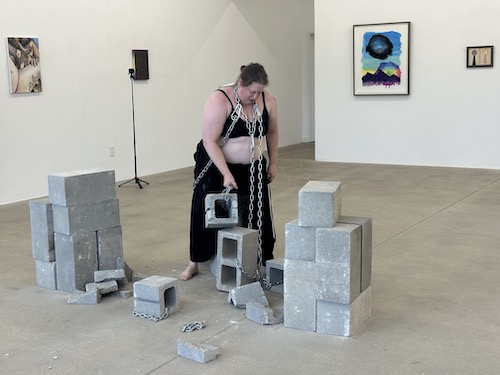 from The Attempt, photo courtesy Colette Copeland
EF: The sound is what I remember most. Concrete slamming concrete, chain striking skin — percussive, violent, impossible to soften. I swung until the blocks split apart, dust rising, fragments scattering. Then I turned the chain on myself, each crack echoing through the space. It wasn’t about punishment. It was about revelation. About showing what we inherit when shame and violence are pushed inward. I wanted it to be difficult to watch, because oppression is difficult to endure. But within that brutality, there was transformation. I entered bound, I left free. The Attempt remained scattered on the floor, but I carried nothing out with me. That fleeting thirty minutes lives longer in memory than in flesh. The body doesn’t lie — it breaks, it scars, it remembers — but it also proves we survive.
CC: We share a similar trajectory—both of us trained in photography, with early intentions of working in that medium. For me, the shift to performance came from a need for embodied expression and a desire to tell stories more viscerally. I’m curious how you discovered performance as your medium, and what does it offer you that other art forms don’t?
EF: I came to performance through loss — my gear was stolen, and suddenly all I had was myself. Photography had given me a way to freeze memory, to build images like Gregory Crewdson or Geof Kern, or to peer into the uncanny intimacy Diane Arbus saw. But I didn’t want distance anymore. I wanted to be inside the frame. Performance gave me presence. Vulnerability. It’s alive and temporal — here, then gone, leaving only residue, scars, memory. Photography freezes time; performance consumes it. My influences aren’t just other performance artists. They’re stranger and more personal. I grew up inside the ceremonial theater of Catholicism, with its incense, ritual, and solemn pageantry — something I’ve tried to leave behind but which shaped my sense of endurance and display. I carry the deadpan tragedy of Buster Keaton, the absurd excess of vaudeville. I love Andy Goldsworthy’s fleeting gestures in the landscape. I make work that is serious, emotionally charged, but it always hovers with a trace of humor, too. Comedy has its roots in tragedy. Laughter, like endurance, leaves bruises. That duality fuels me.
CC: What’s next for you?
EF: What’s next is always twofold: the endurance of my own body, and the endurance of community. Performance is ephemeral — gone the moment it ends — so community is where the work keeps breathing. The Moss/Chumley Award affirmed that balance: the body that breaks, and the body that shows up for others. I’ve often joked that I have a “community problem” — if it helps artists, if it builds connection, I say yes. Dallas Voice recently called me a pillar of the arts community. That word makes me laugh a little, but it’s true that my door is open. Younger artists come to me, and I still go to others, because that’s how survival works: in conversation, not isolation. As for the performances ahead, I’ll keep creating spaces where grief, joy, memory, and resistance coexist. Vulnerability has never been something I hide — it’s the connective tissue. Whether I’m under stones, inside a chain, or laughing at the absurdity of endurance, the work is always about meeting each other honestly. Bruised, scarred, alive.
Colette Copeland is an interdisciplinary visual artist and cultural critic/writer whose work examines prescient socio-political and cultural issues. Sourcing personal narratives, historical research and contemporary culture, she utilizes video, sound, photography, printmaking, performance and sculptural installation to bring awareness and engage in critical discourse. Her work has been exhibited in 34 solo exhibitions and 156 group exhibitions/festivals spanning 36 countries. She received her BFA from Pratt Institute in New York and her MFA from Syracuse University. She writes for Glasstire, and Arteidolia online publications. She was awarded a Fulbright Scholar Research Award for 2023/2024 to write about female contemporary artists in India who work with socially engaged issues, as well as an experimental sound project amplifying female, non-binary and queer voices.