
Gabriele Micozzi
October 2026
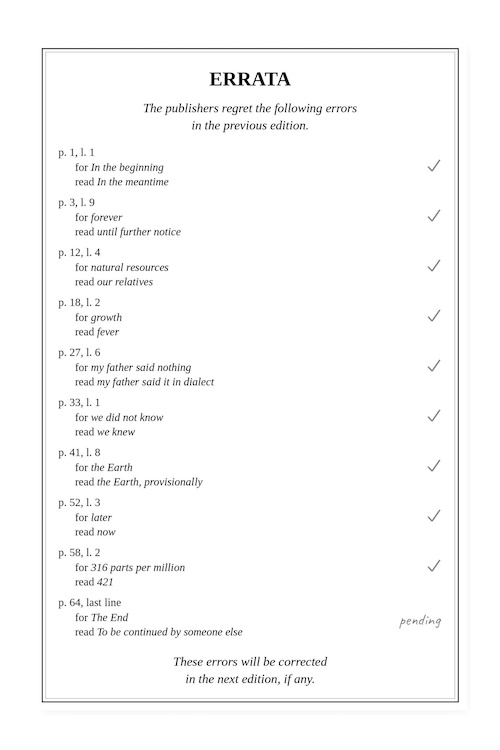
At the back of every book there are two small, quiet pages. One is the errata, where the book says sorry for its mistakes. The other is the index, where it lists everything it ever touched. I wrote those two pages for the book we are all living in. In Errata, the mistakes are real. “For 316 read 421.” In 1959, out of every million particles of air on a Hawaiian mountain, scientists counted 316 of carbon dioxide. In 2023 they counted 421. We have rewritten the sky, and we keep rewriting it faster: three times faster now than then. Every correction on the slip has a tick next to it except the last one, “for The End read To be continued by someone else”. That one is still waiting. It is the only line we can still change.
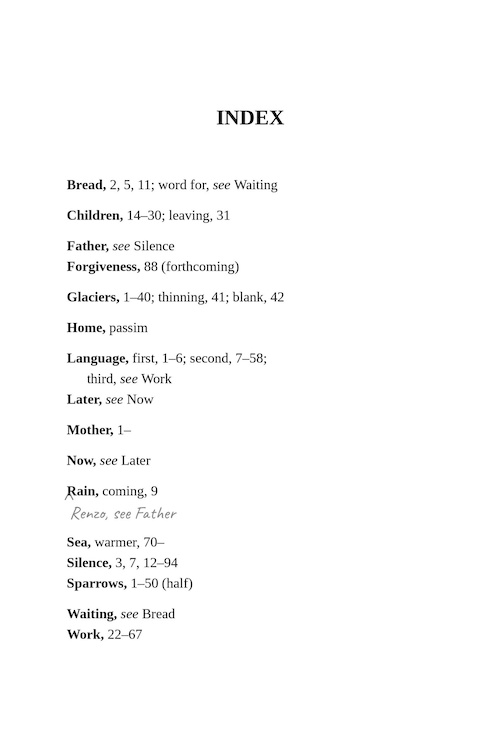
In Index, I didn’t have to make anything up. “Sparrows, 1–50 (half)”: since 1980, Europe has lost 247 million house sparrows. Half of them. One in every two little birds that used to wake us up is gone. “Glaciers: thin ning, blank”: in just two summers, 2022 and 2023, Switzerland’s glaciers lost a tenth of their ice. An index promises that everything in the book can be found again. Some pages already can’t.
I learned what an index was before I knew the word. I grew up in the hills of the Marche, the son of a fattore, the man who kept the accounts of the farms worked by sharecroppers. Every July, after the threshing, the grain was piled on the threshing floor, weighed, and split in two: half for the owner of the land, half for the family who had worked it. My father wrote everything in a ledger: wheat, wine, eggs, oil. There was no line for the swallows in the barn. No line for the hedge. No line for the river.
◊ ◊ ◊