
Randee Silv
August 2026
Interview with Riley Danvers
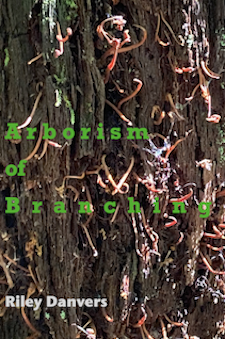
A r b o r i s m of B r a n c h i n g :
Sonnets for Post-Divorce Photosynthesis
Riley Danvers
Randee Silv: Your poetry collection, A r b o r i s m of B r a n c h i n g : Sonnets for Post-Divorce Photosynthesis was just released by Arteidolia Press. Your title is very intriguing and opens up so many avenues of thought. I’m curious what it means to you and how would you like readers to interpret it?
Riley Danvers: This collection documents the emotional evolution of the first year after my separation. It includes not only the separation, but the divorce and the experience of becoming something that is no longer a wife. It’s a shift in identity and sense of self that is imagined through nature imagery, a loss of what’s no longer serving me to make room for the new bloom in spring. This is the Post-Divorce Photosynthesis.
In the same way that who I am changes as the collection moves through each of the four seasons, so too do the sonnets themselves. Sometimes they hold the structure of 13 lines, sometimes they don’t, and never do they rhyme or follow a specific meter. As my wife-self is deconstructed, the sonnets are as well, becoming their own trees in the forest I imagine myself within. Like me, they reach out to find themselves in the aftermath of becoming something different than they were before. This is the Arborism of Branching.
Randee Silv: Perfectly said. Transitions. Transformations. A depth in connecting to nature all come across so strongly in your poetry. What brought you to writing poetry? And how has poetry shaped your life?
Riley Danvers:I first started writing poetry in the 3rd grade. My class learned about haiku and I was immediately obsessed. I started carrying a notebook around with me so that I could write haikus all the time. It’s what made me want to be a writer. I eventually fell out of writing poetry (school and life changes) and didn’t return to it until I was in grad school. I was PNCA’s MFA in Creative Writing program; it was a low-residency and for the second semester, I was paired with the poet Matt Hart as my faculty mentor. I was originally a prose track student, but I asked him if I could include a couple poems with some of my packets for the semester. His response, “Why don’t you send me a prose packet and a poetry packet for all of your packets?”
I was absolutely thrilled, and by the end of the semester I had changed from a prose student to a poetry student. My creative thesis turned into my debut collection of poetry, Even the Air, Too Heavy.
Poetry has changed my life in more ways than I can express. I’ve used poetry as a means of processing trauma, abuse, neglect, loss, grief, love, sex, identity. It truly has become as natural to me as breathing. I’m constantly reading poetry and writing it. To be more specific, poetry is how I make sense of the world: it’s how I find myself in myself, how I find myself in relation to the many selves I’ve been and continue to evolve into, and how I find myself connected to other people and places and plants and animals, etc. It’s how I process life and what it means to be alive.
Randee Silv: Yes, poetry can be a pretty powerful force. What I’ve noticed in your writing is that even though you’re addressing very deep & intense experiences, your writng is not indulgently emotional or looking for sympathy. Was this a choice you made, or did it just work out this way?
Riley Danvers: My poetry used to be incredibly emotionally indulgent. No real nuance. No ability to see beyond myself into something greater than me. Just emotional word vomit on the page, and while this can be a good starting point for poems, it can also detract from the actual point of the poem, which is to branch outward. It’s one thing to want your work to resonate with the emotions of the reader, and it’s another thing entirely to consume the space between the poem and the reader with only your emotions. Readers need room for their emotions to mingle with my emotions on the page. Emotionally indulgent writing, in my opinion, makes this an impossibility.
I learned to identify this through revision. If what I wrote was cliché, it was usually because it was too emotionally indulgent. That kind of writing can only draw on the cliché and the common because it’s skipping off the surface of what’s being written about. Taking something cliché and revising it, turning it into something that isn’t cliché, is where the emotional heavy lifting of poetry shines. Interestingly enough, emotionally indulgent writing actually tends to lack emotional depth, whereas emotionally evocative writing builds the subject/poem into the heart of the experience.
Sympathy is a tricky one. I think it’s something we all want from our audience, but it cheapens the emotional impact if we’re asking for it. It’s important for poetry to pull people inward while moving itself outward, and this isn’t accomplished by telling the audience that they need for feel sorry for me. Nor is that my goal when I write a poem. I want my work to give them something, not ask something of them. This is accomplished by resonating with the reader, expressing experiences that they may be familiar with in ways that leave them feeling their own emotions, not just reading about mine. This is how we make room for our readers to experience our work without taking up all of the space.
This is a long way to answer your question, but I guess I’d say that these are choices I made as I learned how to write poetry. They’re things I’m conscious of whenever I start writing and revising my work. They keep me centered.
Randee Silv: Thanks for taking us inside your writing process and evolution. Your clarity on what’s important to why you write really comes across in your poems. I’m wondering if you have explored other forms of writing besides poetry, and what you might be working on now.
Riley Danvers: Poetry is my primary genre; it’s what provides structure and purpose to my life, so it’s what I tend to gravitate towards most often. However, I do also write and self-publish novels under a different name. I retell fairy tales as dark fantasy stories where the main characters are assassins. I also have a Regency romance series where I reimagine Greek myths in a Regency setting.
I haven’t been working on my novels much this year. With the rise of generative AI in artistic and writing spaces, it’s been extremely disheartening and frustrating. Not to jump on too much of a soap box, but “authors” using genAI to write, edit, design, and market their books has oversaturated a market that was already oversaturated, making it that much harder to earn any money from writing. Large publishers are accepting manuscripts that have been written with AI in some capacity, despite its overwhelming lack of popularity among most authors and readers, and the already enormous effort it takes to market my work to my audience is made even more challenging.
Which means my fiction writing is on a hiatus. I haven’t had any motivation to touch either of the novels that are current works-in-progress for over six months. Instead, I’m working on another manuscript of poetry. The working title is A Body Ripe for Talons. It’s a meditation on what it means to be woman/femme in a world dominated by patriarchy. And while I do explore themes similar to those in my previous poetry collections (abuse, divorce, marriage, miscarriage, etc), these poems move into and out of these experiences through the lenses of different female literary archetypes: the madwoman, the Gorgon, the siren, the witch, and the crone. I use imagery based on these archetypes as well as quotes from different literary texts that connect to them as a way of painting a portrait of womanhood, feminism, sexism, and the ways in which women are defined by their roles in society.
For example, Bertha Mason, the madwoman in the attic in Charlotte Bronte’s Jane Eyre, is presented in the novel as a wild animal, a creature, a beast, a monster that isn’t human. These observations are made by Jane herself as Mr. Rochester provides a narrative that paints himself as a victim and a hero while Bertha is the threat to Jane’s happiness. In my collection, I am both Bertha and Jane (Jane is the me who was naïve and married a man who was, himself, a hidden monster, and Bertha is the me who had to survive him), and the attic is my marriage.
The collection is still young and needs a lot of work. I’m working on the Gorgon section currently, but I hope to have the manuscript mostly done and ready to send out for publication by the end of this year.
Randee Silv: It’s crazy how so many writers prefer to use AI and how it’s saturated all aspects of creative expresssion. I appreciate your commitment to the personally written word. All your projects sound really interesting in how they open such a wide range of possibilities for you. If you were going to give writers who are either starting out or have been trying to find their way in the publishing world, what advice would you like to offer them?
Riley Danvers: This is a great question. There are so many pieces of advice I can offer, especially as the publishing world continues to change. But I’ll keep it simple with these three:
To the other poets, my number one piece of advice is to read as much poetry as you can. Read poets who are writing the types of poetry you want to write and read poets who are writing the types of poetry that are different from yours. Read classic poets. Read modern poets. Read the poets that challenge you the most. And when you find a poet whose work resonates with you, read everything they’ve written as if they’re the only poet on the planet. The more you consume poetry, the more you will understand the poetic path. It’s kind of like alcohol poisoning, but without the negative physical effects: the more poetry you put into your body and your mind and your soul, the more it will become part of you.
The second most important piece of advice is to write as much poetry as you can. The more poetry you write, the more you can hone your craft. The more you hone your craft, the more confident you will be in your own writing. Regardless of which publishing route you choose, you will need confidence in your own writing. You will face rejection. You will face disinterest. You will face ridicule. There will be times when the only one who believes in your work is you, and you need to be able to push through the negativity and keep writing.
The third piece of advice is to learn how to accept feedback on your work. As tempting as is it to ask your friends and family to read your work and give you feedback, more than likely they are not going to give you any feedback that’s actually constructive.
I went through this in my M.F.A. program. I sent the rough draft of my creative thesis to one of my closest friends at the time just to gauge what her initial reaction would be. She was a poet too, so I figured she could appreciate my poems, but also give me her objective perspective. I told her the poems hadn’t been revised yet, but I was going to work on them heavily before sending them over to my faculty mentor for her initial feedback.
Her actual response: “These are great! They don’t need any revisions! You should try and publish them as they are!”
I never sent her another piece of my work ever again. She probably meant well, but that kind of “feedback” is useless when you’re trying to become a better writer. It was also setting me up for failure because the feedback I got from my professor was brutal and showed me that my poems needed a lot of revision.
Learn how to accept even the harshest criticisms. That doesn’t mean you have to listen to every piece of feedback you get from people. You’re still the writer of your own work: you have the ultimate say over what changes are and are not made to your poems. But you must develop a thick enough skin that you can try and see what people are saying. Even the best poets still need feedback on their work, and learning to accept criticism is also how we learn to critique our own work.
If you don’t know who to send your work to for feedback, I suggest finding a local writing club. Sometimes these are even on the campuses of community colleges and open to the public. You can also sign up for writing classes at community colleges, attend writer’s conferences in your area, attend open mics and read your work out loud, etc. These are all different ways to get different kinds of feedback on your work.
For more info and to order a copy of
Arborism of Branching: Sonnets for Post-Divorce Photosynthesis →