
Daniel Barbiero
September 2026
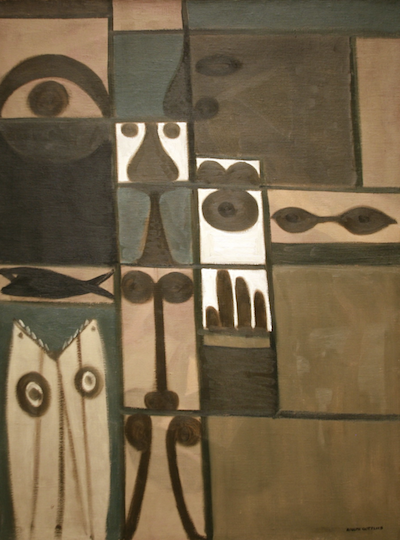
Gottlieb, Pictograph, 1942
Linguistic Myth, Poetic Truth (on Gottlieb and Vico)
Pictograph, Adolph Gottlieb’s 1942 oil on canvas painting of mysterious, juxtaposed figures, is a visual paradox. A landmark in American modernist painting, it seems just as much a message from the deep past—a message transmitted in the semiotic code of a proto-writing system. Gottlieb’s isn’t an archaeological reconstruction but rather an imaginative construction, a hypothetical answer to the question of what the first writing might have looked like. It’s an answer that, by a kind of uncanny postshadowing, converges on a similar answer to the same question as given by the 18th century Neapolitan philosopher Giambattista Vico.
Between the Painterly and the Graphic
Pictograph is one example from a series of paintings, executed from 1941 to 1952, to which Gottlieb gave the general name “pictographs.” Although individual paintings within the series vary in appearance, sometimes substantially, all share an iconography composed of simply drawn, sign-like, figures distributed across the canvas. This particular pictograph is divided up into an irregular grid which forms twenty-one rectangular sections or compartments of different sizes and proportions. While a few of the compartments are empty, most contain these stylized forms. Among them we can recognize eyes, appearing individually or in pairs; two figures suggesting an eyes-and-nose motif; a hand with fingers extended; and two fish, a small one oriented horizontally and a larger one oriented vertically.
In this as in the other pictograph paintings, Gottlieb makes no attempt to create an illusion of spatial depth. His forms appear as flatly painted line drawings on flat backgrounds rather than as depictions of three-dimensional objects extended in space. The colors are dull and austere: browns of varying hues; taupe; steel blue-green; darker and lighter grays. In all, the picture embodies a tension between the painterly and the graphic, with the latter predominant. What it suggests is something closer to a neolithic cave painting, Egyptian hieroglyphs, or prehistoric rock art than to more conventional, illusionistic painting. Gottlieb was well aware of the “unpainterly” quality of his pictographs, and of the parallels that had been drawn between them and primordial sign systems. As he acknowledged in a 1955 statement, “My Pictographs have been linked with totem-poles, Indian writing psychoanalysis, neo-primitivism, private symbolism, etc., the implication being that my work is not quite what painting should be.” But as he was quick to add, “This has never disturbed me because my aim has always been to project images that seem vital to me.”
The pictographs’ images do have a vitality, as Gottlieb wished. It’s an uncanny vitality that derives from their seeming to belong to a past language-before-there-was-language—the kind of proto-language that was hypothesized by Vico in his magnum opus The New Science. In that comprehensive work, a universal history as well as an archaeology of knowledge avant la lettre, Vico speculated that before there was language proper—before there was fully articulate speech with commonly used words whose meanings were generally agreed upon—it evolved through two prior stages: first the “hieroglyphic,” and then the symbolic or metaphorical. Pictograph is strongly suggestive of the first, “hieroglyphic” stage.
The “Hieroglyphic” Proto-Language
Vico’s “hieroglyphic” proto-language was a primordial “mute language of acts and objects” in which ideas were acted out mimetically or represented by the real things associated with them (Vico, #32). Vico asserted that this mimetic mode of communication provided the principle underlying its associated pictorial language of “hieroglyphs,” for just as the gesture or object communicated a corresponding idea through immediately sensual means, the “hieroglyph” communicated the same idea by depicting an image—presumably a simplified or stylized image–of the gesture or object.
I hasten to note that this brief resumé of Vico’s speculations on the ur-language is a reconstruction, since his own account is neither systematic nor technically precise. But it does seem clear to me that for him the ur-language was ideographic, which is to say that it represented ideas through the pictorial depiction of physical phenomena, and appeared prior to the emergence of a recognizably articulate, spoken language. (It’s striking how Vico’s speculation that writing preceded speech anticipates Jacques Derrida’s similar, controversial assertion, made for entirely different reasons, two centuries later.)
The ur-language’s conceptual kernel, Vico thought, was something known intimately to its users: the experience of their own bodies. Vico’s intuition was that early humans would take what they knew most directly—their own body, with its anatomy and physiology, its movement and activities, its sensations and feelings–and cast the things of the world into its image in order to make them comprehensible. He further speculated that the body, as the universal point of reference, would serve as the source of the poetic identifications, or analogies, around which the rudiments of knowledge could coalesce and be expressed. These analogies would take the specific forms of synecdoche, or using a part to represent the whole, and metonymy, in which the body part would be used to symbolize a quality or activity associated with it. Here is how he put it in The New Science:
[…] when [man] does not understand he makes the things out of himself and becomes them by transforming himself into them. (Vico, #405)
In such a logic, sprung from such a metaphysics, the first poets must have given names to things from the most particular and the most sensible ideas. Such ideas are the sources, respectively, of synecdoche and metonymy. Metonymy of agent for act resulted from the fact that names for agents were commoner than names for acts. Metonymy of subject for form and accident was due to the fact that, as we have said […] they did not know how to abstract forms and qualities from subjects. […] (Vico, # 406)
In sum, at its core the original “hieroglyphic” language comprised images of the body and its parts, which it used to convey its meanings through the poetic modes of synecdoche and metonymy. It was through these synecdochal and metoymic analogies, rooted in the body and extended beyond it, that general concepts could be extrapolated from concrete objects and gestures, and could be represented through pictorial images of those objects and the parts of the body engaged in the gestures.
From Linguistic Myth to Poetic Truth
What Vico gives us with his “hieroglyphic” language expressing itself through synecdoche and metonymy is, I think, a linguistic myth. By “myth” I simply mean a story of origins we should take figuratively rather than literally—something that (may have) happened in a time-before-time. Of course it’s also true that Vico’s account may be a myth in the sense of a mystifying, false belief or simply a “just-so story.” We know, for example, that in assuming that hieroglyphs were purely ideographic, when in fact they also were phonetic and alphabetic, Vico, like many others of his time, misunderstood how the Egyptian writing system worked. On this empirical point he was wrong–hence my insistence on putting “hieroglyph” in quotation marks when referring to Vico’s ur-language.
If I believe his account of language’s origins is a myth and possibly not literally true, why then do I bring it up? Because it contains a poetic truth. This truth, which we can see if we strip Vico’s speculations of their empirical and evolutionary claims, is that synecdoche and metonym, extrapolated from the intimate human relationship to the body, provide a basic and intuitive ground on which to build analogies and from which to convey meanings both literal and figurative.
Recent linguists would agree, and have shown how this can be with a rigor Vico lacked. Roman Jakobson, in “The Metaphoric and Metonymic Poles,” held that metonymy, and by extension synecdoche, which he considered a special case of metonymy, is based on relations of contiguity or proximity that tie the signifying figure to the object or idea it signifies. Lakoff and Johnson stress that this tie often is physical or causal (Lakoff and Johnson, p. 39). Hence metonymy’s designation of an agent by an action or a cause by an effect, (or vice versa), or an object by the name of its exemplary or proverbial user or producer (which would correspond to Vico’s “subject for form or accident”). In sum, the metonym’s elements of expressed figure and implied concept are associated by the concrete, perceptible adjacency of a relationship that is often functional in nature.
Both Jakobson’s and Lakoff and Johnson’s analyses bear out the essential poetic truth of Vico’s account, which turns on the insight that a certain analogical poetry, specifically the poetry of body-centered synecdoche and metonymy, lies at the root of human thought and language. This same poetic truth, expressed in Gottlieb’s stylized figures, can be found in Gottlieb’s Pictograph.
Parataxis and the Preconceptual
The most striking figures in Pictograph are its eyes and the image suggesting an eyes-and-nose motif. These figures recur frequently in the pictograph series; we can imagine that for him they were prominent, subconsciously powerful symbols charged with affect. Although they read more readily as metonyms than as synecdoches, it is possible to see some of them as representing part-for-whole substitutions. The ocular images might serve as the part-for-whole representation of someone whose eyes perform the essential function that defines him or her–perhaps a seer or visionary, even a blind one, like Tiresias. This was in fact how Gottlieb had previously used the figure of the eye in 1941’s Oedipus, all but one of whose grid compartments contain images of the organ with which the mythological figure is most closely identified. The eye and eyes-and-nose motifs in turn suggest metonyms based on functional substitutions. Both eyes and nose serve as agents of essential life-sustaining activities, seeing and breathing, which are experienced concretely in the texture of daily life, and hence their images come to stand for those activities. From representing these observable and constantly experienced bodily activities they come, by extension, to stand for the associated substantive notions of vision and breath, as we move by analogy from the specific actions (seeing and breathing) to the general faculties those actions instantiate. Vico surely would’ve recognized these and other of Gottlieb’s pictographic images as akin to the “hieroglyphs” of his proto-language.
Beyond the metonymic and synecdochal significations these images have as individual units, their arrangement in relation to each other is suggestive of a proto-language as well. The individual forms are separate and isolated, each in its own compartment. There is nothing like the hierarchically ordered syntax of a fully developed language at work here. Instead, Gottlieb’s arrangement of the figures within the picture plane effectively underscores the independence and equal force of each form’s signification. This was a deliberate strategy on Gottlieb’s part. As he put it in a 1944 statement, “I juxtaposed my pictographic images, each self-contained within the painter’s rectangle, to be ultimately fused with the mind of the beholder.” Looking back in 1967, Gottlieb further explained the methodology and aims underlying the series:
I would start by having an arbitrary division of the canvas into rough rectangular areas, and with the process of free association I would put various images and symbols within these compartments. And it was irrational. There was no logical or rational design in the placing of these. It was purely following an impulse, which was irrational, trying to use the method of free association. And then when all of these images and symbols were combined, they could not be read like a rebus. There was no direct connection one to the other. And, however, by the strange juxtapositions that occurred, a new kind of significance stemmed from this juxtaposition.
What Gottlieb describes here is arrangement by parataxis. The connections between the individual images are deliberately left unordered beyond the plain fact of adjacency. If such a scheme of arrangement is the product of Gottlieb’s own set of free associations, it also makes it possible for the viewer to associate images on the basis of his or her own associative impulses. If syntax regulates the order in which elements are to be encountered, parataxis instead licenses a certain combinatorial freedom in interpretation. The lines of force connecting images are transferrable and reroutable, yielding many different meaningful clusters or complexes comprising multiple images; the viewer can establish and reestablish associative connections between Gottlieb’s images with a particular fluidity reflecting whatever subliminal criteria he or she brings to an encounter with the work. In effect, Gottlieb’s paratactic structures provide the conditions for the possibility that the viewer’s own imaginative associations will find meaning in his pictographs, and will do so dynamically. What’s striking about this scheme is the resemblance it bears to the Surrealist theory of the image. The latter, which held that the convergence of unlikely or arbitrarily joined elements would catalyze new ideas or associations, was premised on the notion that surprising or unusual combinations of ideas or figures would create startling new meanings–much as Gottlieb’s “strange juxtapositions” would create a “new kind of significance.”
Gottlieb’s statements, with their emphasis on his images’ origins in the irrational impulses of the artist’s unconscious, bring up an essential parallel to Vico’s speculations on the poetic ur-language. For what Gottlieb seems to be aiming toward is the experience of a prearticulate language—a language that trades in sensation and feeling rather than in words and their associated concepts. Once again we think of Vico, whose primordial language was supposed to be preconceptual and presumably concerned with, as well as evocative of, sensations and emotions. And for that reason, operating at an intuitive level, communicating its meaning through the receiver’s ability to grasp it through an analogical leap rather than logical thought. Gottlieb’s pictographs can be said to operate at a similarly intuitive, analogical level as well. The viewer must grasp them through his or her own spontaneous, associative impulses, which may at first manifest themselves in something akin to a sensation or feeling, something initially resistant to being articulated in precise language.
The Sign and the Pictograph
That the interpretation of the signs in Pictograph, as well as in Gottlieb’s other pictographic paintings, occurs other than on the level of precise language is an important ramification of the way in which, as signs within a system of signs, they present meaning. They demand that we grasp their meaning intuitively. We’ve already seen that they embody a certain tension which pulls them between the purely pictorial and the written, though pulling them just off-center and more to the side of the written. For they read like a writing system, or quasi-writing system. But unlike the characters in an alphabetic, phonetically based writing system, the pictographics encode meaning in a way that obviates the need for interpretation to detour through the sound of the spoken word in order to reach meaning.
But this doesn’t imply that the pictograph is a transparent medium that disappears into its meaning. Rather, its pictorial nature emphasizes its materiality, its quasi-thingness, as a medium of sense. It’s just that its mediumship operates in a way that sets it apart from the phonetic alphabet. It refers its meanings to things in the world from which its intended sense can be inferred or derived by analogy (and this is just another way of saying that it works metonymically). To be sure, unlike in phonetic language systems, in which the connection between sound and sense is arbitrary, the relationship between the pictograph’s meaning and its appearance is intimate—it’s pictured, literally—but at the same time the metonymic connection between the pictograph and its meaning implies a need for an interpretive leap from sign to sense. For interpretation can’t go through the conceptual corridors of conventional verbal mediation but instead must proceed by another, more intuitive route. This reliance on intuitive interpretation is generally true of ideographic systems that signify metonymically; what is characteristic of Gottlieb’s pictographs is that the interpretive leap inevitably must take a subjective route that leads through the viewer’s inner web of associations. That’s exactly what Gottlieb hoped to provoke in his viewers, and the deliberately vague and open-ended nature of the meanings of his signs was intended to make sure of that.
What this suggests is that the impact of Gottlieb’s Pictograph arises not necessarily from what its symbols mean, individually or collectively, but rather from how they mean. Gottlieb’s painting is evocative in the way that Vico’s myth of language origins is evocative: it asks us to imagine what the simplest and most direct form of language would consist of, and how it would make itself understood.
References:
Adolph Gottlieb, 1944 statement in Sidney Janis, Abstract and Surrealist Art in America (New York: Reynal and Hitchcock). Quoted in The Pictographs of Adolph Gottlieb, organized by Sanford Hirsch (New York: Hudson Hills Press/Adolph and Esther Gottlieb Foundation, 1994).
Adolph Gottlieb, 1955 statement from the “New Decade” show, in Maurice Tuchman, New York School: The First Generation (Greewich, CT: New York Graphic Arts Society, 1965).
Adolph Gottlieb, 1967 statement, in Dore Aston, ed., Twentieth-Century Artists on Art (New York: Pantheon Books, 1985). Internal cite to Gottlieb 1967.
Roman Jakobson, “The Metaphoric and Metonymic Poles,” in David Lodge ed., with Nigel Wood, Modern Criticism and Theory, Second Edition (Essex, UK: Pearson Educational/Longman, 2000).
George Lakoff and Mark Johnson, Metaphors We Live By (Chicago: U of Chicago Press, 2003).
Giambattista Vico, The New Science of Giambattista Vico, translated from the third edition (1744) by Thomas Goddard Bergin and Max Harold Fisch (Ithaca NY: Cornell U Press, 1948).
◊ ◊ ◊
Daniel Barbiero is a writer, double bassist, and composer in the Washington DC area. He writes about the art, music, and literature of the classic avant-gardes of the 20th century as well as on contemporary work; his essays and reviews have appeared in Arteidolia, The Amsterdam Review, Heavy Feather Review, periodicities, Word for/Word, Otoliths, Offcourse, Utriculi, London Grip, and elsewhere. He is the author of As Within, So Without, a collection of essays published by Arteidolia Press; his score Boundary Conditions III appears in A Year of Deep Listening (Terra Nova Press).
For more info on Daniel Barbiero’s As Within, so Without →
Read other essays & reviews by Daniel Barbiero on Arteidolia’s Archive page →