
Daniel Barbiero
April 2026
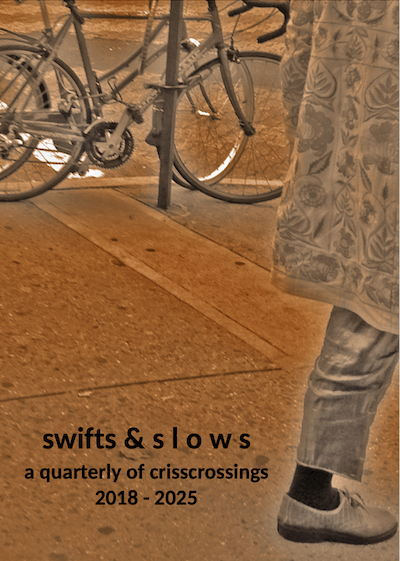
When in 1918 Pierre Reverdy published a definition of the poetic image as the joining together of two more or less distant realities, he was in effect describing the catalyzing potential that two outwardly dissimilar things have when brought into contact with each other. It’s an explosive potential, one that André Breton, taking Reverdy’s idea and developing it further, claimed would spark off something that hadn’t existed before: a new thought. One hundred years after Reverdy’s definition appeared, the online literary journal Arteidolia initiated a quarterly journal within-the-journal that was itself intended as the site where more or less distant realities could come into contact with each other in order to create something new. This journal-within-the-journal was swifts & s l o w s: a quarterly of crisscrossings. and its aim was to foster collaborations—crisscrossings of ideas and aesthetics–by bringing together artists working in different fields and media.
With twenty-six issues appearing between June 2018 and September 2025, swifts & s l o w s brought together poets, photographers, painters, graphic artists, musicians, prose writers, mail artists, video and sound artists, collagists, and artists working in other, less easily categorized fields. From its inception, the quarterly embraced and helped foster a global community of contributors from across North America; Northern, Southern and Eastern Europe; Ireland and England; the Balkans; Scandinavia; Lithuania; Ukraine; Russia; Iran; India; China; Japan; Korea; Africa, and Singapore.
Over the years, swifts & s l o w s underwent gradual shifts of focus, while still retaining its emphasis on an openness to all forms of expression and its belief in art as fostering a global community of like minds. The journal’s eclecticism, present from the very beginning, was clearly stated in the submission guidelines calling for “poetry, collaborative engagements, visual poetry, flash fiction, translations, and anything in between.” The first issue included a heading that was simple but comprehensive: “text &/or visual collaborations & dialogue.” The first several issues were largely taken up with dialogues between pairs of artists creating joint works or juxtaposing their individual contributions in a conversation of contiguity. A number of the contributions consisted of visual works paired with texts, or wordless dialogues of the collaborators’ alternating images. A handful of the contributions were from individual artists whose work, in the context of the journal, contained an inner tension that took on the appearance of a dialogue-within-oneself.
In 2020 the journal’s heading now read “collaborations in any form.” It was a paring down to essentials. Dropping “dialogue” from the statement didn’t signal a retreat from the desire to foster communication but rather an encouragement of collaborative possibilities beyond pairings. In fact the journal hosted a handful of three-way collaborations in addition to the more common two-way collaborations. And the change from the call for text and/or visual collaborations to the call for collaborations of any kind further widened the field of possibility. Because creating “possibility” really had been the essence of swifts & s l o w s from the time it was conceived.
In the June 2022 issue of swifts & s l o w s the heading statement was changed one more time to read “poetry·collaborations·visual poetry·a gamut of possibilities.”
“A gamut of possibilities”—this may be the best characterization of what swifts & s l o w s stands for. Hence this anthology, which serves as a small but representative sample of the work that swifts & slows fostered during eight years of encouraging creative community, gives an idea of how wide-ranging that gamut of possibilities was. By necessity the format of a paperback book prevents inclusion of the multimedia work that graced the online journal, but this volume does contain a generous sample of the verbal and visual compositions that had been swifts & slows’ mainstay.
Whether through outright collaboration, collaboration-by-juxtaposition, or simply putting into contact artists working in their own more-or-less distant aesthetic and geographic realities, swifts & s l o w s forged connections and encouraged the exchange of work and ideas within a global community of artists. In effect, it transposed the Reverdy-Breton concept of the image to the social sphere. In doing so, swifts & s l o w s nurtured a community that wouldn’t have come together as it did without the journal’s serving as a welcoming intermediary.
◊ ◊ ◊
Daniel Barbiero is a writer, double bassist, and composer in the Washington DC area. He writes about the art, music, and literature of the classic avant-gardes of the 20th century as well as on contemporary work; his essays and reviews have appeared in Arteidolia, The Amsterdam Review, Heavy Feather Review, periodicities, Word for/Word, Otoliths, Offcourse, Utriculi, London Grip, and elsewhere. He is the author of As Within, So Without, a collection of essays published by Arteidolia Press; his score Boundary Conditions III appears in A Year of Deep Listening (Terra Nova Press).