
Pria Louka
April 2026
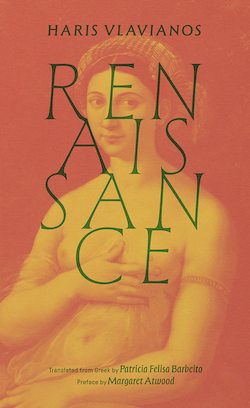
Renaissance
Haris Vlavianos
World Poetry Books
Wild Climbing Vines: The Renaissance Undone and Retold by Haris Vlavianos
Like wild climbing vines, the thirty-six portraits in Haris Vlavianos’ Renaissance unfurl across the staunch walls of historical fact, winding delicate tendrils around “juicy bits”: paradoxes, marginalia, gossip, and the private whispers of letters—what a textbook might overlook as “trivial.” Now available in English, translated from the Greek by Patricia Felisa Barbeito (World Poetry Books, February 2026), the collection captures a medley of artists, poets, scholars, witch hunters, and musicians, bringing to light a Renaissance unseen and untold. Non-canonical figures who slip through the gaps of conventional, often patriarchal narratives (Louise Labé, Isotta Nogarola, Sofonisba Anguissola) stand alongside canonical figures (Michelangelo, Leonardo da Vinci, Raphael), their lives refracted through an entirely different prism. Rather than focusing on Leonardo da Vinci’s celebrated masterpieces, Vlavianos turns to discarded sketches—feverish yet futile attempts to uncover the “astonishing power” of horses and noble women.
The Renaissance is recast here not as a gentle flowering, but as an unyielding explosion, in which the grotesque is wielded as a weapon against institutional authority. “Resistance finds its way” through acts of subtle subversion: Paolo Veronese circumvents Church censorship through a simple retitling—when the Inquisition deems his Last Supper “obscene,” he renames it Feast, leaving the scene wholly intact: “the dwarf and the parrots stayed where they were, / Peter continued to pick his teeth with a fork…” Giordano Bruno is burned at the stake for claiming an infinite universe, only for his statue to be placed, centuries later, buttocks facing St. Peter’s Basilica, ad infinitum. Even Giotto di Bondone’s freehand circle of “breathtaking precision,” drawn in response to the pope’s demand for proof of his mastery, survives in an Italian idiom: “You are rounder, ruder than Giotto’s circle!” Resistance finds its way—living on here through Vlavianos.
As translator Patricia Felisa Barbeito observes, this work embodies an aesthetic of deformitas—of aberration and disobedience—through which Renaissance unfolds in “fracture, asymmetry, and play,” resisting systems that seek to fix meaning. It takes shape as a mosaic-like assemblage: an archival construction animated by intertextuality, hybridity, and playful juxtaposition. Giuseppe Arcimboldo’s portrait of the emperor comes to mind—“a bizarre harvest of a composition,” assembled from fruits and vegetables. Vlavianos’ poem on the artist ends with the emperor grinning inwardly, grateful his nose was rendered as a pear rather than an eggplant—a closing “wink,” capturing a tone of wry irony and delighted discovery that suffuses the work, born of the poet’s deep knowledge and clear affection for his subject.
A key node of this deformitas lies in temporal rupture and fusion, juxtaposition across centuries. Isotta Nogarola’s portrait unfolds as a “dialogue with the dead,” addressed to an unnamed Emily Dickinson—a “sister in arms”; meanwhile, Niccolò Machiavelli’s portrait is based not in biography, but in the elegiac recollection of a beloved professor, himself an ardent admirer of the Florentine philosopher, now gone.
Circling the grotesque and the luminous, the absurd and the rebellious, Vlavianos’ Renaissance—not inherited but lived, embodied—spirals outward across past and present, personal and historical time alike, connecting everything it touches, unruly as wilderness itself.
For more info on Haris Vlavianos’ Renaissance visit World Poetry Books →
Pria Louka is a poet and translator. Her recent translation of Greek Modernist poet George Sarantaris, Abyss and Song, was published by World Poetry Books (2023). Her work has been featured in Asymptote, Caesura, Circumference, and Mantis, as well as in several Greek literary journals. A recipient of a Fulbright Fellowship and a recent Ertegun Scholar at the University of Oxford, she currently lives in Athens, Greece.