
Daniel Barbiero
July 2025
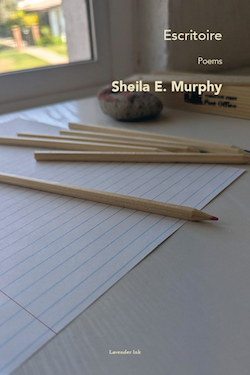
Escritoire
Sheila E. Murphy
Lavender Ink Press, 2025
In Escritoire, Sheila E. Murphy’s new collection of poems, language is given the room to reconstruct the world on its own terms, even if that world is first met through close observation and poignant recollection. Eventually, it finds its way into language meticulously crafted.
Although Murphy’s way of doing things with words takes on a number of thematic and structural guises – ruminations, recollections, and reflections, stream-of-consciousness forays into poetic prose, narrative anecdotes, ludic engagements with form – I find a unity of tone, a kind of self-possessed extroversion through which Murphy reaches out into the world and playfully acknowledges and accepts it for what it offers. She pays close attention to the ordinary, which in the right light can reveal an extraordinary sensual richness and solicit a resonant affective response.
Here, for example, is the short but emotionally dense “Alma Mater”:
1/ A new bird steals through
space between
square fluted columns.2/ Hearting strengthens
covenant of stones.3/ I rub my flute clean,
play it, place it back into
the plush blue velvet case.4/ Spirit mother, soul to me
this long dry patch
of recollection brims with light.
Murphy generates an entire scene and its associated emotions out of the detail of the bird flying through the columns. At work in the image is a haiku-like condensation of a whole into a salient part, reflected not only in the fleeting sight of the bird, but in the way the architectural detail of the fluted columns imply the presence of a neo-classical building on a college campus. (“Alma Mater”’s likeness to haiku is underscored by Murphy’s formal choice of three-line units in all but one instance. And even that single two-line exception recalls the experiments with two- and even one-line haiku form by English language poets.) After registering this scene the poem pivots from the speaker’s perception of the flying bird to a scene of her putting away her instrument, perhaps after a performance or a practice session. Here, Murphy deftly connects two otherwise ontologically distant objects — the fluted grooves on the column and the speaker’s flute – by way of an analogy drawn on the coincidence of their names. As the simple event of the bird flying through a colonnade telescopes out to a second event – the flute being cleaned and put away –, Murphy closes the circle by returning us to the first event with a reflection on the affective pull (the “hearting” of the “covenant” between the speaker and the institution) the speaker’s alma mater (literally, “spirit mother”) has for her. The speaker’s close attention to the bird’s flight has acted on her like a stone thrown into a pond, creating a widening spread of concentric emotional ripples.
The flute in “Alma Mater” gives a hint of Murphy’s own musical background, which includes performing on the instrument. Thus it’s no surprise that musical references and images turn up a number of times throughout her poems. We encounter the “immodest spritz of lively flutes” in the prose poem “Blaspheme, Lurlene,” and in “Encore” read of “flickers of recollection. / resembling my own breath into a flute // producing varying results.” Moving to a different instrument, there is “The Cellist,” Murphy’s portrait of a woman playing prayer-like piece on a cello with gut strings. The detail about the strings is evocative since, unlike the metal strings generally used on modern instruments, gut strings produce a softer-edged, sighing sound appropriate to the performance the poem describes. “Continuo” takes its title from a Baroque compositional convention and has it serve as a metaphor for the complexly interacting parts of – and perhaps even changes of harmony within – a relationship.
In addition to performance, Murphy studied music theory. The awareness of musical structure such studies bring finds a correlate in her attention to poetic form. Here, for example, are the first four quatrains of “I Never Knew”:
We were a tribe of two cocooned in bliss.
I took for granted fragrance of a heaven moon.
I never knew how fragile light and peace would be.
Warm was there when wanted, then cool relief.I took for granted fragrance of a heaven moon.
Vocabulary seasoned with glints of wit and spice.
Warm was there when wanted, then cool relief.
Belief rose from roots to lush branches across.Vocabulary seasoned with glints of wit and spice.
Present tense held tight.
Belief rose from roots to lush branches across.
Our life contained no measurable dross.Present tense held tight.
The olive trees silvered young bird flight.
Our life contained no measurable dross.
Now I lay me down to loss.
Murphy’s arrangement and rearrangement of these echoing and intertwining lines suggest counterpoint or a set of musical variations in which fixed melodies occur and reoccur in different harmonic and other contexts. A closer look reveals that “I Never Knew” is written in the form of a pantoum, a poem of quatrains composed of a limited number of lines that repeat according to certain rules of combination and sequencing. With its line- and rhyme-based linkages forged through varying repetition, the poem binds its constituent parts into a watertight structure – “cocoons” them, in effect. As in many of Escritoire’s poems Murphy meditates on the mysteries of a relationship – apparently a good one, or at least one without “measurable dross,” although the subtle qualifier, combined with the title, leaves open the possibility that the relationship may contain trace amounts of dross nevertheless. Or rather may have contained dross; the line “Now I lay me down to loss” as well as the predominance of the past tense, which comes colored with regret, imply that it’s over. Perhaps what the speaker never knew only came to light after it ended. Throughout, we find a number of striking images and wordplay. For example, the understated if conventional analogy between eyes and windows, and the substitution of “slivered” for the more expected – and previously occurring — “silvered” in “The look of windows echoed sense of sight. / Flute lines slivered toward new heights”, and Murphy’s description of the colors of sunrise as unraveling into “threads of pink and lavender young light”
Murphy also writes – more or less loosely – in the style of the ghazal, an Arabic poetic form of five to fifteen couplets whose endings employ the same word or phrase. Of the three in Escritoire, the one simply titled “Ghazal” comes closest to replicating the standard formal conventions:
Fractions fracture, shift what we elect to think.
We tell ourselves that thinking spawns retrieving.Merciful half loud birds litter the street with
punctuation that safekeeps our retrieving.Posses of arithmetic advance toward
routine left right where we left it, retrievingdaylight that thresholds innocence, behold ferns,
accumulated drops of sun, retrievingwhat we once believed the norm, whole lives stillborn
in locked lanes perpetually retrieving.
In addition to her attention to form here, Murphy shows attention to the sensual qualities of words. The poem may be externally shaped by a pre-given structure, but internally, its rhythms and diction have the improvisational feel of a free play of alliteration, word repetition beyond the requirement of the form, and internal rhyme. To be sure, Murphy often lets her poems seemingly compose themselves through their play of language. The prose poem “Shoe Fly Pie” is built of puns (the title; “matrilineal détente”), off-rhymes seguing into full rhymes (“align, arraign, detain / refrain”), and alliteration or consonantal half-rhyme (“Telltale tantrums leaving doldrums out in the intermittent rain”). In this excerpt from “Late July,” Murphy plays with some of the contrasts she can obtain from words’ aesthetic qualities:
Music does not happen by itself. Music happens by itself. Am I a midwife catching
a tiny squalling miracle in my moist hands? Or the archer taking aim
beyond anxiety? Time allows nothing but an eraser to remove what has
not belonged…
The alliterations on “m” provide a legato, forward motion to the phrasing, while the staccato, repeated “a”s immediately following break up the rhythm into discrete segments. The contradiction is subtle, but it introduces a discernible element of rhythmic dissonance into the flow of the passage.
In the end, it’s difficult to sum up a set of poems as formally and thematically varied as those in Escritoire but – its self-deprecating irony aside – perhaps this line from “I Never Knew” comes closest: “Vocabulary seasoned with glints of wit and spice.”
For more info on Escritoire by Sheila E. Murphy →
Daniel Barbiero is a writer, double bassist, and composer in the Washington DC area. He writes about the art, music, and literature of the classic avant-gardes of the 20th century as well as on contemporary work; his essays and reviews have appeared in Arteidolia, The Amsterdam Review, Heavy Feather Review, periodicities, Word for/Word, Otoliths, Offcourse, Utriculi, London Grip, and elsewhere. He is the author of As Within, So Without, a collection of essays published by Arteidolia Press; his score Boundary Conditions III appears in A Year of Deep Listening (Terra Nova Press).
Link to Daniel Barbiero’s, As Within, so Without →
Daniel Barbiero’s other essays & reviews on Arteidolia →