
Daniel Barbiero
October 2025
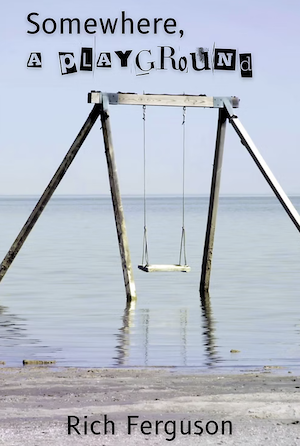
Somewhere a Playground
Rich Ferguson, Moon Tide Press, 2025
In “The Nonnational Boundaries of Surrealism,” André Breton defined “black humour” (humour noir) as the “paradoxical triumph of the pleasure principle over real conditions at the moment when they are considered the most unfavorable.” In its own way, humour represents the assertion of human freedom over the slings and arrows of outrageous circumstances. Somewhere a Playground, the new collection of poems from Rich Ferguson, is imbued with the spirit of Breton’s humour, through which it confronts the catastrophes of contemporary life. And even, somehow, transposes the minor key of humour into the major key of redemption.
Of catastrophes Ferguson gives us many signs. His perspective is of an observer positioned in the midst of the fraying urban fabric of a civilization on the verge of a nervous breakdown – a place of “worried wanderers/ roaming pitiless cities/ of demolished optimism.” Ferguson comments on the follies of the times in diatribes delivered with the righteous rage of an Old Testament prophet – albeit one given to insomnia, as we read in the stream-of-semi-consciousness prose poem “once again, i find myself wide awake in this bed –”, in
this locomotive of instability, batmobile of imbalance, tram ride to slamtime, 911-crankcalling calm breath robber counterfeiting conundrum after conundrum wrapped inside still another conundrum stuffed with lootbags of car alarms…
Leibniz may have claimed –against all the evidence — that ours is the best of all possible worlds, but for Ferguson, it’s a “Garden of Eden Now Bleedin’”,
A complex geometry
where parallel lines
of love and consideration
contend with irrational proportions
of emotional, physical neglect and constriction…The place where one confuses
the highly personal with the universal,
retunes enlightenment to a TV reality
where we can’t stop looking at our phones,
even when in the presence of redemption.
The humour here and throughout the book is in the telling—in the mastery of the situation through language, which for Ferguson is the vernacular diction and improvisatory rhythms of Beat spontaneous bop prosody, carried over into the hyperreal age of ubiquitous media and mass distraction. Circumstances may seem to hold one joke at our expense after another, but language lets us turn the joke around on itself, in the process “Carving intellects sharp enough and weapon enough/ to save ourselves from the dangerous primal instincts/ breeding in our Garden of Eden now bleedin.’”
In the end, in Somewhere, a Playground the potential for redemption is never far away. At the same time that he denounces a utopia “going into foreclosure,” Ferguson suggests that too much of a focus on this flawed utopia’s dystopian strains – too much of a preoccupation with the conflicts and aggression that seem so prevalent now – can be as misleading as an unwarranted Panglossian optimism. History may be “practicing its blindfolded knife-throwing trick again”, but in the end it’s a maddening mixture of the senseless and the transcendent, “A Confection of Chaos and Glory” where
Life teeters on a fulcrum
between melody and madnessA confection of chaos and glory
stuck between the teeth.Some salvage old kisses from love’s cemetery
and polish them anew,while others rub malice and menace into wounds
and call it medicine.Walking the world’s streets,
you can feel the mixed-message brailleof broken glass
and heads-up pennies beneath your feet.The chalk outline of a body here, a bouquet of laughter there —
a teetering between melody and madness.You can feel it in each new earthquake and bomb blast.
Yet even in the most violent moments, when grace dies,its hair refuses to stop growing.
For more info on Somewhere a Playground →
◊ ◊ ◊
Daniel Barbiero is a writer, double bassist, and composer in the Washington DC area. He writes about the art, music, and literature of the classic avant-gardes of the 20th century as well as on contemporary work; his essays and reviews have appeared in Arteidolia, The Amsterdam Review, Heavy Feather Review, periodicities, Word for/Word, Otoliths, Offcourse, Utriculi, London Grip, and elsewhere. He is the author of As Within, So Without, a collection of essays published by Arteidolia Press; his score Boundary Conditions III appears in A Year of Deep Listening (Terra Nova Press).
Link to Daniel Barbiero’s, As Within, so Without →
Daniel Barbiero’s other essays & reviews on Arteidolia →