
Daniel Barbiero
December 2025
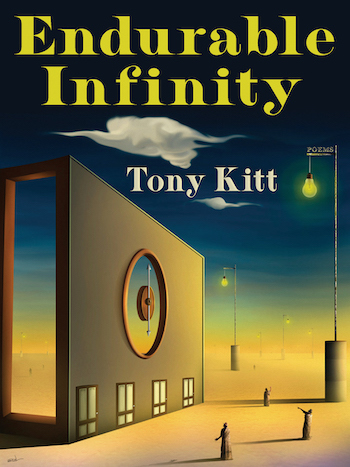
Endurable Infinity
by Tony Kitt
University of Pittsburgh Press
The central tenet of Surrealist and Surrealist-inspired writing is that language reveals through imagery that catalyzes thought. Such imagery, as first defined by poet Pierre Reverdy and then taken up by Surrealism’s chief theorist André Breton, would bring together more or less distantly related phenomena and ideas in a way that would break the straitjacket of rational response—and the more distant the relation, the more powerful and suggestive the image. In Endurable Infinity, poet Tony Kitt brings Surrealism’s fascination with the image forward into a poetic landscape of his own. Kitt’s is not a textbook Surrealist poetry but rather is subtly shaped as much by a concern for the signifying reflexes of language as such as by Surrealist-inspired practice.
Endurable Infinity is the first full-length poetry collection from Kitt. It came out in 2022 but somehow was overlooked; it’s well worth rediscovering. The book is structured as a triptych whose three parts are titled “Close Formation,” “genius loci temporisque,” and “Slanting Through.” The grouping of poems within each section is contrived in such a way as to suggest a unity of tone or, especially in the second section, topic.
One of the purposes of Surrealist writing, as articulated by Breton, was to bring out words’ secret affinities. This is a poetic direction Kitt follows as well. In his poetry these secret affinities are enacted through associative linkages forged both within sentences and between them. Here, for example, is the beginning of the poem “Close Formation” from the book’s first section:
A hunter trails a long-tailed consequence.
It is the sixth nightmare.
Children watch eggplants
grow meaning.
Exuberance exists at the exit.
How would you talk to a mind arrow?
What would you give
for a bullet-proof poem?
Seasonal dying is one profession
one should avoid. I’m doing my beast,
And you are doing yours.
Our genes are our engines.
Questions follow statements and in turn are followed by further statements, but not in order to prod the text dialectically to a further stage of rational development. If anything, they throw an oblique light onto each other, which may illuminate—or better, create–possible meanings. The sixth nightmare of the first stanza may point back to the hunter, who may be experiencing the nightmare or may be a figure within it, or it may point forward to the children and their eggplants. Either possibility trades on the nature of the images, which are dreamlike in their concentration of unrelated ideas. For example eggplants and semantics aren’t concepts that ordinarily travel together, but here they’re linked by the ambiguous verb “grow,” which could be taken literally if the children are watching the eggplants grow on the vine, or figuratively, if they’re witnessing the (symbolic?) meaning of the eggplants come to fruition. At the same time, some of the images’ connections are established on a purely internal, linguistic basis. The words in “Exuberance exists at the exit” are associated by alliteration; their sound is their meaning even as they suggest the idea of the cheerfulness one might feel at the end of something, when leaving it. The punning substitution of “beast” for “best” explodes the cliché “I’m doing my best” and evokes the biological bottom line of animal existence, which in turn sets up the allusion to the gene-driving procreative impulse at the end of the stanza. There is a closeness to these linguistic formations, but it’s measured by a set of standard stoppages made up of units of their own choosing.
Kitt’s mastery of imaginative suggestion is highlighted in poems like the (possibly) ekphrastic “Yves Tanguy”:
Moonlit colors out of a silken jar
The book of whispers
responding
not responding
Distortion has its weather
You’re unmoved
you’re a stone wearing dragonfly silver
a brush tree devoid of soil
Breathe the foliage salt
breathe the circumstances
The wind in a bottle-trap
The ivory hooves of exile
The first thing to notice is the sheer beauty of the images: “Moonlit colors out of a silken jar”; a “book of whispers”; a “stone wearing dragonfly silver.” The distant realities brought together in each of these images conspire to catalyze a sense of immediate pleasure even before any meaning is revealed. Although Kitt doesn’t indicate whether the poem is “about” any of Tanguy’s paintings, the imagery suggests certain of the paradigmatic qualities of his paintings in general. The first line is as good an evocation as any of the atmosphere of Tanguy’s early quasi-marinescapes, which seem to show strange vegetation growing from a pallidly lit ocean floor. The impression is enhanced by the images of the “brush tree devoid of soil” and the “foliage of salt.” The line “you’re a stone wearing dragonfly silver” calls to mind Tanguy’s late paintings, which feature spaces crowded by rock-like projections of steel blue. In “Yves Tanguy” we may not get a particular Tanguy, but we do get the concept of Tanguy in an economical vocabulary.
“Calabria (3)” is a poetic invocation of a genius loci temporisque—a guiding or guardian spirit of a time and place. The poem unfolds in fragmentary images that present this southernmost part of Italy in a mosaic of unassembled parts:
Sirocco, its sandy hair
a swim-dark sky
palm trees and centuries
Sicily rises from the mist
roads unroad
the Cartesian circle has re-emerged
as black hole
into another infinity
Kitt finds the spirit of the place in the hot wind blowing over beach sand, in the sea reflected in the sky, in the view of Sicily from across the Straits of Messina, and in the seemingly infinite ancient history that hangs over the land and pulls everything toward it like a black hole. In “Aeolia,” titled for the mythic island thought to lie off the northeastern coast of Sicily, near Calabria, Kitt further captures that pervasive sense of time’s heavy presence:
Time is a mirror where the past poses
as the future; history a jellified air.
A moment we live in, a rockery
of thoughts. Rodents. A sundial.
The past threatens to determine the future as history literally congeals in the air and thought, perhaps calcified in its repeating patterns, takes on the qualities of the rocky landscape. The metaphorical identification of time with a mirror is a nice move within the Surrealist language game of analogizing phenomena that share little or nothing in common, as is the identification of the intangible—thought on the one hand, air on the other—with the tangibly solid or semi-solid substances of rock and jelly.
For Kitt, the spirit of a place is a hybrid made of the physical contingencies it’s composed of as overlaid—and transmuted—by what Breton in a different context called the will to objectify the subjective. In the end, it’s this imaginative engagement, characterizing all of the poems in the book, that makes infinity endurable.
◊ ◊ ◊
Daniel Barbiero is a writer, double bassist, and composer in the Washington DC area. He writes about the art, music, and literature of the classic avant-gardes of the 20th century as well as on contemporary work; his essays and reviews have appeared in Arteidolia, The Amsterdam Review, Heavy Feather Review, periodicities, Word for/Word, Otoliths, Offcourse, Utriculi, London Grip, and elsewhere. He is the author of As Within, So Without, a collection of essays published by Arteidolia Press; his score Boundary Conditions III appears in A Year of Deep Listening (Terra Nova Press).
Link to Daniel Barbiero’s, As Within, so Without →