
Daniel Barbiero
April 2026
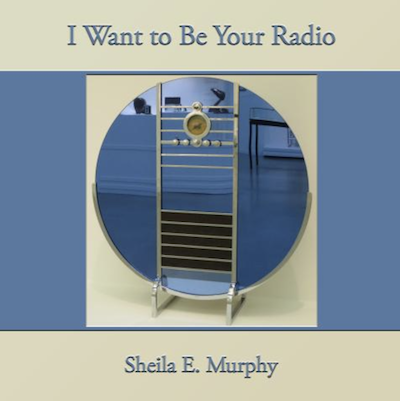
I Want to Be Your Radio
Sheila E. Murphy
Unlikely Books
I Want to Be Your Radio, Sheila E. Murphy’s latest volume of poems, is a rich collection of free verse, prose poems, and poetry written through her adaptations of the formal conventions of pantoum, ghazal, and haibun. As in her previous collection, Escritoire, in I Want to Be Your Radio Murphy engages language through both sound and sense, bringing out its musicality as well as its meaning. In the following conversation, conducted by email the first week of April, she talks about process, the attraction of formal constraints, language-as-melody, and much more.
Daniel Barbiero:
When I get a new book of poems the first thing I do is leaf through it to get an overall sense of what’s inside and to let something jump out at me and force me to pay attention. In I Want to Be Your Radio it was the title poem. It’s a long, unpunctuated—stream of consciousness? Of semi-consciousness?–quasi-sentence that seems to encapsulate the creative act of writing a poem, beginning with that initial “dis-/cursive urge/to open up and/ sing tetrameter”. As the poem unfolds, the language seems to take over the steering, as if the initial creative impulse is impelled to realize itself in a pure play of words. Is this poem giving us a window into your creative process?
Sheila Murphy:
Great way to launch this conversation Dan! This day-and-night explosion on the page emerged as a poem I frankly never dreamed would yield the title for this book. The realization came late in the process when Tobey Hiller guided our re-consideration of an array of possible titles. On re-hearing the title of this poem, it became the one. So much depends on the perpetual listening, as “these heavenly opinionated yawlings” advance us collectively amid proprioception / kinetic force that draws us forward collectively as I find myself in the continual act of ear tuning with “yet more / trebling possibilities to snatch daylight to “match / the hatching of yet more / trebling possibilities / to snatch daylight / from calm otherwise.” I keep re-discovering ways that “all of us” are woven together as we move forward in the various acts of living and working and sensing. From an aesthetic viewpoint, “I Want to Be Your Radio” is more a blast of observation than an ars poetica, detailing in quick succession the process that patches lines, sounds, even music to form something best described as “itself.” All of this with energy, surely a primary gift, gathering language as my preferred melodic form, in which I hear both the said and the unsaid with the “zest” mentioned early in the poem. And it’s “constant” as “the constant / midnight song / across a constant highway.”
Daniel Barbiero:
We’ll get back to the book in a minute, but for now I just want to say that “language as my preferred melodic form” suggests so much. Is poetry music carried out by other means?
Sheila Murphy:
A very stimulating question, Dan. Poetry music arrives both by design and by emergence. As a fan of natural and thus unforced reciprocity, I cradle poetry music that comes to me via voices human and in nature, surely including silence, of which I produce all too little! Poetry music needs listening to occur and extend itself into existence. As you know, Dan, auditory ingredients are prominent for trained musicians. Likewise, I sense the bountiful music in visual art and in movement, too. And touch, alongside the perfume of flowers and creosote here in the desert. The sense of taste, too, prompts recognition, more perhaps for some people than others.
Returning to movement, I revel in motion, my own when walking sometimes considerable distances on a nearly daily basis. The chemical changes in the body seem to spawn word or sound music in my mind. I know I am not unique in this, yet I mention it because of appreciating the lovely energy. I also love being in motion, both on planes and trains, especially trains, that uplift a special clarity and even joy.
Color and shapes also present themselves to the psyche, yielding a sort of symphonic splay of light and shadow. A minor confession: When driving, I used to listen to NPR programs. I have recently replaced that practice of hearing news-as-(tedious) gossip column with a steady diet of classical music. As that music pours itself into my soul, a purity and constant surprise feeds me such events as an Impromptu by Schubert, a familiar dose of Stravinsky, and more recently some new (to me) gifts of Alla Pavlova, Jeri Southern, and Bill Evans. I commit to designing and being open to emergent ways of discovering and making poetry music.
Daniel Barbiero:
This brings me back to something you said earlier, about “ear tuning.” Clearly there’s also a tuning of the eye to the ear and vice versa. And of course it doesn’t surprise me that music runs as a kind of continuo throughout what you do and experience. In I Want to Be Your Radio it’s a recurring source of vocabulary, images, and analogies. There’s a lyrical description of a young French horn player – I imagine her as finishing up a lesson, although if her tone really is “as mellow as a faun” she probably is no beginner! There’s also “The Woodwind Sphere above Middle C,” a prose poem in which music appears more obliquely, the sound of the classical radio station in “Last Call.” We even find Schubert in “Long Live Present Tense.” And there’s much more. I wonder, what is it like for you to translate music—and sound generally—into words? The two modalities are so different in so many ways.
Sheila Murphy:
You ask about translating music and sound into words, Dan. As I consider this intriguing question, I would submit that what was happening when composing the sestina “Long Live Present Tense” and the free verse piece “Last Call” may differ from the act of translation. Rather, in these poems, grief virtually perspired the words. Closely related to your question is the issue of formal structure. Forms in poetry ironically facilitate a new freedom that a less restrictive process would deny. As you say, the modalities of music and words are quite different. For me, words become their own melody or melodies. Having consciously turned away from the flute and voice as primary performative forms and making art in words primary has meant even more portability for me. Given your own instrument, the bass, you may laugh at the idea that the flute metaphorically became too heavy for me to heft around. That’s a whole different conversation. I needed, oddly, more elbow room in which to flex and reach for the stream of sounds coming to me, as though mirroring a ticker tape from days of yore that I sought to grab as I sifted what was there.
Daniel Barbiero:
Oh no, I don’t at all doubt that the metaphorical weight of the flute—or of any instrument—can get to be too much to carry. It’s our experience that determines when it does, not the scale. But I’m glad that you brought up the matter of formal structure in poetry, as I wanted to ask you about that. I Want to Be Your Radio, like earlier work of yours, includes poems cast in given forms—ghazals and pantoums, and what looks like a variation on the haibun. I think we both would agree that form constrains, but that when allowed to it can be an enabling constraint. I wonder, was there anything that attracted you to these forms in particular?
Sheila Murphy:
Thanks for that, Dan. I’ll discuss the three forms you reference. I vividly remember the day when traveling on business and lugging poetry with me, I came upon John Ashbery’s “Six Haibun” in a 1984 issue of Sulfur. Those poems that would later appear in Ashbery’s A Wave woke something in me. Ashbery’s use of the form, notably with inclusivity of subject matter alongside leaps in tone and perspective prompted me to scribble out a haibun. To fortify my understanding, I later procured the anthology From the Country of Eight Islands to help me understand how the form worked in the original Japanese language. Immersion in that volume supported the logic of employing the single-line haiku at the end of each piece, as Ashbery had. Later, I termed what I was doing “American Haibun,” to solidify use of a single-line haiku of an indeterminate number of syllables with no terminal punctuation following the prose passage. The leap from prose patch to single line brought an often surprising connectivity between the two. Although some magazine publishers prefer to see a three-line haiku appear at the conclusion of the prose passage, I am not drawn to that practice myself. By now I’ve written a vast number of haibun, finding them natural and revealing. Two early books of mine, With House Silence (Stride Books, 1987) and A Sound the Mobile Makes in Wind (Mudlark #4, 1998) were composed of haibun.
The ghazal form brings great potential for the kind of leaps I referenced when speaking about the haibun form. My own use of the form involves writing dispensing with the rhyming requirement of the traditional form. For a structural sense of integrity, I have recently sought to maintain continuity in syllabic count within each line of the couplets. Most attractive to me about the form is the often surprising relationship that emerges from one couplet to the next, potentially affording a sense of discovery and satisfaction. American poets as diverse in style as Jim Harrison, William Stafford, Adrienne Rich, and Heather McHugh have worked in the ghazal form.
The pantoum emerged as a point of focus when I heard Anne Waldman perform at the Bisbee Poetry Festival and included a reading of her “Baby’s Pantoum,” which dazzled me. The folding of lines two and four into lines one and three of the succeeding stanzas, and closing the poem with the initial line, makes for palpable music. As you might suppose, I wound up writing many pantoums. One of these elicited an amusing line: “Tiny animosities convene in my fat cells.” Such moments as this keep me writing poetry.
Daniel Barbiero:
Now that you mention it, I remember reading Ashbery’s haibun several years ago in A Wave. Back in the ‘80s I was familiar with trends in American haiku and was intrigued by the one-line haiku that some poets were experimenting with at the time. Something about the extreme economy of expression was appealing to me. Having read your own, my sense that the form holds possibilities worth pursuing is reaffirmed. And now let me pursue one final question. There’s a line from one of the ghazals I found particularly striking: “words happen by accident.” I can’t resist asking: Do they?
Sheila Murphy:
As we close this conversation, let me express my gratitude, Dan, for your thoughtful and insightful questions that challenged me to consider several facets of this book. I also appreciate your noting how you’ve experienced the one-line haiku that I agree offers much potential, both within the haibun form and as a standalone poem. As for “words happen by accident,” the way this line functions in this piece is as a kind of retrospective camera capturing the past, including disparate elements brought together in an ephemeral whole. I doubt that I could pluck this line from this context and make a solid argument for its truth. As I read the poem closely, I might observe that our lives are replete with chance and intention. How we weave these is surely singular.
For more information on I want to Be Your Radio →
◊ ◊ ◊
Daniel Barbiero is a writer, double bassist, and composer in the Washington DC area. He writes about the art, music, and literature of the classic avant-gardes of the 20th century as well as on contemporary work; his essays and reviews have appeared in Arteidolia, The Amsterdam Review, Heavy Feather Review, periodicities, Word for/Word, Otoliths, Offcourse, Utriculi, London Grip, and elsewhere. He is the author of As Within, So Without, a collection of essays published by Arteidolia Press; his score Boundary Conditions III appears in A Year of Deep Listening (Terra Nova Press).
Link to Daniel Barbiero’s, As Within, so Without →