To Order a Copy →
Review in SYNCHRONIZED CHAOS
Phrases and words are both familiar and unfamiliar at the same time. We can recognize the language and sometimes we can understand it, though oftentimes we don’t even care to because the verbal dexterity, the jarring juxtapositions, the mash-ups, and clever portmanteaus enthrall us. Neil Flory’s poetics is enthralling! A spattering, crowded, endlessly inventive mélange.
Read the full review here by Joshua Martin →
Arts on Fire: WRFA Community Radio in Jamestown, NY
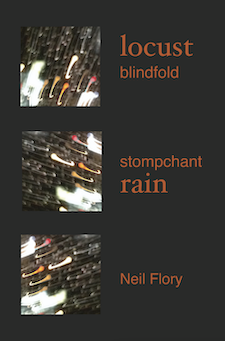
Neil Flory discusses with AOF host Anthony Merchant his two new collections of writings “locust blindfold stompchant rain” (Arteidolia Press) and “73000overcaffeinated g/rackleS” (C22 press).
Listen to the interview here →
Poetry in Misalignment: A review by James Mesiti
Here, understanding the compositions through perception is recommended. It is nearly cinematic and tied to specific moments that are constantly unsettled and incapable of solidifying harmoniously. In one lens, the image of the metaphysical poet appears. In another, the weathered-down court jester.
Read the full review on Compulsive Reader →
A Playful Coexistence of the Eye and the Ear: A review by Daniel Barbiero
Stompchant” is just one of many new coinages that Flory mints over the course of the book. Open to a page at random and you’ll find hybrids like “mistymurky,” “engineflow,” “pistonflopping,” “ironcast blazemolten,” “mophead draincloud squeezeworkings.” (All of these occur in “mesh.”) Flory’s fusions of words, which are made as much on the basis of sound as on meaning, have the playfulness of not-quite-forced marriages between words that ordinarily are adjacent but hadn’t yet thought to take the leap into union.
Read the full review on e-ra/tio →
A review by Justin March
To experience Neil Flory’s collection locust blindfold stompchant rain is to explore the fringes of structure, sound, and wordcraft. Flory’s lines are frenetic yet deliberate, offering a shrewd perception of the world withdrawn from behind a syntactic curtain.
Read the full review on periodicities →
Interview with Neil Flory
To mark the publication of poet Neil Flory’s new collection from the Arteidolia Press, locust blindfold stompchant rain, I thought I’d ask Neil, who’s a composer and pianist as well as a poet, about the new book, the relationship between music and poetry, what it’s like to write poetry in an age of media oversaturation, and more.
Daniel Barbiero: I’d like to start by remarking on your amphibious creative life. You’re equally at home in music and in poetry. Did you take up one before the other, or have you always practiced both more or less at the same time?
Neil Flory: I was fascinated by both music and poetry from an early age. For most of my life I’ve practiced both simultaneously, but I actually started trying to write poetry before I started trying to create music. Of course, with poetry, one can use one’s native language, whereas music is really a language of its own, as you know. So I couldn’t really start to try to do anything with music until I started to learn an instrument (the piano) and to learn some things about chords and scales and such. That was around age 12. I started experimenting with poetry a couple of years before that. It took me a while to get serious about both art forms, but by the time I was in high school I knew that I was deeply committed to the pursuit of both, in the best ways I could manage and to the greatest extent possible.
Read the full interview on Arteidolia →
Christopher Munde, author of Slippage writes:
Through portmanteaus and syntactical dazzle, Flory’s evocations make a dervish of the detritus around us, that it might choir in brutal harmony above, and descend with the percussion of a downpour. This rain, cacophonous and incendiary, carries the human melody that powers the storm, the way light catches in bottle glass and oil, until all is “(transfigured / in surrounding smoke) / (resonant) with / the remembering.”
New from C 22 CollectiveNeil Flory’s 73000overcaffeinated g/rackleS(
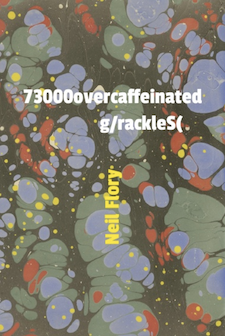
Fleas irrigate the trashpile frontier. Pregnant diving boards. Saturation’s indicted in a drumhead trial yet the Great Wall continuously advancing across the desert. Dandruff. Megaphones of interdimensional archipelagos. 75 joggers. Exhibit 683:…
For more info →
C22 (Collective 22) is an artistic collective focussing on experimental writing. Our work is influenced by Dada, Surrealism, the L=A=N=G=U=A=G=E poets, Futurism and other pockets of the avant garde. We are a small group aiming towards expression rather than commercialism. Each member is free to create art as they wish, to collaborate if they wish, and to publish work elsewhere should they choose. It’s all about creative freedom and sharing our passion for experimentation.
Neil Flory’s work is part of C 22 Collective’s eYeland #4
For a free download or to order a print copy here’s the info →
Neil Flory’s poetry has appeared in a variety of journals such as Ink in Thirds, Ranger Magazine, Clockwise Cat, Poetry Pacific, Sleet, Superpresent, Word For/Word, Fleas on the Dog, dadakuku, and The Gorko Gazette. Beyond his literary work, Flory is a published composer of concert music, a college music professor, and a pianist whose passion for improvisation in live recital settings knows no bounds. He lives and works and writes among the wooded hills and lakeshores of Western New York State with his wife, fiction writer and poet Elaine Flory, and their three hyperactive cats.
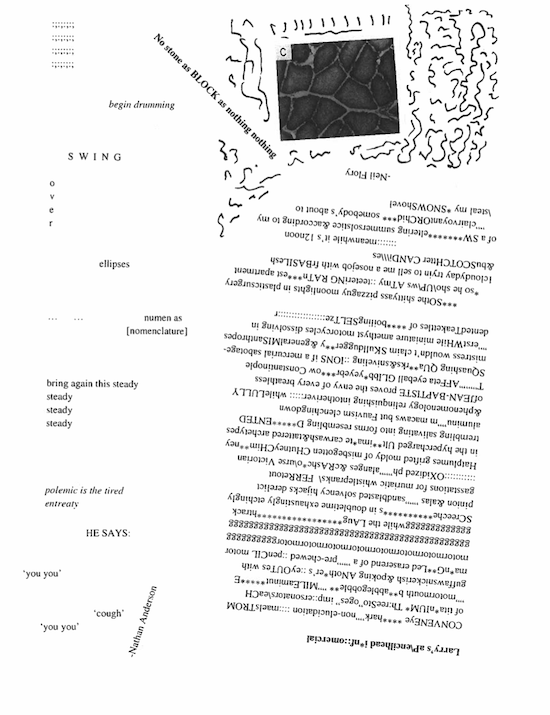
Another collection of poetry by Neil Flory from Arteidolia Press
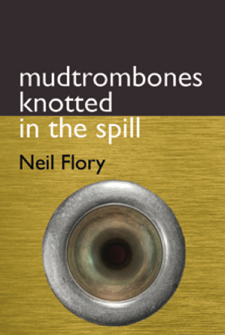
Neil Flory writes to put disorder into order, strenuously using language that mirrors the thought processes of the mind: innovative punctuation; non-linear progression of ideas and images; linking and enjambment of words, lines, and immediate syntactical constituents; controlling and mixed metaphors, obliteration of the lines between poetry and prose and music. These are poems about authentic and unvarnished truth. This bizarrely, beautifully conceived and executed work will reward the patient reader with glimpses of otherwise unavailable knowledge and possibly perceptions of silver whisperings in the night. – Thomas Penn Johnson
To read reviews & more info →