
Daniel Barbiero
July 2026
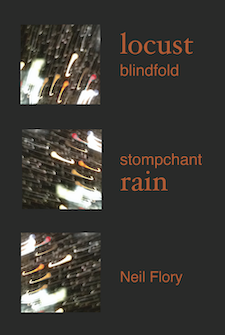
locust blindfold stompchant rain
Neil Flory
Arteidolia Press, 2026
A Conversation with Neil Flory on locust blindfold stompchant rain
To mark the publication of poet Neil Flory’s new collection from the Arteidolia Press, locust blindfold stompchant rain, I thought I’d ask Neil, who’s a composer and pianist as well as a poet, about the new book, the relationship between music and poetry, what it’s like to write poetry in an age of media oversaturation, and more.
Daniel Barbiero: I’d like to start by remarking on your amphibious creative life. You’re equally at home in music and in poetry. Did you take up one before the other, or have you always practiced both more or less at the same time?
Neil Flory: I was fascinated by both music and poetry from an early age. For most of my life I’ve practiced both simultaneously, but I actually started trying to write poetry before I started trying to create music. Of course, with poetry, one can use one’s native language, whereas music is really a language of its own, as you know. So I couldn’t really start to try to do anything with music until I started to learn an instrument (the piano) and to learn some things about chords and scales and such. That was around age 12. I started experimenting with poetry a couple of years before that. It took me a while to get serious about both art forms, but by the time I was in high school I knew that I was deeply committed to the pursuit of both, in the best ways I could manage and to the greatest extent possible.
People are sometimes surprised to learn that I don’t often combine the two. There have been a few times when I’ve set my own poetry to music, or have used my own poetry as the basis for an instrumental work, but for the most part I don’t bring them together in those kinds of obvious ways. Much of the music I write is abstract instrumental music—and I love writing vocal music when opportunities arise, but I tend to set text by other poets most of the time for those pieces. My wife is an excellent, published fiction writer and poet; we’ve collaborated on a number of pieces, including a full-length cantata for large choir, children’s choir, vocal soloists, and concert band. We also love doing live improvisatory works, where she’ll recite her own text while I improvise on the piano or percussion instruments.
While I don’t usually combine my words with my music in the obvious ways, nevertheless they are still inextricably connected for me. My work with each art form definitely informs my work with the other. Music and musical ideas play a major role in my poetry, on many levels and in many ways; I can certainly say that I would not have been able to discover the poetic worlds and voices that I’ve discovered without having worked with music as I have. And my experience with poetry certainly comes into play in my music as well—definitely when setting text by others, but even also in the abstract instrumental works. The kinds of phrasings and cadences that I discover with words also translate themselves into phrasings and cadences with pitches and rhythms.
DB: When you mention that music plays a major role in your poetry, I’m reminded that in the new book there are several poems carrying musical references or subtexts. For example “mesh” moves in and out of a waking dream organized around string music—we read of “col legno mystery” and “spiccato tablescraps” and “sul ponticello of negation”. That last phrase is a particular favorite of mine, since it’s a good description of a technique I’ve been known to use—be warned it’s an expression I might steal! It’s interesting to me how the experience of music jumps modalities here and makes its way into words and images.
NF: I’m glad you like that phrase—indeed, I’m very honored by your desire to steal it! Musical terms and concepts certainly manifest themselves frequently in my poems, and there are also occasional references to specific musicians and musical works. Some of the poems focus primarily on ideas connected to one musician’s work. For instance, “$$$whiskeytoasts” explores a quote from Jim Morrison (“all games contain the idea of death,” from his collection of poems The Lords and the New Creatures) and connections between that quote and the Doors song “Five to One,” containing the famous line “no one here gets out alive.” “listening to Ornette Coleman” focuses on ideas arising from my repeated listenings of his landmark work Free Jazz.
You are also correct that musical subtext is common, in the process transcending the typical textbook definition of music. As you know, the ancient Greeks perceived music as a force that went way beyond sound, interpreting the large-scale workings of the universe to be not just mathematical, but also musical. John Cage found music in every sound occurring in everyday life, ultimately finding the experiences of such music as doorways into mindfulness and higher states of consciousness. In general, the perception of music as something that can access realms of truth and intimations of possible meanings that go beyond everyday life is a continuing thread throughout human history. These ideas certainly resonate with me in major ways. Music is central to how I perceive life and the world. Consonance, dissonance, rhythm, counterpoint, textural density or lack thereof, harmonic rhythm, overtones and other such musical concepts are woven into the very fabric of the universe and the depths of the human condition for me. Thus, to quote your descriptions, it’s quite common for musical ideas in my poems to “jump modalities” and “make their way into words and images”—I love how you’ve described that, you’re right on the mark! The musical ideas combine themselves with things outside of music, getting all tangled up with those things in the process. (To me, the world is also a beautiful and perplexing mess!) Some other poems that explore these kinds of ideas are “Nautilus warts ignore bluenote cadenzas,” “sludge-haka,” “reedstack,” and “ostinati.” The latter explores Cage’s ideas (while also finding connections to Keith Jarrett), specifically his statement “I have nothing to say and I am saying it” and his inquiry as to whether the sound of a truck passing by would constitute music. As you know, Cage tended to think of himself more as an inquirer than as a composer.
Beyond all of that, I just love to play with sound! Like yourself, in my musical work I have an abiding passion for improvisation (for me, it’s primarily on the piano, although I’ve occasionally experimented with percussion as well), and so that also translates itself into how I work with words. Therefore, not unlike the work of the French Symbolists of the past, in many of my poems the sonic characteristics of words and combinations of words are of equal or even greater importance to the meanings and implications of the words. And to me, phrases arrived at through this kind of musical approach to poetry can also manifest new, unanticipated implications of possible shades of meaning or questions. Humor is also important to my work (and to my life), and so I also have a lot of fun playing with sound in this way. Some poems that exhibit these ideas are “glassblowing bedclothes,” “reedstack,” “skrifflevatSIDEKICK,” and “commensurate stopgap.” And yes, I’ve been known to make up words too, as seen in “skrifflevatSIDEKICK” or “fliktenblort.” To me, poetry should also be fun, at least at times! Otherwise, why write it?
DB: Yes, there’s a sense of humor that pervades the poems, and not only in terms of sound. It comes through in the meaning as well. In the poem “wobblybox”—and here’s another musical reference—we read of the
torqueful (ping)snap of
every []overtaxed
harpsichord string
—a very funny description of the sound of an instrument you describe as “anachronism’s wobblybox.” But what I want to ask about here is the poem’s construction. It’s a kind of verbal montage of abrupt shifts of rhythm; eruptions of words and phrases out of other words and phrases; crossings of tone; cross-purposed meanings; and so on. In that regard it’s exemplary of much of locust blindfold stompchant rain. Are these semantic and grammatical displacements a rhetorical tactic for short-circuiting reference in order to get to the music of words? Or maybe something else?
NF: I love your description of that poem! I find life and the world to be, among other things, multi-layered beyond description, and full of interruptions, ambiguity, fragmentations, juxtapositions, contradictions, half-glimpsed and unconfirmed implications, and situations requiring one to spontaneously interpret things without certainty as whether or not that interpretation is correct, or even whether or not concepts such as correct or incorrect still apply. I also find the human mind and human perception to have many of the same qualities, and to be especially multi-layered, complex, and constantly surprising. (Even now, we still know so little about the human mind!) And so you are right on target when you observe that a number of the poems in this book do indeed explore and play with those ideas. In general I find that such concepts manifest themselves frequently in my work; one can certainly find plenty of examples in both of my other books as well.
Are these kinds of displacements a tactic? I wouldn’t say so. To me they are simply part of the natural, native language of that poem (or any given poem that would include them in whatever way). I think of myself almost as an amplifier or a scribe—when I’m writing, I’m not thinking consciously about tactics or technique, but instead trying to shut my brain up and listen intently to the poem itself, without asking too many questions or interrupting the flow of the poem’s language by raising unnecessary concerns or arguments. “Channeling the Muse,” for lack of a better phrase. The poem really takes on a life of its own for me. (Here’s another connection to music—as you know, musical improvisation, especially in group settings, is also largely about listening). Of course, I will experiment and “work on” the poem in the process, but not in a way that would impose an outside agenda on the poem, but instead always trying to stay true to the poem’s agenda, and to translate the poem’s language into something that can be on a page. What is a poem of this sort trying to “do” or “say”, exactly—in other words, what exactly is its “agenda”? I don’t always completely know, but I don’t think I need to know—all I know is that the poem needs to be born, and so I’ll see it through and make sure it is born. When a poem reaches completion, I know it’s come to that point more through instinct or intuition than intellect.
Are these displacements “short-circuiting reference in order to get to the music of words?” Maybe yes, maybe no. Maybe yes and no. I prefer to let the reader decide. Again, in many cases I don’t have a definite conclusion on that myself, but I simply know that those kinds of displacements are integral to the native language of that particular poem. We don’t often get answers to the ambiguous and paradoxical elements of life, so why should poetry try to claim an imaginary moral high ground of being able to provide answers? As you know, Romanticism tended to think of the artist as one endowed with special gifts of insight and knowledge beyond the ordinary human. To me, that fits the nineteenth century just fine, but it doesn’t harmonize with life in the twenty-first century, at least not my life. (Don’t get me wrong, I love Romanticism—poets like Wordsworth and Keats and Shelley were major early inspirations for me—but by and large I just don’t find that Romantic conception of the artist to fit the poems I transcribe now, coming from my life experience in this time and place).
If a small spider takes up residence in the top left corner of the doorway of a public restroom, do we need to know why? Can we even know why? All we know for sure is that the spider is there. Perhaps whatever a poem like “wobblybox” is “saying” or “not saying” can’t be precisely pinned down, or is multi-faceted and contradictory and ultimately more than the sum of its parts. Perhaps its primary concern is not conclusions at all, but new questions instead. Perhaps the whole question of meaning is entirely beside the point. Returning briefly to the mind of John Cage, it’s worth highlighting his idea of listening to what he called “the sounds of the sounds themselves”—to him, this phrase described the act of listening directly to sounds, without the filter of our own thoughts, emotions, preferences, and judgments. (It’s not nearly as easy to do as it might seem!) I think that we can approach poetry in this manner as well, experiencing the images and ideas and disruptions in a poem as simply existing in their own spaces, without the need for questions or judgments, and “without harmony or reason,” to borrow a phrase from the closing of Philip Levine’s poem “Getting There.”
To explore one other possible perspective on this, I’d like to come back to Jim Morrison briefly. Obviously, most people know him as the lead singer of The Doors, but what’s not as well-known is the fact that he was also an accomplished and prolific poet outside of his work with the musical group. Anyway, I think Morrison provided a really interesting possible answer to your question when he said: “Listen, real poetry doesn’t say anything, it just ticks off the possibilities. Opens all doors. You can walk through any one that suits you.” To me, this is a fascinating and compelling way to think about a poem! Before I discuss the quote further, I’d like to mention that I do disagree with the first part of the statement. “Real” poetry (whatever that might be) can take practically any form, and it can communicate if it is so inclined. However, the rest of his statement resonates with me greatly! I believe that one thing poetry can do is to present possibilities of previously unimagined ways of perceiving things, and it can also present previously unimagined things to be perceived—without attempting to provide reasons or conclusions. The reader can choose to engage with any of these possibilities in whatever way they see fit, or not at all if they so choose. (Of course, Morrison’s quote also reminds us of the source of inspiration for The Doors’ band name—Aldous Huxley’s book The Doors of Perception, the title of which is itself a quote from a poem by William Blake).
Whatever a poem like “wobblybox” ultimately is, I’m okay with it—“it is what it is,” as the saying goes. And again, I prefer to let the reader arrive at their own interpretation of whatever it is. And their interpretation is also okay with me.
DB: It’s like the late philosopher Gianni Vattimo used to repeat, paraphrasing Nietzsche (and I’m paraphrasing his paraphrase here), it’s interpretation all the way down, especially given the place language has in our lives. To live within language is to wander in a metaphorical hall of mirrors, with all the paradox, distortion, and uncertainty that entails. Poetry is a good reminder of that.
Something that really stood out for me in locust blindfold is how so many of these poems—I’m thinking of “au]dit.”, “skat/E”, “blisteringNONENcaps(ulation”, “$$$whiskeytoasts”, but there are many others—make creative use of nonalphanumeric characters like brackets, parentheses, asterisks, virgules, and mathematical symbols integrated into the bodies of words and phrases. I wonder, how do those come into the poem? Are they—how are they—part of its native language?
NF: I absolutely agree with the metaphor of wandering in that hall of mirrors. For me, I would also extend that, saying the same about the human condition as I find it now—the condition of living in the space between one’s own constant (and sometimes subterranean) river of thought and the constant barrage of the world of the third decade of the twenty-first century. (And also living within both.) I’d describe today’s world as oversaturated to the point of a continuous flight of euphoria or a continuous panic attack, or perhaps both at the same time. And so for me, that hall of mirrors is not only a place of paradox and contradiction, but also a place of oversaturation, of finding oneself completely overwhelmed. I also find much irrationality and absurdity in that space, as well as exhilaration and extreme exuberance. Many of my poems come from that space, and I think of them as a celebration and contemplation of all of that and more.
The nonalphanumeric characters are certainly part of the native language of any poem in which they appear. They come into the poem from the beginning, as it’s developing, and they develop right along with it. To me they can suggest many things. One function they have, at least in my view, is to invoke and depict, sometimes in the foreground or sometimes more as subtext, all the distortions, contradictions, interruptions, irrationality, euphoria and absurd exuberance of that hall of mirrors. In some of my work, the nonalphanumeric characters can become so pervasive as to almost suffocate and overwhelm language entirely—isn’t this world full of an outrageous deluge of distorted and garbled messages? Doesn’t this condition called life leave us utterly speechless at times, devoid of adequate descriptions?
I think those characters can imply or symbolize many other things as well. In “$$$whiskeytoasts,” the dollar signs may suggest the idea of hitting the jackpot—I agree with E.E. Cummings in his description of Death as “rich beyond wishing.” Also, the pervasive quotation marks in “$$$whiskeytoasts” connect with the fact that much of the poem is either actual quotes, from Jim Morrison’s book The Lords and the New Creatures and The Doors’ song “Five to One,” or imitation quotes, phrases resembling the things that sports commentators often say during broadcasts. The quotation marks may also suggest the resonance and staying power of those kinds of statements in our collective consciousness. In “listening to Ornette Coleman,” the characters may suggest the surface-level cacophony of the music in conjunction with the hasty conclusions of a would-be listener who won’t bother to actually listen. The open parentheses in that poem may also imply implication itself, that which is not necessarily overtly stated, but found under the seemingly cacophonous surface. The pervasive brackets and virgules (and the intermingling of words) in the first and last sections of “multistability” seem to me to suggest the idea of things mixing together. At the end of “halfawor ]ld away,” the use of virgules and extra spaces may invoke the sound of stammering. By the way, if you’ve noticed that I keep saying things like “may suggest,” that’s no accident—again, at the end of the day I prefer to let the reader reach their own interpretation of what function these nonalphanumeric characters may have. I don’t feel it’s my place to tell a reader how to think about my work, any more than it would be the place of Mondrian or Rauschenberg to tell a viewer how to interpret their visual compositions.
Apart from all of this, I should mention that I just really like poems that include visual elements. To me, such poems can find a different kind of expression than those with words alone. (But also, absolutely nothing against poems with words alone—I’ve got plenty of those too!)
DB: You’ve put your finger on something that I’ve noticed as well—the sense of inhabiting a liminal space between contemplation and cacophony. I often feel that that demilitarized zone separating the massed forces of media of all kinds on one side, from the subterranean river—it’s an apt metaphor—of thought on the other, is narrow and narrowing. “Oversaturated” is certainly how it often feels. Besides writing poetry, which as you mention is one way of transmuting the ambient irrationality and absurdity into exhilaration and exuberance (but presumably not into irrational exuberance—we aren’t talking about economics here!), how do you maintain that distance for yourself, and keep open a space in which to write?
NF: Indeed, as Wordsworth put it, this world can be “too much with us,” and when we allow that, we can “lay waste our powers.” (I think this idea is even more relevant today than it was in his time!) Fortunately, I have some habits that prevent that from happening. Like the Romantic poets, I’ve long been drawn to nature, always finding much solace and renewal in the outdoors. I’ve always been drawn to water and trees—here in western New York State where I live, Chautauqua Lake is not far away, and there are miles of trails through dense woods near the lake. I walk there as often as possible. Much of my writing happens, or at least begins, during those hours. In conjunction with those walks and just in general, I engage in the regular practice of mindfulness. The awareness that one strives to cultivate in that practice is one not only of the external world, but of the internal world as well, in any given moment, and most importantly, without judgment. It’s certainly the stance of an impartial listener and observer. To me, this also connects with John Cage’s ideas that I mentioned earlier. And of course, I’m sure you won’t be surprised to hear that mindfulness is another concept that plays a major role in some of my poems.
I initially compose my poems using the notepad app on my phone; only after they’re complete in the phone will I then type them into the computer and do the final formatting. I never sit down and say “I’m going to write a poem now”—instead, poems speak to me through the activities of daily living, and I attempt to write them down as best I can in the midst of things. So, the use of the phone makes it easy to write that way, to type in words or phrases at random moments throughout the day and night, anytime the ideas manifest themselves, and also to make adjustments to those words and phrases at will. I don’t have any news alerts, email alerts, or social media alerts enabled on my phone, so my thought process isn’t hindered by those kinds of distractions and interruptions. I also don’t keep my phone near me while I sleep. In general, I find little to no need to access the internet on my phone; my internet usage occurs mostly on a computer. I don’t spend much time on social media.
Another activity that allows me to keep that space open is reading—poetry, fiction, historical nonfiction, articles, essays—really whatever catches my interest in the moment. Listening to music also serves that purpose. I have a constant, unquenchable thirst to hear music that I’ve never heard before, so I’ll listen to anything and everything; free jazz is a particular favorite, with all its gradations and variants. And, of course, the practice of making music—improvisation, traditional composition, and/or both—also plays a major role in keeping that space open for me. I should clarify that I’m still overwhelmed and perplexed by this world and these aspects of the human condition that we’ve discussed, but the habits outlined here allow me to still be able to think, feel, flourish, inquire, dream and write within that deluge. This may be best summed up by some lines in locust blindfold stompchant rain, in the poem “Sunday”: “there are plenty of cemeteries that I don’t / listen to and perhaps that’s what / keeps me just afloat.”
DB: That last quote is I think good metaphorical advice, and a nice way to wrap things up here. Thanks for the conversation—it’s been a pleasure.
NF: Thank you—I’ve enjoyed our conversation very much!
To buy a copy of Neil Flory’s locust blindfold stompchant rain →
For more info on the poetry books by Neil Flory →
◊ ◊ ◊
Daniel Barbiero is a writer, double bassist, and composer in the Washington DC area. He writes about the art, music, and literature of the classic avant-gardes of the 20th century as well as on contemporary work; his essays and reviews have appeared in Arteidolia, The Amsterdam Review, Heavy Feather Review, periodicities, Word for/Word, Otoliths, Offcourse, Utriculi, London Grip, and elsewhere. He is the author of As Within, So Without, a collection of essays published by Arteidolia Press; his score Boundary Conditions III appears in A Year of Deep Listening (Terra Nova Press).
Link to Daniel Barbiero’s, As Within, so Without →