[spacer height=”0.1px”]Marcelo Bettoni
August 2025
[spacer height=”20px”]
Algorithmic Canon and Performative Agency in Natural Machines by Dan Tepfer:
A Reading of “All The Things You Are / Canon at the Octave”
[spacer height=”20px”]
This essay examines the first episode of the Natural Machines series by pianist and astrophysicist Dan Tepfer, in which the jazz standard “All The Things You Are” is reinterpreted through an octave canon generated algorithmically in real time. Through the analysis of this performance, the piece explores questions of musical agency, computational aesthetics, and co-authorship between human and machine. It is proposed that Tepfer’s work stands as a paradigmatic example of structured improvisation within generative environments, where performativity extends beyond the performer into a cybernetic system of creative feedback.
Improvisation has historically been understood as an act of expressive freedom, situated in the present moment and embodied in the performer’s subjectivity. In jazz, this practice has been linked to ideals of authenticity, risk, and spontaneity. However, within the context of interactive musical technologies and algorithmic intelligence, this conception is challenged by new forms of distributed agency and technical mediation.
Natural Machines, a project initiated by Dan Tepfer in 2018, is situated within this transformation by articulating an improvisational practice mediated by real-time generative algorithms. Trained in both music and physics, Tepfer positions himself at the intersection of jazz tradition, computational thinking, and generative art.
Tepfer uses a Yamaha Disklavier — an acoustic piano capable of reading and writing MIDI data. This instrument acts as a physical interface for the SuperCollider programming environment, an open-source platform specializing in sound synthesis and algorithmic control. The connection between both allows each physical gesture of the performer to be simultaneously translated into digital data, processed by the system, and returned to the piano as a sonic response.
In the episode under analysis, the algorithm implements an octave canon: every note played by Tepfer is replicated one octave higher, with a constant delay of approximately one measure. This procedure recalls Baroque contrapuntal techniques (as found in the canons of Bach or the Canon per Tonos), but here it is reconfigured as a mechanism of cybernetic interaction.
Unlike a pre-recorded or automated reproduction, the system’s response occurs in real time and is conditioned by the live flow of interpretation. The machine does not improvise in the strict sense, but it actively participates in shaping the musical discourse, altering its course and demanding attentive listening from the performer. The choice of the standard “All The Things You Are” (composed by Jerome Kern and Oscar Hammerstein II in 1939) is significant. The piece presents an unusually modulatory harmonic structure for traditional jazz, with transitions through various tonal centers (Ab – C – Eb – G – E), which favors complex melodic explorations and modulations within the improvisation.
Tepfer improvises over this progression, fully aware that each gesture will be replicated by the system. This condition generates a form of anticipatory improvisation, where every decision is shaped by its future transformation. The result is a kind of real-time composition with delayed memory, in which the performer listens, reacts, and engages in dialogue with his own deferred echo. The notion of co-authorship is key: the algorithm is not a mere filter or effect, but a structuring agent. Listening becomes recursive and adaptive. The canon, therefore, does not simply duplicate what is played, but transforms the very way improvisation is conceived and executed.
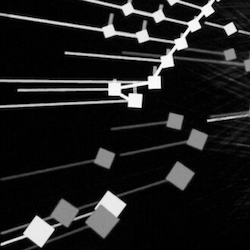
The performance includes visualizations generated in Processing, an open-source graphic environment frequently used in generative art. These visual representations translate musical parameters — such as pitch, duration, dynamics, or the melodic relationship between main voice and canon — into animated geometric forms. The resulting images are not mere embellishments, but visual extensions of structural thinking.
This approach situates the work within a genealogy of synesthetic and audiovisual practices that dates back to kinetic art and the visual music of figures like Oskar Fischinger or John Whitney, but with a contemporary specificity: visuality is generated by code and in real time, following the immanent logic of the algorithm. Aesthetically, Natural Machines articulates a computational sensibility where formal clarity, structural symmetry, and generative logic replace traditional gestural expressiveness. The work does not “simulate” jazz, but rather reinscribes it into a new regime of meaning, where the human and the machinic interpenetrate.
Natural Machines proposes a new way of thinking about improvisation: not as autonomous subjective expression, but as a situated interaction with complex systems. The octave canon, far from being an archaic technique, becomes a speculative device that challenges notions of authorship, time, and listening. In this context, musical agency becomes delocalized: it no longer resides exclusively in the human subject but is distributed among performer, algorithm, and technical environment. Music emerges from the negotiation between intention, response, and programmed contingency.
Dan Tepfer does not seek to replace human creativity with technology, but to expand it. His work invites us to conceive of creativity as an ecology, where machines do not substitute the musician, but amplify, reorganize, and challenge them. In this sense, Natural Machines stands as a contemporary manifesto on the possibilities of algorithmic improvisation as a living, reflective, and open form.
[spacer height=”60px”]
◊ ◊ ◊
[spacer height=”20px”]
Buenos Aires guitarist & musicologist Marcelo Luis Bettoni is the author of a number of books including El sonido de los modos (The Sound of Modes, Tinta de Luz, 2021), Rítmicas de guitarra (Guitar Rhythms, Tinta de Luz, 2021), and most recently an exhaustive history of jazz, Las Rutas del Jazz (The Roots of Jazz, Publiquemos, 2024).
Read Marcelo Luis Bettoni’s essays on Arteidolia
Edgard Varèse and the Jazzmen: The Avant-Garde That Anticipated Free Jazz →
The Jazz Paradox in the Digital Age: Between Immediacy and Authentic Expression →
