[spacer height=”0.1px”]Marcelo Bettoni
September 2025
[spacer height=”30px”]
[spacer height=”20px”]
Schoenberg, Sandole, and Coltrane:
An Invisible Thread Between Musical Modernity and Giant Steps
[spacer height=”20px”]
The musical history of the twentieth century is marked by a continuous rupture with inherited forms and the emergence of new systems of sound organization. In this context, the often implicit dialogue between European academic music and American jazz becomes essential to understanding certain profound stylistic transformations. A paradigmatic example of this convergence can be found in the figure of John Coltrane, whose musical development cannot be dissociated from an aesthetic genealogy that includes both his mentor Dennis Sandole and, on a more abstract level, Arnold Schoenberg.
Dennis Sandole, a guitarist and pedagogue from Philadelphia, was one of Coltrane’s first formal teachers. His approach was characterized by the intensive use of exotic scales, non-traditional modal structures, and principles of intervallic symmetry, with the aim of freeing the musician from the constraints of functional tonal language. This methodology, which included rigorous study of European musical theory, introduced Coltrane to concepts derived from serialism and twelve-tone thinking, though without strict adherence to these systems. Sandole’s influence is evident in Coltrane’s pursuit of an internal logic in the organization of sonic material that transcends the conventional patterns of jazz of his time.
Arnold Schoenberg, meanwhile, represents a central figure in the break from the classical tonal system. His proposal of the twelve-tone technique and the emancipation of the dissonant marked a turning point in Western music. Although there is no direct evidence of explicit contact between Coltrane and Schoenberg’s writings, it is possible to trace a conceptual thread between them: the will to structure sound from new logics, the serial organization of elements, and the tension between freedom and formal imposition. In this sense, Schoenberg’s work becomes an aesthetic antecedent—perhaps unconscious but resonant—in Coltrane’s oeuvre.
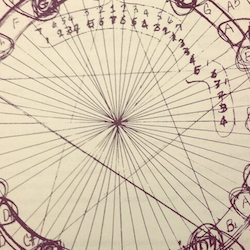
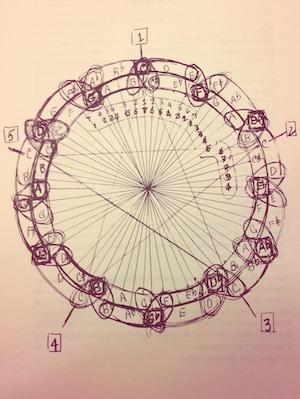
One of the most discussed elements in Coltrane’s music is the famous “Coltrane Matrix” or “Coltrane Circle,” a diagram attributed to the saxophonist himself that organizes the twelve notes of the chromatic system into geometric arrangements, often associated with major third relationships. This graphic, used to explore cyclic harmonic movements and alternative tonal structures, is commonly interpreted as a tool to understand the progressions of pieces like Giant Steps (1959) or Countdown. These arrangements reflect principles of intervallic symmetry and spatial logic, which can be linked both to musical thought and cosmological models (Alexander, 2016).
However, the interpretation and valuation of the “Coltrane Circle” have undergone critical review in recent times. Vibraphonist and researcher Corey Mwamba has pointed out that interpretations tending to sacralize this diagram often exceed the documentary evidence. Mwamba warns that there is no concrete proof that Coltrane conceived this diagram as a complete system or intended to encode a unified worldview through it. From a phenomenological perspective, Mwamba proposes that the power of the diagram lies not in a fixed or closed meaning but in its practical operativity. The central issue shifts from what the diagram “represents” to how it influences listening, improvisation, and the way the musician relates to intervals, modes, and progressions.
This shift of attention from semantic interpretation to sonic and bodily experience opens new possibilities for understanding the use of the diagram. Rather than considering it a text to be deciphered, the “Coltrane Circle” can be conceived as a perceptual stimulus that enables and promotes new ways of organizing musical thought and instrumental practice. In this regard, its value lies in its function as a living and dynamic tool, capable of generating transformative musical experiences beyond a purely rational or symbolic reading.
Beyond its uncertain origin and the multiple interpretive layers it has generated, the diagram attributed to Coltrane condenses essential tensions of twentieth-century musical thought: the dialectic between reason and faith, science and art, system and freedom. Its ambiguity is precisely where its richness and evocative power reside. It can be approached as a pedagogical model, a compositional instrument, or a spiritual symbol without ever exhausting its potential for meaning. Ultimately, this circular graphic, without a definitive name or conclusive explanation, stands as a liminal fragment, an object situated at the intersection between the visible and the audible, between idea and revelation.
A key component to understanding Coltrane’s structural thinking was his systematic study of Nicolas Slonimsky’s Thesaurus of Scales and Melodic Patterns (1947), a work that exerted decisive influence on his musical language. This book compiles over a thousand melodic patterns constructed from intervallic symmetries, non-traditional divisions of the tone, and unconventional scalar structures. Coltrane used this compendium intensively as a tool to expand his melodic and improvisational vocabulary, finding in its pages a way to free his discourse from the shackles of functional tonality without abandoning rigorous sound organization.
Theoretical physicist Stephon Alexander has proposed that Coltrane might have been inspired, at least intuitively, by principles of modern physics, such as general relativity or cosmological models of a curved universe, to conceive the arrangement of his musical materials (Alexander, 2016). Although speculative, this reading reinforces the notion that Coltrane conceived music as a coherent system of relationships where mathematical abstraction, spirituality, and sonic exploration converge.
Thus, the link between Schoenberg, Sandole, and Coltrane is neither merely anecdotal nor chronological but can be read as a phenomenon of aesthetic, pedagogical, and epistemological transfer. The non-functional organization of harmony, the search for internal structures based on symmetries, and the use of extratonic material are traits that traverse their respective productions. Giant Steps, far from being only a technical feat, can be understood as the crystallization of a musical thought that, departing from jazz, dialogues with broader currents of twentieth-century art. And at the center of this process, books like Slonimsky’s, teachers like Sandole, and antecedents like Schoenberg weave a fabric that allows us to think of Coltrane not only as a performer and improviser but also as a sonic architect of musical modernity.
[spacer height=”20px”]
Bibliography
Alexander, S. (2016). The Jazz of Physics: The Secret Link Between Music and the Structure of the Universe. Basic Books.
Mwamba, C. (2023). Critical Reflections on the Coltrane Circle: Phenomenology, Interpretation, and Musical Practice.
Slonimsky, N. (1947). Thesaurus of Scales and Melodic Patterns. Schirmer Books.
Buenos Aires guitarist & musicologist Marcelo Luis Bettoni is the author of a number of books including El sonido de los modos (The Sound of Modes, Tinta de Luz, 2021), Rítmicas de guitarra (Guitar Rhythms, Tinta de Luz, 2021), and most recently an exhaustive history of jazz, Las Rutas del Jazz (The Roots of Jazz, Publiquemos, 2024).
[spacer height=”20px”]
[spacer height=”20px”]Read Marcelo Luis Bettoni’s essays on Arteidolia
Algorithmic Canon and Performative Agency in Natural Machines by Dan Tepfer:
A Reading of “All The Things You Are / Canon at the Octave” →
Edgard Varèse and the Jazzmen: The Avant-Garde That Anticipated Free Jazz →
The Jazz Paradox in the Digital Age: Between Immediacy and Authentic Expression →
