[spacer height=”0.1px”]James Mesiti
March 2026
[spacer height=”20px”]
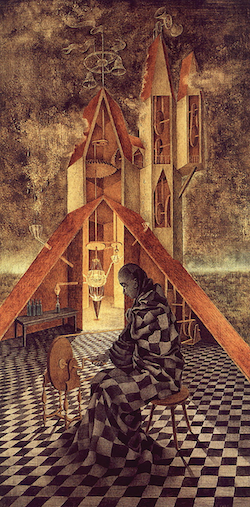 Useless Science or The Alchemist
Remedios Varo, 1955
Museo de Arte Moderno, Mexico City
[spacer height=”20px”]
Philadelphia, a city forced to lubricate its streetlights when its sports teams win; where 10,000 jesters parade down its main avenue on New Year’s Day (does anyone know what a mummer really is?!); home to a four-letter word that defies all grammar and speech. Philadelphia was uniquely deserving of the solo US stop of “Dreamworld: Surrealism at 100.”
Over the course of my two visits during its final days on display, the Philadelphia Museum of Art was still hungover from its fever dream as the Philadelphia Art Museum and slowly recovering back to its pre-rebrand self. “Dreamworld” provided a glimpse into the imaginative and irrational world of Surrealism in honor of its centenary (1924-2024). With pieces coming from across the globe, many of the most iconic figures of modern art were represented, notably Salvador Dalí, Frida Kahlo, Wifredo Lam, and Leonor Fini.
The viewer was guided thematically across the installations, beginning with artworks from Surrealism’s conception to its inspiration in the natural world and sexual desire. The latter portion showcased how Surrealism reacted to war, when many of its members were forced into exile, and finished by highlighting its turn towards the esoteric and occult arts.
It is no easy feat summarizing a movement as complex, inventive, and wide-ranging as Surrealism, and “Dreamworld” did a commendable job. It offered a perspective into what became of Surrealism after the midpoint of the 20th century, following its imprint across the Atlantic and among North American creators. There was a noticeable and welcomed shift in featuring Latin American artists, intended to show how Surrealism spread beyond Europe. However, the distinction between the works of Surrealism’s core members and those they influenced could have been more clearly traced to better show how the movement continuously evolved.
More importantly, the exhibition seemed to tiptoe around Surrealism’s masculinity. In one moment, I overheard a mother reply to her son who had asked why Dalí’s Aphrodisiac Telephone isn’t just called “the lobster phone.” She would have had to explain why the surrealist crustacean sat not far from the magical works of Leonora Carrington and Remedios Varo that concluded the showing. “Dreamworld” at times felt like her brush-off of the curious pre-teen. Reconciling Surrealism’s women was a matter of “we can discuss that later.”
This is not to say that “Dreamworld” did not gesture towards Surrealism’s femininity. There was an honest effort to include many of the women associated with Surrealism, such as Dorothea Tanning, Jacqueline Lamba, and Suzanne van Damme, among others. It also did reference the role of muse that was imposed upon them, as well as the female spirituality that “helped to chart a new course for Surrealism” later in the subsection placard about Carrington and Varo. Yet, these inclusions missed the opportunity to more actively participate in Surrealism’s contemporary debate, rather than just graze it. This is particularly relevant considering the layout of the exhibition, which started with the male dominant viewpoints and ended with Carrington and Varo.
Despite these minor critiques, it was impossible not to be impressed by the diverse pieces that the museum brought together from November 8, 2025, to February 16, 2026. It complemented the already remarkable permanent collection of surrealist artworks of the PMA, many of which were incorporated into the exhibition.
It is true that “Surrealism is about surprise,” as head curator of “Dreamworld” Matthew Affron affirms in the audio tour. There indeed was something surprising as I meandered through the galleries, wondering how the surrealists would have behaved in the world of today. Perhaps they would have known how to respond to the contradictions that have defined the present, such as the rapid advancement of technology despite ongoing social unrest or the increase in access to information amid the heightened rise in disinformation.
In their time, they sought to challenge modernity’s logic and reason in the hope of changing human consciousness. In ours they can offer an example of how to embrace the irrational elements of life so that we can better understand ourselves and those who surround us. Remember that the next time the Birds win the Super Bowl.
For more info about “Dreamworld” →
Philadelphia Art Museum back to its pre-rebrand self →
[spacer height=”40px”]
◊ ◊ ◊
[spacer height=”20px”]
James Mesiti is a PhD candidate at the University of Pennsylvania whose research focuses on Surrealism. Mesiti’s poetry collection petal / transport was published by Arteidolia Press, 2024
