[spacer height=”0.1px”]Daniel Barbiero
March 2026
[spacer height=”20px”]
 Susan Lewis
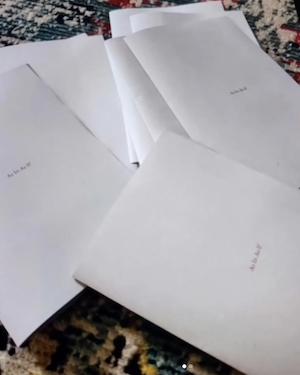
As In As If
Antiphony Press
[spacer height=”20px”]
Mallarmé famously compared language to a worn coin passed from hand to hand in silence. We know why the coin is worn: it’s part of the currency, a token of exchange that’s changed hands any number of times and has had much of its substance rubbed away. In effect, it’s a debased object whose face value exceeds its intrinsic value. But why silence? Because the “coin”—when it takes the form of the cliché, the adage, the rote talking point, the stale metaphor—having already been spoken anonymously, speaks for the speaker, leaving him or her little or nothing original to say. Hence the need for poetry to reclaim the language in any of the many ways that poetry can. In As In As If, a compact chapbook of ten prose poems, Susan Lewis contributes to such a renewal by mining everyday language for its hidden value.
Like many poets concerned with the state of contemporary language, Lewis takes up a critical stance toward words’ capacity to mean. We can infer this from the chapbook’s title. The phrase “as in as if” takes the familiar formula of using of the phonetic alphabet to clarify or disambiguate spelling (e.g., “A as in apple”)–and turns it into an ironic counterfactual. In Lewis’ reformulation, the irony is multiple. Not only is the term to be disambiguated left out, but the disambiguating term is itself replaced by the skeptical “as if”—a suggestion, perhaps, of the impossibility of the perfect disambiguation of meaning in a medium as notoriously ambiguous as language, particularly as it’s used in the readymade forms of everyday communication.
In addition to providing the book’s title, “As in as if,” divided in two, heads two poems: “As In” and “As If.” Here is the beginning of “As If”:
As If
this wizard, this hazard, this alienation of labored breath alibied unto desperation alien & salient as another dearth of valor overborne, outworn & overgrown, ground down for the count.
“As If” isn’t a title so much as a jumping off point for a labyrinthine stream of thought in which language seems to speak itself. Lewis’ sentence defies the conventions of grammar—the verb phrase we’d expect to complete it never appears—just as it defies the conventions of mundane communication. In choosing which words to use with which she doesn’t rely on their semantic or logical kinship but instead puts them together on the basis of their extra-semantic affinities. “Wizard” and “hazard” are joined by assonance and consonance as well as a shared rhythm; the liquid consonants of “alienation” “labored” and “alibied” tie them together, while the alternating stress patterns of “labored” and “alibied” make them sound like mirror images of each other; “alien” and “salient” are paired by rhyme; the similarities of prefixes and assonances of “overborne,” “outworn,” and “overgrown” cast them as variations of each other; and finally, the sentence ends with an invented image synthesizing the two clichés of “ground down” and “down for the count.”
We can see Lewis turning clichés and catchphrases inside out in the poem beginning “Immersed”:
To fudge or not to fudge is the quest, make a proffer we can’t defuse or shop, drop, & roll.
Lewis’ sources here are phrases from cultural landmarks that have entered common discourse and become clichés— “to be or not to be” from the famous soliloquy in Hamlet; “make them an offer they can’t refuse” from The Godfather; and “shake, rattle, and roll” from the old R&B song crossed with “drop and roll” from schoolchildren’s absurd Cold War-era drills. Through a series of word substitutions Lewis reworks these phrases for an ironic, comic effect. “To fudge or not to fudge” translates Hamlet’s vacillations into vernacular terms that both deflate and emphasize this essential part of his nature; “shop, drop, and roll” fuses the prime directive of consumer culture with the grim possibility of atomic warfare, and transposes it into an exuberant musical refrain. And perhaps defuses it in the process. What all this suggests to me is the way—sometimes insightful, sometimes trivializing—that popular discourse blends the vocabularies of what used to be called high, middle, and low culture into a common stock of allusions available for the taking.
Beyond the critical implications running throughout As In As If, there’s the sheer pleasure that Lewis invites us to experience in the way words present themselves to the ear. Here, for example, is a sentence from the poem beginning “Wallowing”:
The sun glistening on our fare-thee-wells like wintergreen & waterboards, fairy dust & feral lust, labile & nubile & loathe to lend a whelping hand.
Beyond the dense play of consonances, whose recurring “l”s literally roll off the tongue, there are delightful symmetries of rhythm and rhyme tying together the pairs “wintergreen & waterboards,” “fairy dust & feral lust,” “labile & nubile.” The language carries us along as sound becomes meaning.
The poems in As In As If are part of a larger collection titled Life Sentences. It’s an apt title for Lewis’ prose poems. So many of them are sentences taken from everyday life and reconfigured to reveal unexpected facets that may have been latent in them all along. All it took was letting words relate to each other according to their secret affinities. And when they do, we discover that no matter how worn, Mallarmé’s coin still retains something of its intrinsic worth.
[spacer height=”40px”]
◊ ◊ ◊
[spacer height=”20px”]
Daniel Barbiero is a writer, double bassist, and composer in the Washington DC area. He writes about the art, music, and literature of the classic avant-gardes of the 20th century as well as on contemporary work; his essays and reviews have appeared in Arteidolia, The Amsterdam Review, Heavy Feather Review, periodicities, Word for/Word, Otoliths, Offcourse, Utriculi, London Grip, and elsewhere. He is the author of As Within, So Without, a collection of essays published by Arteidolia Press; his score Boundary Conditions III appears in A Year of Deep Listening (Terra Nova Press).
Link to Daniel Barbiero’s, As Within, so Without →
