[spacer height=”0.1px”]Daniel Barbiero
October 2025
[spacer height=”20px”]
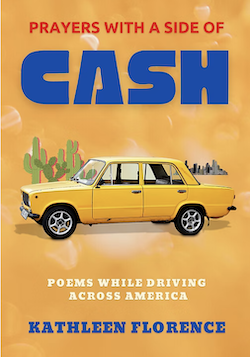
Prayers With a Side of Cash:
Poems While Driving Across America
Kathleen Florence
Moontide Press, 2025
[spacer height=”20px”]
Speaking of Prayers With a Side of Cash, her new collection of poems, Kathleen Florence has said that “old American myths need new voices.” One of the myths revoiced in these poems, which grew out of a cross-country road trip from New York to Los Angeles, is the perennial American myth of mobility – of going on the road.
For Florence, the road is both reality and metaphor. Here, for example, is “There Are Other Routes Than 66”:
[spacer height=”10px”]
Because Jack coulda been Jackie,
if tables had been laid differently,
With stories dished to suit
pinker tongues — this songbook of recipes
rides shotgun. Penned by grandmothers
Who rode stormy ocean waves,
into beginnings unknown, as if they knew
this life is for going places,
should you want to make it home.
I’m steering my ship with sound.
I’ve Been Everywhere is loud
for ancestors riding
with me through veins pumping
red — bound to turn purple, burst
into flowers, push through unseen spaces
along paved roads. Smile
through cracked-tooth ditches,
even as they are called mere weeds.
As my song list flips from Cash
to Breeders to Alabama Shakes,
I remember names. taught
to me by those with hands in the ground.
Names like Cornflower, Balm Bee,
and my favorite: Dame Rocket.
Yeah, Jack, that’s me.
[spacer height=”10px”]
On the surface, this is a road poem that deals with the empirical details of the trip: the view out the car window, the playlist for sounds to accompany the drive, the roadside flora. But it also contains a meditation on the accidents of identity—on who one is—and the sheer contingency of how it is one becomes who one is. Things could always have been different under different circumstances– “if tables had been laid differently.” Change the conditions and the outcome won’t be the same. Beside the outcomes over which we have no control – for example the inheritance of a bloodline resulting from the games of genetic roulette played over centuries by those “ancestors riding/ with me through veins pumping/ red”—there are the accidents over which we do have some control and can change, such as where we live and with whom. Hence the road as analogous to the migratory routes taken by “grandmothers/ Who rode stormy ocean waves, into beginnings unknown.”
The classic myth of the road is really the modern iteration of the older American myth of the frontier – the myth that holds that there’s something else, something new, lying just beyond the boundaries, both physical and psychological, that contain us. Where the road meets the frontier is in the sense of life as open possibility – of existence preceding essence and essence being deferred indefinitely, if you can manage it. America is supposed to be the place where second acts are possible: if you don’t like where you are or who you are, you can always light out for the territory and start over. There’s an unfilled space somewhere, and the road will take you there, whichever road you take. There’s a hint of this in “There Are Other Routes Than 66.” But for Florence, the frontier is more of a personal one, and the road a place of meeting rather than a means of escaping. While others go on the road to find themselves, while on the road Florence finds others. This awareness of the need for connection provides the collection’s center of gravity, and it’s what allows Florence to articulate the myth of the road in her own voice.
In her revisioning of the myth, the road is subtext and context rather than subject. To be sure, we read of the solitude induced by the hypnotic experience of driving America’s seemingly endless interstate highways:
[spacer height=”10px”]
No songs, no talking
no podcast, for now.
Just this stretch of cool gray,
miles of cruise control,
periphery of cornfield,
straw man hanging,
silver tree jazz-handing
[spacer height=”10px”]
But more often, Florence turns her attention to the people she meets along the way – hitchhikers, passengers, random locals she encounters at her stops. There’s Madison, a hitchhiker Florence picks up because “I fall for the wide-legged pants,/ the two finger peace sign”, and the woman with a PhD who now lives on a goat farm, an “anxious hippie looking like Greta Gerwig…Dirt dark as coal in her fingernails.” In the prose poem “Cinema Paradiso” she writes touchingly of a stop at a food truck where
[spacer height=”10px”]
An eighty-year-old man asks me to join him. I bring my take-out over.
Battered fish and deep-fried chips. Extra sides of slaw and pickles.
I settle in and listen to his story for more than an hour.It feels like talking to my dad, again, in a way. On those days when
we were happy to see each other and careful not to say things to upset
the hive of bees.[spacer height=”10px”]
While she doesn’t hesitate to allude to the brittleness and tensions that inevitably are involved, Florence throughout these poems focuses on the basic human need for relationships of all kinds – family, romantic, friendships both longstanding and circumstantial. Prayers With a Side of Cash contains meditations on the former, but is also full of these latter, which she compares to the “friends I made when I was ten/ While on vacation with my parents..We didn’t need to keep in touch,/ we’d never forget each other. At least, that’s how it was/ with me…”
For better and for worse, what Florence sees on her drive is an America that still contains Whitmanian multitudes. Although regional differences aren’t what they were in the days before mass media, New York isn’t Texas, which isn’t Las Vegas or Los Angeles. Traces of the peculiarities of place are still there, if you know where to look. Florence reads them off of “Billboards from Alabama to Louisiana”:
You see promises of salvation, but not Banksy.
You see highway signs from Whiskey Bay
to Bayou Bridge. Mixed in with shouts
for fast food, casino, payday loans—is Jesus.
Pictured with shoulder-length hair, look
of love for everyone who dares
see him…
The America Florence drove across in 2024 was – is – a country divided and at war with itself. As someone originally from Canada, Florence has, and has had, her own reservations about the place. There’s much she doesn’t like about it, but she nevertheless concludes her book with a poem titled “America, I Won’t Give Up on You.” It should have the last word:
I used to love you, and still do love
your movies, your three-chord hits,
denim jean history and Gibson guitars…
I love the car you made to drive, blasting
eighty years of rock’ n’ roll on the ride west…
People rave about your cities and countryside,
you’ve got a honey-sweet B-side,…
There’s always so much more to say to you.
Just know that I won’t give up on you,
America, in this madding world
we call home.
[spacer height=”20px”]
For more information on Prayers With a Side of Cash: Poems While Driving Across America →
[spacer height=”05px”]
Kathleen Florence on Instagram →
[spacer height=”60px”]
◊ ◊ ◊
Daniel Barbiero is a writer, double bassist, and composer in the Washington DC area. He writes about the art, music, and literature of the classic avant-gardes of the 20th century as well as on contemporary work; his essays and reviews have appeared in Arteidolia, The Amsterdam Review, Heavy Feather Review, periodicities, Word for/Word, Otoliths, Offcourse, Utriculi, London Grip, and elsewhere. He is the author of As Within, So Without, a collection of essays published by Arteidolia Press; his score Boundary Conditions III appears in A Year of Deep Listening (Terra Nova Press).
Link to Daniel Barbiero’s, As Within, so Without →
