[spacer height=”0.1px”]Daniel Barbiero
February 2026
[spacer height=”20px”]
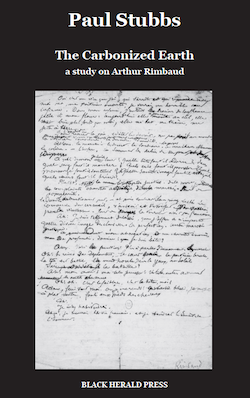
The Carbonized Earth: A Study on Arthur Rimbaud
Paul Stubbs
Black Herald Press
[spacer height=”20px”]
Rimbaud as “Second Self”
[spacer height=”10px”]
Rimbaud possessed me completely: what he had seen, albeit in an entirely different place,
interfered with what I was seeing, and even went so far as to replace it.
–André Breton
[spacer height=”20px”]
Breton’s experience of being possessed by Rimbaud, which occurred when he was posted to Nantes during the First World War, testifies to the powerful influence Rimbaud had on the future Surrealist both through his poetry and through the example he set of how a poet should be. Breton wasn’t unique in coming under Rimbaud’s spell; since even before his untimely death at the age of thirty-seven Rimbaud, through his writing and his life, had become a something of a Protean figure providing an intoxicating model not only for modern poetry, but for the modern poet as well. So many of the ideas and phrases found in his poems and early correspondence— “the alchemy of the word”; “derangement of the senses”; “it must be absolutely modern”; “one must change life”; “I is another”—have come to be taken as programmatic ideals for a truly revelatory poetry and an authentically poetic way of being in the modern world. Yet underneath it all, he remains an enigma that continues to fascinate.
In his book-length essay The Carbonized Earth: A Study on Arthur Rimbaud, poet Paul Stubbs delves into that enigma. The Carbonized Earth isn’t a biography or a close reading of Rimbaud’s work; rather, in the book’s eight chapters and deeply personal Afterword Stubbs give us an investigation of the implications—philosophical, theological, poetic—that he finds in Rimbaud’s work and life, implications that have a bearing not only on how we might read Rimbaud’s poetry, but on the larger question of what it is to be a poet of a particular kind.
For Stubbs, that kind of poet is the visionary, exemplified by the Rimbaud who in May 1871 announced himself as such in his famous letters on seership. It is this Rimbaud in particular with whom Stubbs identifies as a poet and an imaginative thinker himself; Rimbaud, he feels, is “a second self.” Hence in The Carbonized Earth he doesn’t take a detached view of Rimbaud but rather writes through him, from a perspective consciously situated inside of his own practice. It is a deliberately unconventional stance to take, but one that allows him to address, precisely because of his identification with Rimbaud, the complex and sometimes self-contradictory poet that Rimbaud was. Stubbs’ study thus inquires into a series of relationships he finds in Rimbaud’s life and work: relationships between vision and expression; between the impersonality of poetry and the personality of the poet; between failure and self-realization; and especially between the various identities that go into the making of an identity. For Stubbs, Rimbaud’s example, particularly as it culminates in the silence following his renunciation of poetry, demonstrates how these interrelationships as Rimbaud exemplified them can transcend matters of art and poetry as they reveal the provisional nature of what we take ourselves to be. Thus “[t]o write about Rimbaud is to be interested in only one thing: human nature; there is nothing literary about it.”
Significantly, the first of The Carbonized Earth’s chapters is titled “The Illusion of the Self.” There, Stubbs lays out a sketch of what will become one of the essay’s major motifs. He writes that
In [Rimbaud’s] search for his own identity, he became both a sum of his own contradictions and a poet determined to…accept, without question, the visions that were in the process of duping his own perceptions into being a new reality.
Stubbs here is unpacking some of what it was that Rimbaud meant when in his letter of 13 May 1871 to Georges Izambard he denounced “the false significance of the Ego.”As Stubbs notes at various points throughout the essay, one of the supports of that false significance is consciousness, which he describes as “an enigma.” Its evidence of a unitary, transcendent ego is misleading; what it sweeps underneath it are contradictions of character as well as what within us might work to contradict reality. The self is to that extent an illusion or, as Rimbaud famously put it in his letter of 15 May 1871 to Paul Demeny, “Je ist un autre”–“I is another.”
For Rimbaud the visionary, the other that is I is the source of the visions that could dupe his ordinary grasp of reality, and thus could make him in to a kind of medium through whom it could find expression. This would upend the conventional idea of authorship, which assumes the agency of the writer vis-a-vis the text that bears his or her name. But for Stubbs, Rimbaud
never [was] just an author..Rimbaud concealed his mind from himself long enough to produce a lifetime’s work in four years.
By concealing his mind from himself he alienated it from consciousness and in effect, made it into something other than himself—made his “I” into another and renounced authorial agency in its simplest sense. He became a second self to himself. We can imagine this other within him as an unconscious, and originally inarticulate, force underlying conscious existence, something that manifests itself in moments of delirium, trance, and dream. Hence the usefulness, for one who wants to be a seer, of this self-concealment. It becomes the fundamental choice through which “I” becomes other and the first person gives way to the third person, as it does in the grammar of Rimbaud’s formula. The “other” that I “is” is a third person that I am, an other person with whom I identify, internalized within me. It’s a paradox—one of many paradoxes associated with Rimbaud—that the first person and third person, mutually alienated as they are in consciousness, are the same. “I is another” is thus a statement of identity for the visionary, who grasps this other, unconscious substrate as being in some nontrivial way the bedrock of identity.
The visionary in Rimbaud, the other to the empirical “I” through whom the visionary had to speak, was more than just a creative impulse concerned with crafting words into poetry, even a poetry that was most startling for its time. Stubbs reads the “seer letters” and finds that they
are as much concerned with a poetry that will exceed the nature of human speech as…with…celebrating the vocation of a mind in correspondence with itself…the task Rimbaud had set for himself was…to be as certain in his imaginings as Descartes was in his doubt.
Imagino ergo sum: Rimbaud the visionary grounds his being in the nothingness through which imagination transcends the world to the extent that it negates it. Stubbs characterizes this imaginative negation as consisting in Rimbaud’s seeking
to steal the idea of the world back from God and make it his own…the only credible alternative for Rimbaud was to erase the essential cause of the imagination, i.e., reality, and force the imagination to believe again in only itself, not men.
Not even in the man who chooses it. For just as the imagination is the negation of the contingency of the real world, which it replaces with its own counter-world of entities and laws of relationships, the visionary is the negation of the contingent being who becomes its vehicle. Stubbs in fact emphasizes that Rimbaud’s visions are “impersonal visions.” Thus the operative question here isn’t “Who am I?” but rather “What is it that, through my enactment of it, projects itself through this ‘I’ that I take myself to be?” For Stubbs, the answer lies in the vision that transcends the visionary—in the impersonal eruption within the empirical being through whom it comes to expression. Or, in the negation of the cogito by the imagino.
In order to get to that point at which the imagino replaces the cogito, Rimbaud undertook his project of the systematic dereglement, or disorganization, of the senses. Stubbs describes it this way:
Rimbaud, in rearranging the senses, would begin to exist in a new heterogenous space that he himself created…a no-place, in which the orientation of the mind has been abandoned, and where the old creaking structure of past-present-future has been rehoused in the eternal ‘now’ of every image.”
To be a visionary means choosing a mode of being which originates in the dismantling and reorganization of ordinary sensual experience. It is a mode of being whose fundamental stance toward the world is taken up by its choosing negation of the self and the real over acquiescence to the constraints of selfhood and the resistance of the real. Stubbs emphasizes that this negation is most acutely expressed in the willed collapse of the everyday experience of time into a the black hole of a “now” whose gravitational pull forces the movement of time to a standstill. In sum, through the choice he makes of deranging the senses, the visionary creates a virtual space within which to realize himself in the atemporal, self-contained world of the image. It is an impersonal world, one in which imagination “strives continually to depersonalize humanity.”
This is the paradox of “I is another” as seen from close up. It is a paradox that plays itself out in the tension between the visionary and the contingent being through whom the vision must be articulated. Stubbs sees this tension as inhering in the relationship of the source of the poetry–call it the creative impulse, the visionary spark, the divine madness of inspiration, or whatever you will—to the person through whom that source articulates itself. But it is a tension that arises as well from the interrelationships of the various competing forces that make up that person’s identity. The identity of Stubbs’ Rimbaud turns out to consist of a series of masks, a multiplicity of personae at once canceling each other out and fostering each other. But even a mask contains a trace of existential truth, since it represents a projection of the wearer’s attitude toward him- or herself and toward being in general, and thus constitutes one significant, if external, aspect of his or her overall project of being-in-the-world. And it is through the complex, often clashing relationships among these masks that an identity pulls itself together. Rather than a static, once-and-forever finished thing, identity consists in a temporary, isometric tension through whose push-and-pull it reveals itself as a series of contingent choices constrained by the givens of temperament, affect, and the fulfilled and failed projects of a personal history.
It is the tension between the visionary and the person who expresses those visions that Stubbs’ essay consistently brings to the forefront. This leads him to ask: “[I]f the essence of a poet is in fact the ‘author’ in him, can it [i.e., the essence], like a soul, exist after the poet has stopped writing?” With this question Stubbs approaches what many have taken to be the central enigma of Rimbaud’s life: the silence following his abandonment of poetry. Stubbs deftly reframes the matter in terms of whether he in fact needed to continue writing poetry:
The presence of the ‘author’ inside…a great poet like Rimbaud [is] a metaphysical error; we should look only for the author in those rare beings who no longer require concepts, suppositions, symbols, idioms and other particularities of language in order to exist; for ‘authorhood” can only ever be a noetic means, never an etymological end…The end of authorhood…is the beginning of complete and absolute vision, the time when all ‘literary’ satisfaction appears as nothing more than a necessary defeat, a defeat that was perhaps…the only true glory of his life.
Through Stubbs it’s possible to read Rimbaud’s silence as a realization of his choice of being as a visionary rather than as a renunciation. The poet lives to the extent that the author dies. The poems, the words, were mere accidents of time and place in a process that transcended the mundane practice of putting pen to paper. Stubbs thus interprets Rimbaud’s abandonment of literature not as a failure of nerve or inspiration on the poet’s part, or as the collateral effect of his outgrowing the turbulence of adolescence. Stubbs suggests that Rimbaud’s silence was a kind of failure, but one in which the loser turns the tables on himself and wins. The failure lay in his inability to write as if he were the center of the universe, or to write of his struggle in failing to become it. Able to do neither, he simply “los[t] interest in both.” The visionary could realize himself only when the writer was shown up as an inadequacy and “when all ‘literary’ satisfaction appear[ed] as nothing more than a necessary defeat, a defeat that was perhaps…the only true glory of his life.” Seen this way, Rimbaud’s failure didn’t represent a cul-de-sac in which the visionary was caught and checkmated, but rather was the necessary choice through which Rimbaud “asserted man’s right to dispel or confirm the existence of any one identity.”
With the failure of an identity, in other words, comes insight into the possibilities that are available instead and thus to the possibility of making the choice that will realize, if only provisionally, an identity if not the identity that one aspires to. What Stubbs appears to take away from Rimbaud’s success-through-failure—the moral of the story of that one-time anti-moralist–is that failure is the prerequisite for an understanding not only of the multiplicity of selves that we trade in over the course of our lives, but that in fact we irreducibly are this multiplicity of selves. What Stubbs sees in Rimbaud—an assertion of the right to affirm or deny an identity—is really an integral part of what it is to project oneself into one’s world. The hard limits set by certain qualities one is born with aside, identity inevitably involves an element of choice, including the default choice of not choosing and simply “being what one always has been.” Seen this way, failure to achieve what one’s aspired-to identity demands becomes the ground of a certain kind of freedom. “I” can always aspire to be another.
If Rimbaud’s silence was the outcome of a kind of failed bet, it was at bet whose stakes, in Stubbs’ reading, were always existential rather than literary. With The Carbonized Earth, Stubbs plays for these same high stakes. We can see it in his impassioned writing, which elegantly blends commentary, aphorism, and metaphor in a poetically charged prose that carries his argument along with striking imagery. And because he writes from a standpoint of identification with his subject, he succeeds in expressing, through Rimbaud, a bold poetics of his own. In doing so, he allows us to see how Rimbaud could come to possess poets as different as Breton and Stubbs himself.
The Carbonized Earth: A Study on Arthur Rimbaud is accompanied by
A Perfect Little Monster, Stubbs’ three-act play covering Rimbaud’s life.
[spacer height=”40px”]
◊ ◊ ◊
[spacer height=”20px”]
Daniel Barbiero is a writer, double bassist, and composer in the Washington DC area. He writes about the art, music, and literature of the classic avant-gardes of the 20th century as well as on contemporary work; his essays and reviews have appeared in Arteidolia, The Amsterdam Review, Heavy Feather Review, periodicities, Word for/Word, Otoliths, Offcourse, Utriculi, London Grip, and elsewhere. He is the author of As Within, So Without, a collection of essays published by Arteidolia Press; his score Boundary Conditions III appears in A Year of Deep Listening (Terra Nova Press).
Link to Daniel Barbiero’s, As Within, so Without →
Daniel Barbiero’s other essays & reviews on Arteidolia →
